Eleven Facebook ad tools ranked on launching and managing campaigns, rules, AI agents, reporting and making image and video ads, from bulk launchers and enterprise suites to creative generators. Madgicx leads the ranking.
Which Facebook ad tools come out on top?
How do the 11 tools compare side by side?
| Tool | Tool score | Best for | What it does for you | Starting price | Free trial |
|---|---|---|---|---|---|
| Madgicx | 9.8/10 | Launching, managing and making Facebook ads in one platform | Yes.AI chat builds and launches campaigns you approve. | From $45/mo | 7-day free trial |
| Hunch | 9.5/10 | Brands that turn a product feed into catalog and local ads | Yes.Bulk launches from a media plan to Meta and Snapchat. | by quote | No trial; book a demo. |
| Smartly.io | 9.3/10 | Enterprise teams producing campaigns from feeds and blueprints | Yes.Blueprints and product feeds generate many campaigns. | by quote | No trial. Book a demo to get started. |
| Markifact | 9.2/10 | Plain-language tasks and workflows across 14 ad platforms | Yes.Its agent builds campaigns; nothing goes live unapproved. | from $79 a month | Start free with trial credits. |
| Creatify | 9.1/10 | Teams that make avatar and UGC-style video ads at volume | Yes.Launches on Meta, Google, TikTok and more. | from $10 a month | Free plan; 10 credits, watermarked. |
| Fab |
9.1/10 | Performance teams that generate and bulk-launch ads | Yes.Bulk Launcher builds campaigns, ad sets and ads. | from $39 a month | 7-day trial on most plans, not FAB AI. |
| Ad |
8.9/10 | Launching large ad batches across 15 channels | Yes.Builds campaigns, or copies existing ones on Meta. | from £199.99 a month | No free trial. Money-back guarantee. |
| Bïrch | 8.4/10 | Media buyers who write rules and bulk-launch from Drive | Yes.Bulk ad builder: several ad sets, up to 50 ads each. | from $49 a month | 14-day free trial. |
| Ad |
7.8/10 | Agencies and small teams that build campaigns manually | Yes.Campaign builder plus Grid Composer for many variations. | from $49 a month | 14-day free trial, no free plan. |
| Pencil | 7.7/10 | Brands that want AI-made ads scored before they run | Partly.Exports finished ads to ad accounts; no campaign builder. | from $14 a month | No trial. Six free ads at sign-up. |
| Ad |
7.3/10 | Generating image, video and text ads, with scores before launch | Partly.Pushes creatives to ad accounts; no campaign builder. | from $39 a month | 7-day free trial with 20 credits. |
Our 11 picks for the best Facebook ad tools
Madgicx Best overall
9.8/10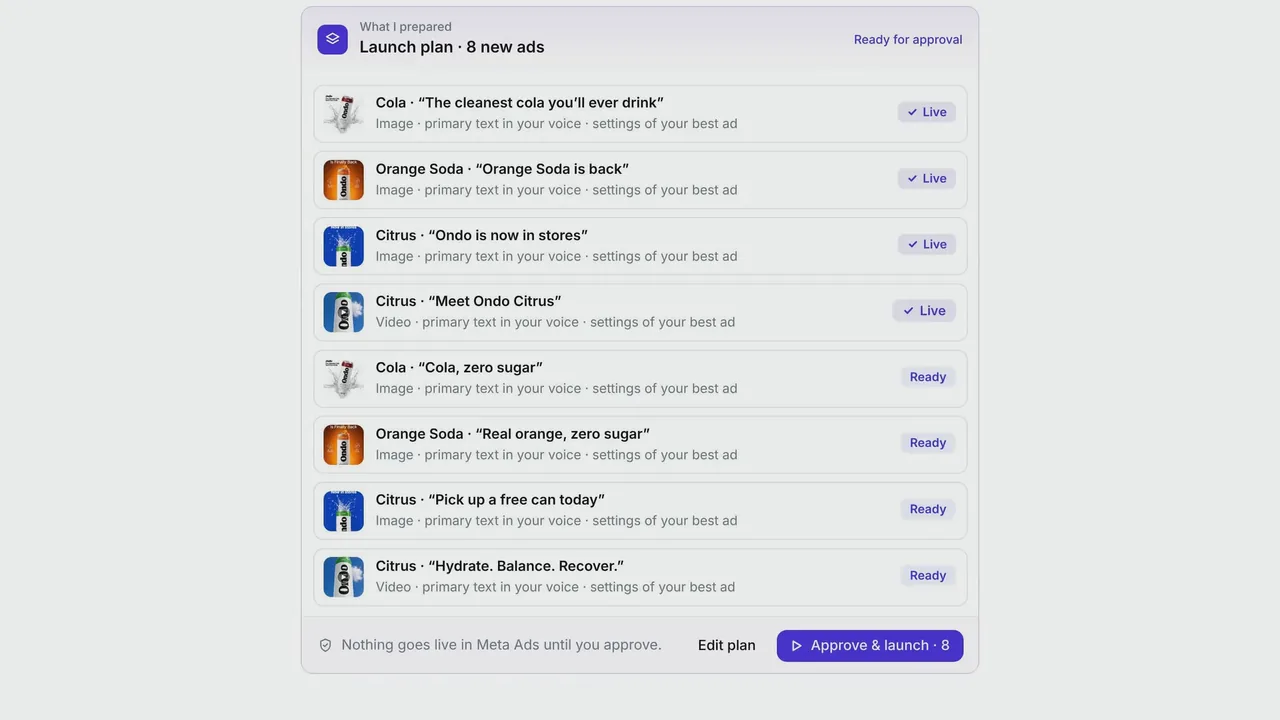
Madgicx runs as a loop of asking, preparing and approving. Its AI chat builds campaigns, ad sets and ads from a typed request, from video ads made of MP4 or MOV files you upload to Click-to-WhatsApp ads and ad sets aimed at a place you name, and it creates nothing until you approve. For new image ads you give it a prompt, a product photo or any ad from the Meta Ad Library, and it generates versions to review. Meanwhile its AI media buyer audits your Facebook and Instagram accounts and lists prepared actions that run only when you launch them.
Ecommerce brands, agencies and media buyers who put most of their budget into Facebook and Instagram are its core buyers, and they get ad making, launching and checking under one subscription. Plans start at $45 a month and rise with the ad spend you manage, with monthly, quarterly or annual billing. The MCP server that lets Claude, ChatGPT and other AI agents work in your ad account is included in every plan, and server-side tracking built on Meta's two gateways, the Conversions API Gateway and Signals Gateway, can be bought alone or as part of a plan.
- Best for
- Launching, managing and making Facebook ads in one platform
- Starting price
- From $45/mo
- Free trial
- 7-day free trial
How it scores
- Yes.Building and launching campaignsMadgicx's AI chat builds campaigns, ad sets and ads from a chat, and every change runs after you approve it.
- Yes.Image adsMadgicx creates image ads from a prompt, a reference image or any ad in the Meta Ad Library.
- Yes.Video adsMadgicx builds Facebook and Instagram video ads from your own videos, ready to publish after your approval.
- Yes.Rules and automationAutomation rules run Meta campaigns 24/7 on the conditions you set.
- Yes.Reporting and analysisMadgicx brings Meta, Google Ads, TikTok, Shopify, Klaviyo and Google Analytics data into one place.
- Yes.AI actions and agentsMadgicx's AI media buyer prepares actions you approve or dismiss, and agents run on a schedule.
- Partly.Ad platforms coveredMadgicx optimizes Meta ads. Reporting covers Meta, Google Ads, TikTok, Shopify, Klaviyo and Google Analytics.
Pros
- Answers why a metric moved, using your own account's data
- Shows what makes winning ads win, and flags fatigue early
- Alerts you when the account drifts from your targets
- One uploaded video can serve many ads without a second upload
Cons
- Makes Meta ads, not organic social posts
Prices checked 23 November 2026
Hunch
9.5/10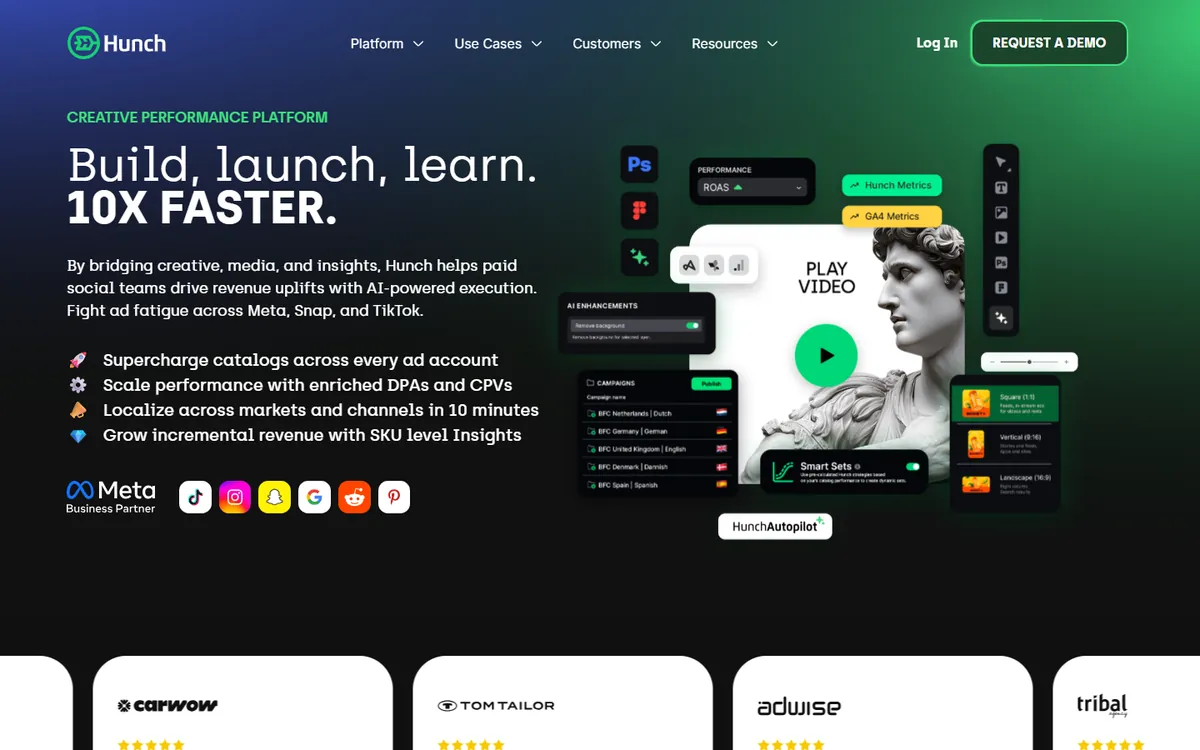
Hunch is driven by a product feed or a media plan. You draw templates with dynamic layers, or import Figma and PSD files, and Hunch generates an image or video ad per product, publishes it to Meta and Snapchat and keeps it matched to the feed. Autopilot follows a campaign plan you write to create, edit or pause ads, while rules you activate can pause or start campaigns and ad sets and shift budgets on a schedule or when performance conditions hit, with checks as frequent as every 30 minutes.
Its buyers are ecommerce, travel and retail brands that run big product catalogs or many local markets. A team spending $50K or more a month on Meta is steered to the full platform, which is quoted after a demo. The self-serve CPV Accelerator for catalog video is priced by catalog size: the CPV Plan costs $350 a month for up to 500 products and rises by bracket to $2,000 for 25,001 to 50,000 products, and every bracket allows $50,000 of monthly catalog ad spend on Meta.
- Best for
- Brands that turn a product feed into catalog and local ads
- Starting price
- by quote
- Free trial
- We saw no free trial. The full platform starts with a demo; its self-serve CPV Accelerator is free to set up and bills when you publish.
How it scores
- Yes.Building and launching campaignsLaunches campaigns in bulk to Meta and Snapchat from one sheet or media plan, filling in targeting, budgets and copy, and inserts its ads into Advantage+ shopping campaigns you already run.
- Yes.Image adsTurns one template, or your Figma and PSD files, into on-brand image ads for every product in your feed.
- Yes.Video adsMakes videos from images with set or custom animations, and animated catalog videos from your feed.
- Yes.Rules and automationRules on Meta pause or activate campaigns and ad sets and adjust budgets when performance conditions or a schedule are met, checked as often as every 30 minutes. A rule can also just send an alert.
- Yes.Reporting and analysisCampaign insights pull real-time data from Meta, Snap and Google Analytics into one view with custom, shareable views, and Product Insights shows ROAS, revenue and conversion rate per product.
- Partly.AI actions and agentsAutopilot creates, edits or pauses ads from a campaign instruction plan you set up, and AI builds Smart Product Sets from GA4 and conversion data. We saw no AI agent or chat on its pages.
- Partly.Ad platforms coveredIt launches and manages campaigns on Meta and Snapchat, and sends enriched product feeds to other channels such as Pinterest and Reddit. Its rules run on Meta.
Pros
- Rules also apply to campaigns Hunch didn't create
- Ads can change by location, language, weather or time of day
- Product Insights shows ROAS and revenue for each product
Cons
- Campaigns come from a media plan; building them from a chat isn't described
- Its help center shows no creative analysis of your live ads
Hunch alternatives, compared · Prices checked 23 November 2026
Smartly.io
9.3/10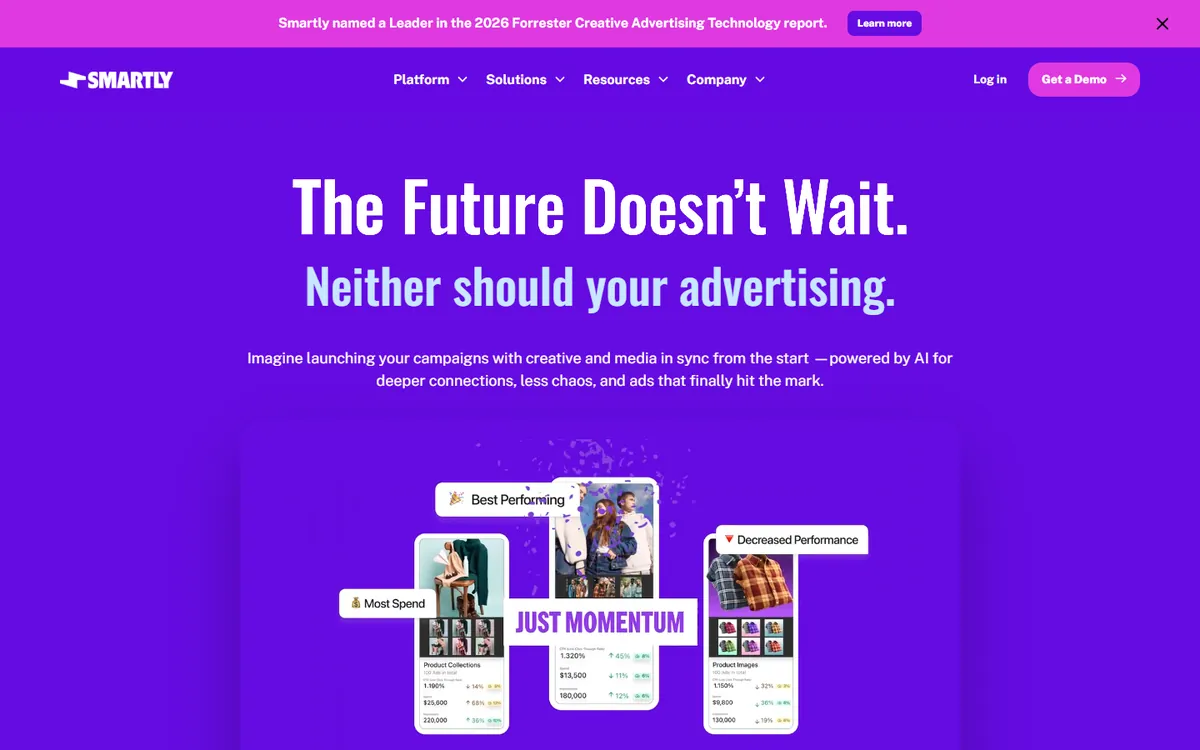
Smartly.io works from reusable set-ups. Blueprints linked to a product feed generate many campaigns, dynamic templates adapt a single creative to each format and channel, and a shared workspace lets a team approve ads before they launch together. Its creative tools cover image generation and editing in AI Studio, image-to-video animation and AI voiceovers, while Creative Insights splits each ad into content, calls to action and visuals and links every part to performance KPIs.
It sells to enterprise brands and agencies with large creative teams, through a contract agreed after a demo. Its site lists no plans or prices, so it can't sit on the same price scale as the self-serve tools here, and G2 puts its average implementation time at two months.
- Best for
- Enterprise teams producing campaigns from feeds and blueprints
- Starting price
- by quote
- Free trial
- We saw no free plan or trial on its pages. Its site asks you to book a demo.
How it scores
- Yes.Building and launching campaignsCampaign blueprints linked to a product feed generate many campaigns, and a shared space lets teams approve and launch ads.
- Yes.Image adsAI Studio generates and edits images, and dynamic templates scale image ads across channels.
- Yes.Video adsAI video assembly, image-to-video animation and video templates with AI voiceovers.
- Yes.Rules and automationTriggers switch ads on or off by performance, weather or time of day, and budget moves between selected campaigns by predicted performance.
- Yes.Reporting and analysisA reporting dashboard, creative insights, a forecast of creative performance before launch, and reach and frequency measurement.
- No.AI actions and agentsBudget moves between campaigns by predicted performance, run from the blueprints and triggers you set.
- Yes.Ad platforms coveredIts product pages name Meta, TikTok, Snapchat, Pinterest and YouTube. It describes itself as cross-channel; check with its team for the full list.
Pros
- Triggers can pause or restart ads based on performance, weather or the time of day
- Automated Ads creates and archives ads at scale from a synced sheet or feed
- G2 reviewers often praise its dedicated team and support
Cons
- Budget moves follow blueprints and triggers; an AI agent isn't described
- Building a campaign from a typed request isn't described; blueprints do it
Madgicx vs Smartly.io · Prices checked 23 November 2026
Markifact
9.2/10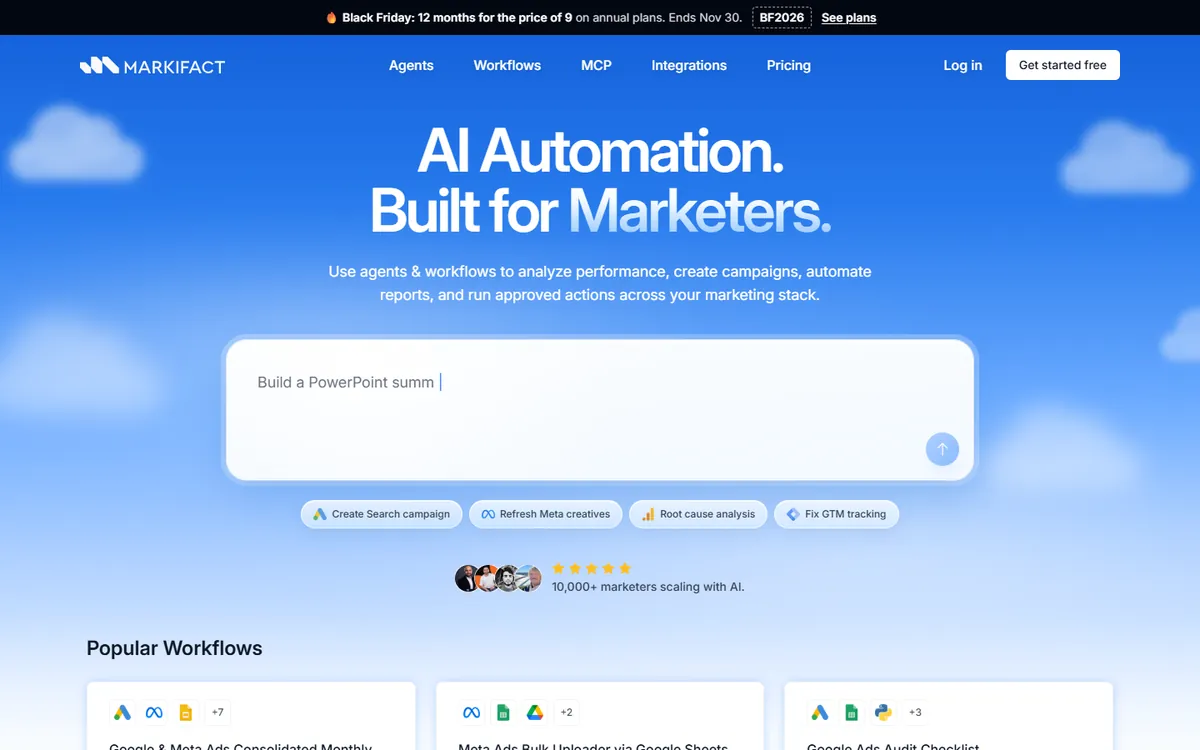
Markifact is an agent platform for marketing work. You describe a task in plain language, such as building a campaign or running a Meta creative analysis, or you assemble a multi-step workflow on a visual canvas, and it runs whenever you ask, on a timetable or when a trigger fires. Its pages say nothing goes live without your approval, given in chat or Slack, and an MCP server brings the same tools into Claude, ChatGPT, Gemini and Cursor, where changes wait for approval too.
It reaches well beyond Meta, with 1000+ operations across 14 ad platforms and tools such as Google Ads, TikTok, LinkedIn, Shopify, HubSpot and GA4. It suits solo marketers, freelancers, agencies and marketing teams who want a single home for automating ad and data work. Pro is $79 a month for one seat, Team is $249 and serves 10 to 50 seats, with priority support plus API access, and a custom Managed plan has Markifact build and tune the workflows for you.
- Best for
- Plain-language tasks and workflows across 14 ad platforms
- Starting price
- from $79 a month
- Free trial
- Its pricing page says to start free with trial credits. We saw no free plan in its plan table.
How it scores
- Yes.Building and launching campaignsIts agent can create campaigns, upload ads and handle setup across channels. Its pages say nothing goes live without approval, handled in chat or Slack.
- Yes.Image adsAn AI template makes up to 10 ad image variations from a prompt and reference image, ready to upload to Meta.
- Partly.Video adsA workflow step makes videos with OpenAI's Sora 2 from a prompt; we saw no ready video ad template.
- Partly.Rules and automationWorkflows run manually, on a schedule or from a trigger, with templates for reporting, audits and bulk ad creation. We saw no rule builder for ad performance described.
- Yes.Reporting and analysisWorkflows build consolidated Google and Meta performance reports in Google Slides, with Slack briefs and email alerts. We saw no standalone dashboard described.
- Yes.AI actions and agentsYou describe a marketing task in plain language and an agent carries it out, such as building campaigns or adding negative keywords. An MCP server brings its tools into Claude, ChatGPT, Gemini and Cursor.
- Yes.Ad platforms coveredIt lists 1000+ operations across Google Ads, Meta Ads, TikTok, LinkedIn, Shopify, HubSpot, GA4, Sheets and Slack, with 14 ad platforms in total.
Pros
- Pro covers unlimited ad accounts, agents, workflows and the MCP server
- An image template makes up to 10 ad variations from a prompt and a reference
- Pacing workflows email you when spend passes a limit you set
Cons
- Workflows run on schedules and triggers; a rule builder for ad performance isn't shown
- Video comes from a workflow step; a ready video ad template isn't shown
Markifact alternatives, compared · Prices checked 23 November 2026
Creatify
9.1/10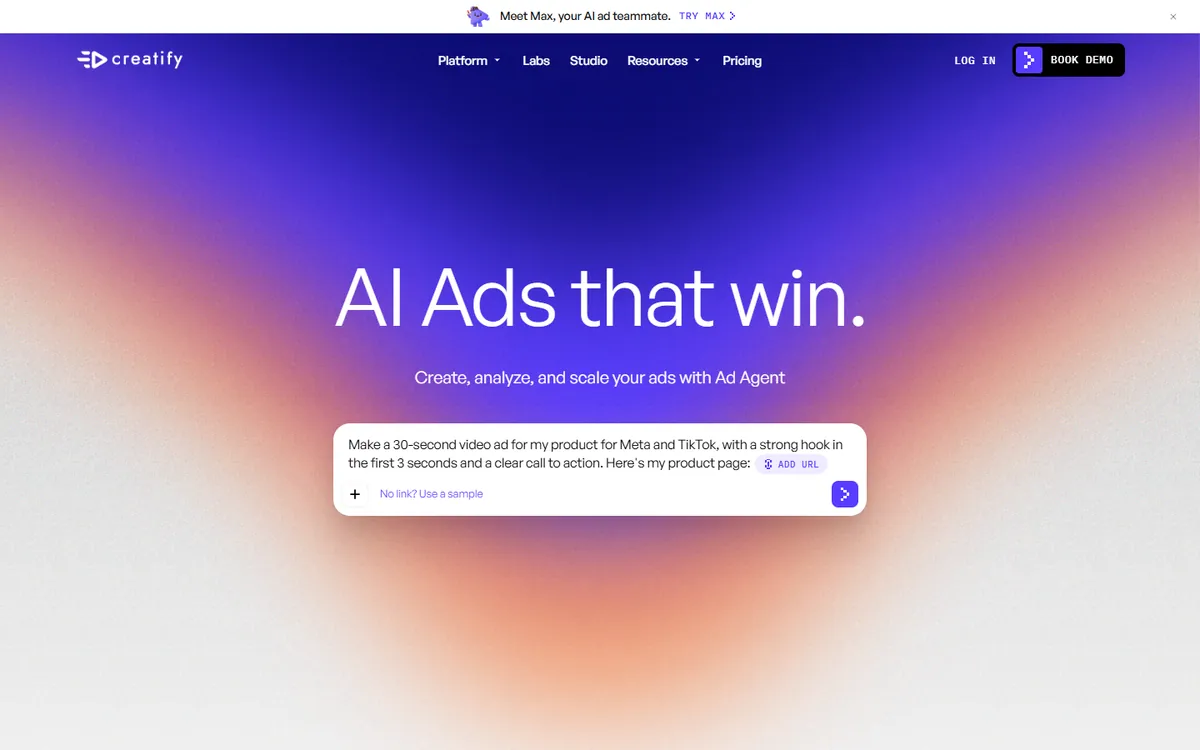
Give Creatify a product URL, some photos or a written script and it returns video and image ads. Its Ad Agent chat drafts the concept and script before anything is generated, and its video side offers avatar and UGC-style ads, with the number of AI actors, from 300 to 1,500, set by your plan. A second agent, Max, reads connected ad accounts, ranks creatives by CTR, ROAS and CPA, and builds, launches, pauses and adjusts campaigns on Meta, Google, TikTok and other channels, with each change held for your approval.
It is for teams that make video and UGC-style ads at volume, from one person on its free plan to larger teams on Business. Plans scale with credits, seats and brand spaces, not with what you spend on ads: Standard is $10 a month for 55 credits and one seat, Pro is $38 for 280 credits with the Ad Agent, Ultra is $66 for 730 credits and three seats, and Business is $136 for 1,500 credits and ten seats. Credits on paid plans expire after two months.
- Best for
- Teams that make avatar and UGC-style video ads at volume
- Starting price
- from $10 a month
- Free trial
- A free plan with 10 credits a month and watermarked exports. We saw no free trial of the paid plans.
How it scores
- Yes.Building and launching campaignsLaunches campaigns, ad sets and ads on Meta, Google, TikTok and more, after you approve each change.
- Yes.Image adsProduct images turned into static ads.
- Yes.Video adsProduct link to video, plus avatar and UGC-style video with 300 to 1,500 AI actors by plan.
- No.Rules and automationCreatify is a creative tool; we saw no automation rules on its pages.
- Yes.Reporting and analysisIts agent reads results across ad accounts, runs daily checks and sends cross-channel reports, also to Slack.
- Yes.AI actions and agentsMax builds, launches, pauses and adjusts campaigns after you approve each change.
- Yes.Ad platforms coveredMeta, Google, TikTok, Snapchat, Reddit, LinkedIn and OpenAI Ads; AppLovin for analysis only.
Pros
- A competitor ad tracker and an ad clone arrive with the Pro plan
- Daily account checks and cross-channel reports can go to Slack
- Scheduled routines flag spend swings and fatiguing ads by email, Slack or chat
Cons
- Automation rules aren't on its pages; routines report spend and fatigue changes
- Its MCP makes video ads, but ad account access through it isn't shown
Creatify alternatives, compared · Prices checked 23 November 2026
FabFunnel
9.1/10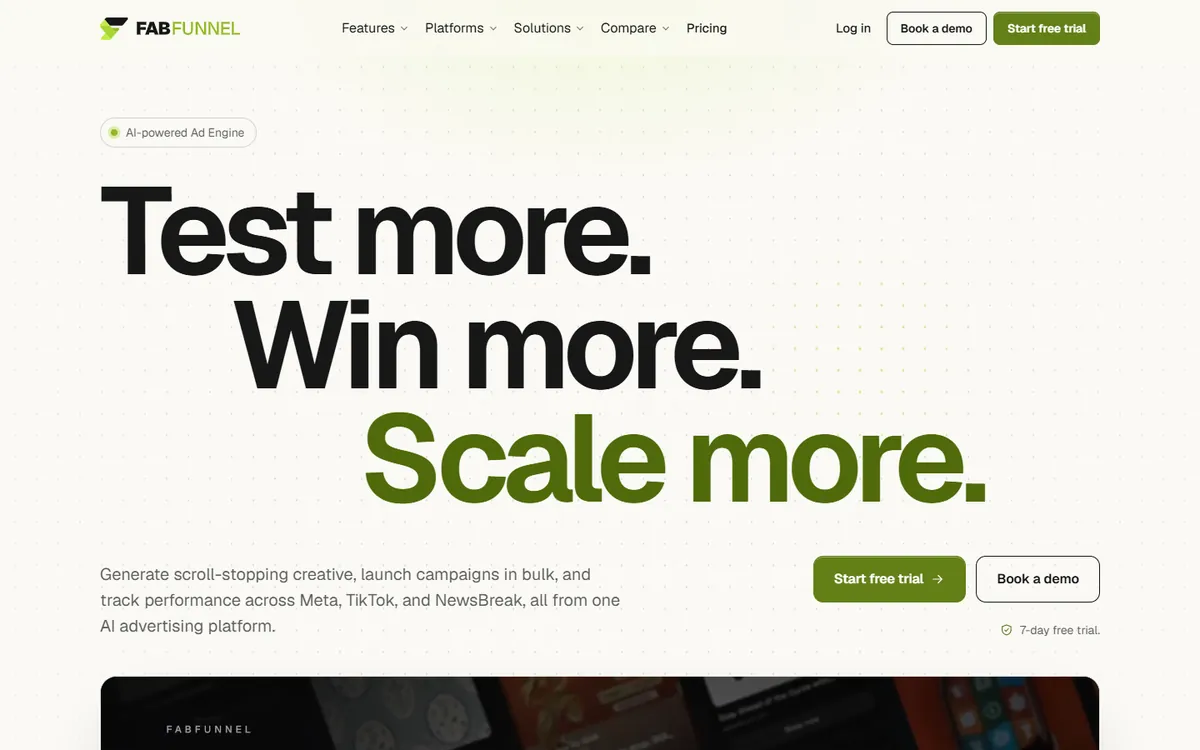
FabFunnel puts ad making, bulk launching and reporting behind one login. Genie, its AI, produces static, carousel and story image ads in five sizes, and video ads in UGC, Reel or Demo styles running 8 to 60 seconds, or turns your own script into video. Bulk Launcher crosses creatives, audiences and copy into every combination, so three of each make 27 ads on Meta, TikTok and NewsBreak, and rules tied to ROAS, CPA, CTR and spend move budgets and pause or restart campaigns and ad sets, with checks as often as every 10 minutes.
Its home page speaks to ecommerce brands and agencies as well as affiliate marketers and media buyers, and it plugs into trackers such as Voluum, RedTrack, ClickFlare and Everflow. Plans split by job: FAB AI, at $39 a month, is for research and creative only, Explore at $199 adds one launch ad account and five rules, Growth at $349 five accounts and ten rules, and Scale at $599 fifteen launch accounts. Yearly billing lowers each plan, with Growth falling from $349 to $291 a month.
- Best for
- Performance teams that generate and bulk-launch ads
- Starting price
- from $39 a month
- Free trial
- Explore, Growth and Scale include a 7-day trial with 30 credits, charged from day 8. The $39 FAB AI plan has no trial.
How it scores
- Yes.Building and launching campaignsBulk Launcher builds campaigns, ad sets and ads on Meta, TikTok and NewsBreak, on Explore and above.
- Yes.Image adsGenie makes static, carousel and story image ads from one brief, in five sizes, on every plan.
- Yes.Video adsGenie makes UGC, Reel and Demo video ads of 8 to 60 seconds, or turns your script into video.
- Yes.Rules and automationIts rules change budgets and turn campaigns or ad sets on or off based on ROAS, CPA, CTR and spend, checked as often as every 10 minutes.
- Yes.Reporting and analysisIts pages describe reporting that shows every connected ad account side by side. Growth adds multi-ad-account reporting.
- No.AI actions and agentsIts Genie generates creatives; we saw no AI media buyer on its pages.
- Partly.Ad platforms coveredIt launches on Meta, TikTok and NewsBreak. Google, Snapchat, OpenAI Ads and BIGO appear in reporting only.
Pros
- A rule that fires posts to Slack, and to Telegram on Explore and up
- Video Sage breaks video ads into hooks and scenes
- Industry Insights shows competitor ads on Meta, NewsBreak and SmartNews
Cons
- Genie generates creative, but an AI that decides budgets and bids isn't shown
- Its MCP reads reports and makes creatives; building campaigns through it isn't shown
FabFunnel alternatives, compared · Prices checked 23 November 2026
AdManage
8.9/10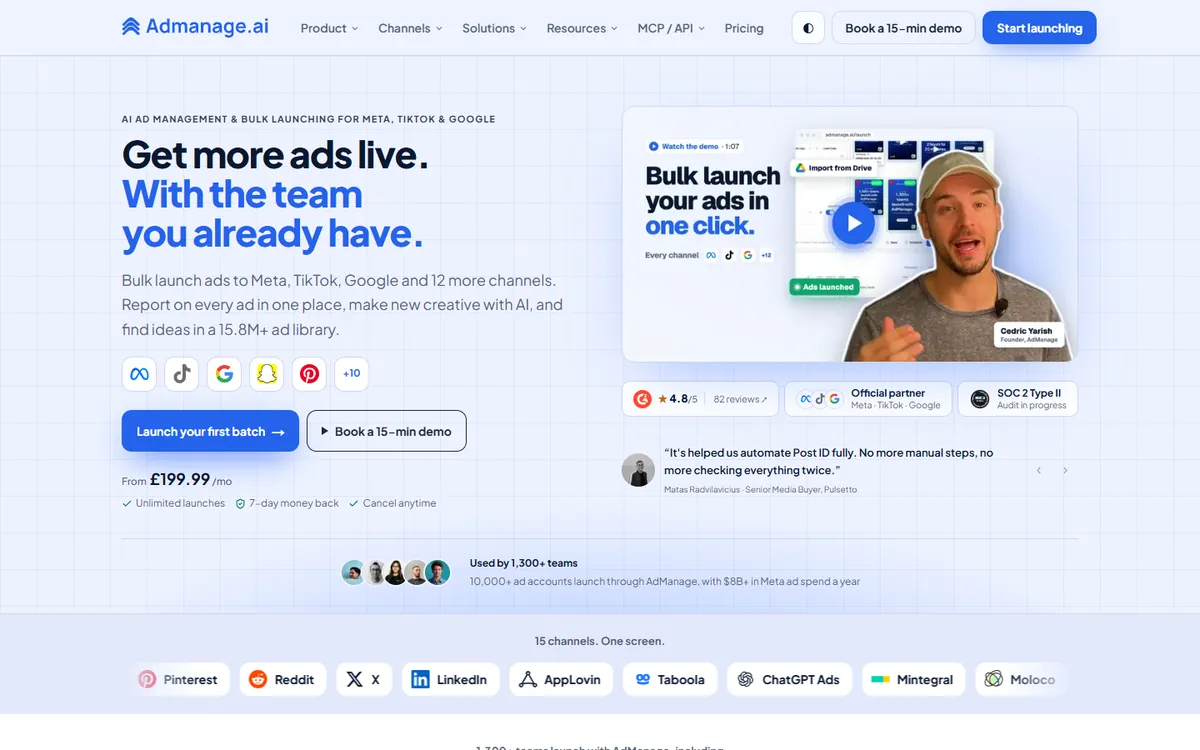
AdManage is a launcher built around your existing creative folders. It pulls creatives from Drive, Sheets, Dropbox, Frame.io or Canva, applies the naming, copy and UTMs you define once, and ships batches to Meta, TikTok, Google and 12 more channels. Once ads are live you can also edit status, budgets, copy or URLs across hundreds of them in one go, while clients can review a preview link ahead of launch and get a shareable report afterwards. Its MCP connection gives Claude, ChatGPT or Cursor the means to report on ads, draft them, launch them and edit them, read-only until you switch writes on.
It is aimed at media buyers, in-house teams and agencies that ship large volumes of ads across several channels. Prices are in pounds and grow with ad accounts: Essential is £199.99 a month for one account (extra accounts £99.99 each) and one automation rule, In-house is £499.99 for five accounts and ten rules, and Agency is £999.99 for ten accounts with unlimited rules. Monthly credits also buy AI images, up to 250 on Essential, and AI video ads from product images or a prompt.
- Best for
- Launching large ad batches across 15 channels
- Starting price
- from £199.99 a month
- Free trial
- We saw no free plan or free trial on its pricing page. It offers a 7-day money-back guarantee on Essential and 30 days on the larger plans.
How it scores
- Yes.Building and launching campaignsBuilds campaigns on Google, TikTok and more; on Meta it launches into existing or copied ad sets.
- Yes.Image adsGenerates AI images from monthly credits, up to 250 on Essential and 1,250 on Agency.
- Yes.Video adsTurns product images or a text prompt into video ads with AI video models, using credits.
- Partly.Rules and automationRules can pause weak ads, scale strong ones and hide comments. Essential includes 1 monitoring or comments rule; performance automations start on In-house with 10 rules; Agency has unlimited.
- Yes.Reporting and analysisIts home page describes creative performance compared across Meta, TikTok and Google, plus hit-rate and fatigue reports and shareable client reports.
- No.AI actions and agentsIt is a bulk launch tool; we saw no AI media buyer on its pages.
- Yes.Ad platforms coveredIts pricing page lists 15 platforms, including Meta, TikTok, Google, Snapchat, Pinterest, Reddit, X and LinkedIn.
Pros
- Slack alerts when an ad crosses a CPA, ROAS or CTR threshold
- Reports on hit rate and creative fatigue line up Meta, TikTok and Google ads
- A money-back guarantee runs 7 days on Essential and 30 on larger plans
Cons
- On Meta it fills existing or copied ad sets; building new campaigns there isn't shown
- Performance rules start on In-house; Essential has one monitoring or comments rule
AdManage alternatives, compared · Prices checked 23 November 2026
Bïrch
8.4/10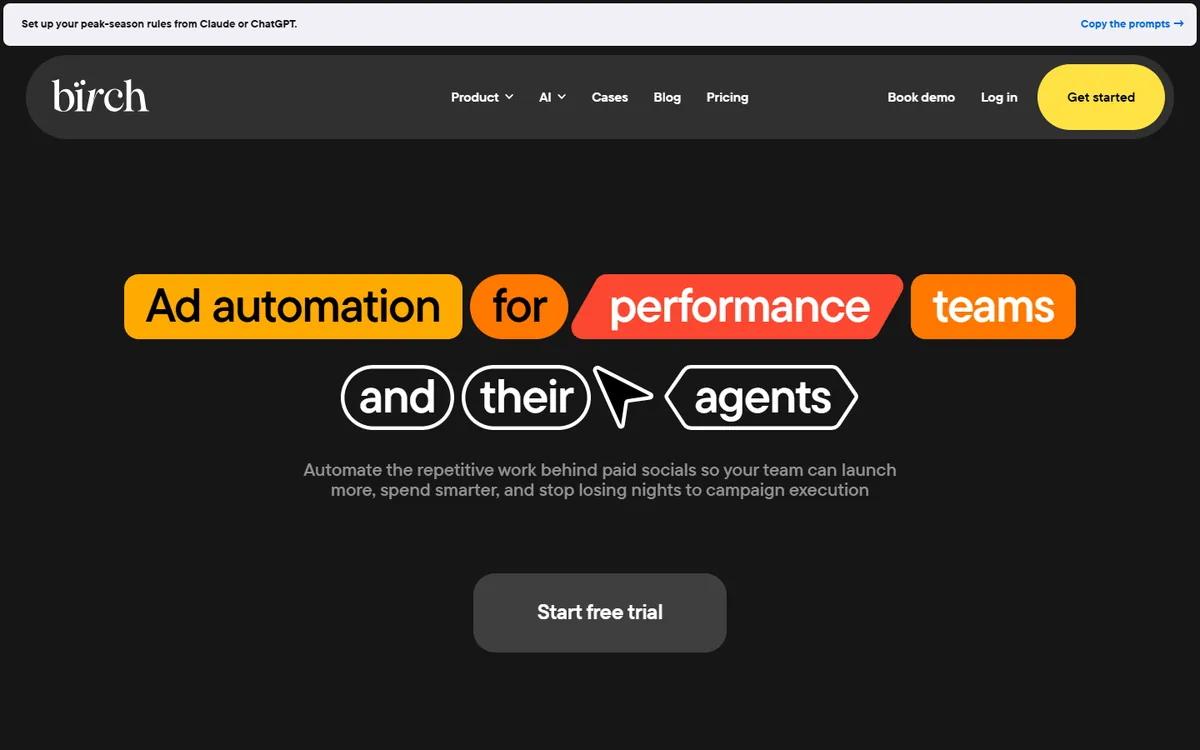
Bïrch (formerly Revealbot) is built around rules. You write conditions, nested if you like, that pause or start campaigns, change budgets and bids or send alerts, and once published they fire by themselves, and the quickest check runs every 15 minutes for Meta, Google Ads, TikTok and Snapchat accounts. Its AI chat reads performance and edits existing Meta ads; with Meta's connector linked it can also create campaigns, ad sets and ads, all of which start paused. Stage, its bulk launcher, takes your own creatives from Google Drive or Sheets and fills each ad set with as many as 50 ads.
It suits experienced media buyers and agencies who prefer to set every condition themselves. Essential ($49 a month) covers reports, alerts and workspaces; rules and the audience builder start on Pro ($99). Enterprise is quoted, with no spend caps or overage fees, and every plan's price tracks the ad spend you connect. Paying annually takes one month off the year.
- Best for
- Media buyers who write rules and bulk-launch from Drive
- Starting price
- from $49 a month
- Free trial
- A 14-day free trial with all features. We saw no free plan.
How it scores
- Yes.Building and launching campaignsA bulk ad builder launches several ad sets at once with up to 50 ads each, and builds ads from Google Drive or Sheets.
- No.Image adsWe saw no image ad generation on its pages; it builds ads from your own media.
- No.Video adsWe saw no video ad generation on its pages; it builds ads from your own media.
- Yes.Rules and automationRules with nested conditions that pause or start campaigns, change budgets and bids and send alerts, checked as often as every 15 minutes, plus a library of ready-made strategies.
- Yes.Reporting and analysisPreset reports on top and declining ads, cross-platform reports, and scheduled client reports with alerts in Slack and email.
- Partly.AI actions and agentsBïrch AI reads performance and, with Meta MCP connected, edits ads or builds paused campaigns when you ask.
- Yes.Ad platforms coveredRules run on Meta, Google Ads, TikTok and Snapchat. The bulk ad builder covers Meta, TikTok and Snapchat.
Pros
- A library of ready-made rule strategies saves writing from scratch
- Customizable Slack and email alerts on your campaigns
- Preset reports show your top and declining ads
Cons
- Image and video ads come from your own files; its pages show no generation
- Its MCP lets Claude or ChatGPT edit rules, but not campaigns or ads
Madgicx vs Bïrch · Prices checked 23 November 2026
AdEspresso by Hootsuite
7.8/10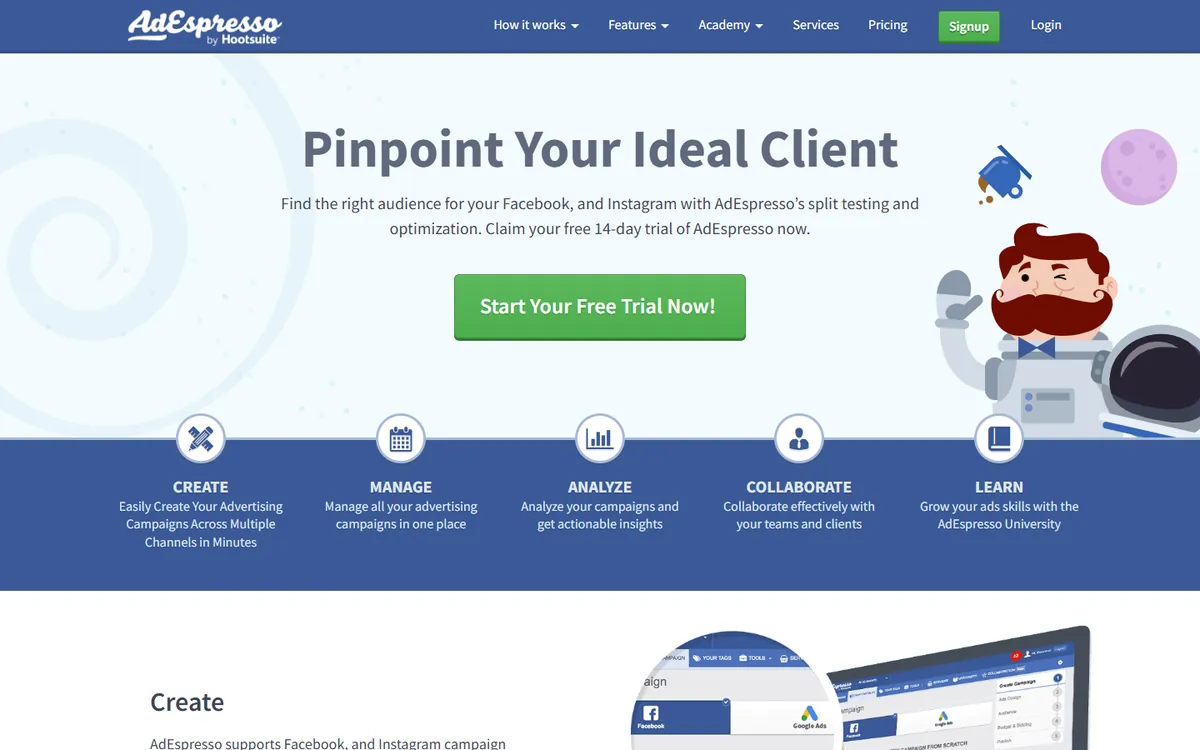
AdEspresso by Hootsuite is a manual builder for Facebook and Instagram. You build every campaign by hand in its builder, test headlines, images and audiences against each other, and see the winner in split-test analysis, while Grid Composer turns a spreadsheet into many ad variations. An optimizer pauses the costliest ads and moves budget to the best ones, and triggers on cost per acquisition, conversions and return change budgets, pause ads or start campaigns.
Its core users are agencies and small teams that prefer manual control. Starter, at $49 a month, covers up to $1,000 of monthly ad spend; Plus, at $99, removes that cap and adds up to 15 seats, bulk creation, campaign approval and view-only access for clients; Enterprise starts at $259 and adds API access, unlimited seats and a named Facebook marketing consultant.
- Best for
- Agencies and small teams that build campaigns manually
- Starting price
- from $49 a month
- Free trial
- A 14-day free trial on all three plans. We saw no free plan.
How it scores
- Yes.Building and launching campaignsA campaign builder, plus a spreadsheet tool called Grid Composer that makes many ad variations. Plus adds bulk creation across several pages.
- No.Image adsWe saw no image ad generation on its pages; you add your own images.
- No.Video adsWe saw no video ad generation on its pages.
- Yes.Rules and automationAn optimizer pauses the costliest ads and moves budget to the best ones, and triggers on cost per acquisition, conversions and return on investment change budgets, pause ads or start campaigns.
- Yes.Reporting and analysisA dashboard with a customizable graph and a drill-down per ad, and drag-and-drop PDF reports.
- No.AI actions and agentsWe saw no AI assistant, chat or AI ad generation on its pricing page, tour pages or home page.
- Partly.Ad platforms coveredFacebook and Instagram campaigns, which its pricing page lists as the plans' scope.
Pros
- Bulk update applies one change to every ad that shares it
- Drag-and-drop PDF reports with a drill-down for each ad
- Unlimited ad accounts on every plan
Cons
- No AI recommendations or chat on its pricing, tour or home pages
- Images and videos come from your team; its pages show no ad generation
Madgicx vs AdEspresso by Hootsuite · Prices checked 23 November 2026
Pencil
7.7/10
Pencil's agents read a brief, your brand guidelines and your assets and generate image ads, with an agent called Scribble running creative work from the brief. Finished ads go to connected accounts on Meta, Google Ads, YouTube, DV360, CM360, TikTok and LinkedIn, and a results dashboard with 50+ metrics, filtered by channel, ad account, campaign and ad set, shows how they perform. You review what the agents make before anything is placed.
The Brandtech Group owns it, and larger brands and agencies appear on its news page, although the entry plan looks aimed at small teams. Core is $14 a month ($11 billed annually) for 50 generations in one workspace, Growth is $55 ($44 annually) for 250 generations and unlimited workspaces, and Pro is custom, through a demo, with unlimited generations, users and brands. Its pricing table leaves AI video out of every plan, although its home page shows video.
- Best for
- Brands that want AI-made ads scored before they run
- Starting price
- from $14 a month
- Free trial
- No free plan and no trial of the full platform. A guided sign-up creates six ads at no cost.
How it scores
- Partly.Building and launching campaignsIts pricing says it launches ads on 7 channels; its help center describes exporting finished creatives.
- Yes.Image adsAgents generate images and ads from briefs and assets, using third-party image models.
- Partly.Video adsIts home page and blog show AI video, but its pricing table includes it in no plan.
- No.Rules and automationPencil is a creative tool; we saw no automation rules on its pages.
- Yes.Reporting and analysisA results dashboard with 50+ metrics, filtered by channel, ad account, campaign and ad set.
- No.AI actions and agentsIts agents generate creatives; we saw no AI media buyer on its pages.
- Yes.Ad platforms coveredMeta, Google Ads, YouTube, DV360, CM360, TikTok and LinkedIn are listed as live integrations.
Pros
- A model trained on your own account data scores new creatives
- Shows which of your creatives perform best, and why
- Core costs $14 a month, or $11 billed annually
Cons
- Rules for running ads aren't on its pages; it stays on the creative side
- Whether it launches ads or only exports them isn't clear; its pages differ
Pencil alternatives, compared · Prices checked 23 November 2026
AdCreative.ai
7.3/10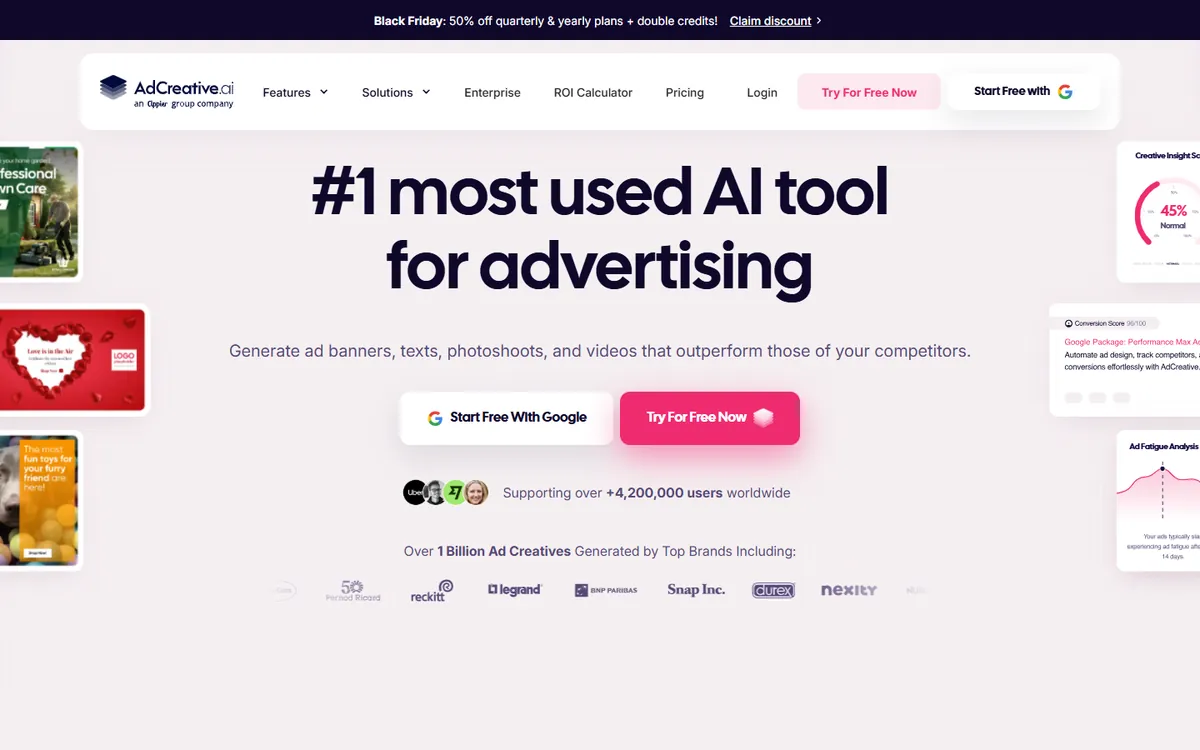
AdCreative.ai generates the assets and leaves the account to you. Prompts with custom styles or a reference image make images, templates make banners, and product-to-video and UGC-style video sit beside text generation. Creative scoring predicts which ads will perform better before launch, an accuracy claim of over 90% that comes from AdCreative.ai itself, and Creative Insights watches connected accounts, charts top creatives, CTR and fatigue per brand and platform, and alerts you when a creative needs a refresh.
It is self-serve and aimed at marketers and agencies. A credit is used each time you download an ad: Starter is $39 a month ($29 billed quarterly) for 20 credits, one brand and one user, Professional is $249 ($185 quarterly) for 300 credits and ten users, Ultimate is $999 ($749 quarterly) for twenty users, and Enterprise is custom. Two of ten recent G2 reviews call its video narrow or missing.
- Best for
- Generating image, video and text ads, with scores before launch
- Starting price
- from $39 a month
- Free trial
- 7-day free trial with 20 credits. We saw no free plan.
How it scores
- Partly.Building and launching campaignsPushes finished creatives to Meta, Google and LinkedIn ad accounts; we saw no campaign or ad set builder.
- Yes.Image adsPrompt-based images with custom styles or a reference image, and banners from ready-made or custom templates.
- Partly.Video adsProduct to video and UGC-style video. 2 of 10 recent G2 reviews call video narrow or missing.
- No.Rules and automationAdCreative.ai is a creative tool; we saw no automation rules on its pages.
- Partly.Reporting and analysisA Creative Insights dashboard of top creatives, CTR and fatigue per brand and platform, shareable by link.
- No.AI actions and agentsWe saw no AI media buyer or campaign optimization agent on its pages.
- Yes.Ad platforms coveredPushes creatives to Meta, Google and LinkedIn; Creative Insights also reads Pinterest and Microsoft Ads.
Pros
- Competitor Insights shows rivals' best-performing ads in the same tool
- Sends finished creatives straight to Meta, Google and LinkedIn accounts
- Its API can generate creatives inside your own workflows
Cons
- Building campaigns and ad sets isn't described; it sends finished creatives
- Automation rules aren't on its pages; it is a creative tool
Madgicx vs AdCreative.ai · Prices checked 23 November 2026
What should the best Facebook ad tools do for you?
A Facebook ad tool is software that helps you launch, run, measure or make ads on Facebook and Instagram, and the label covers more than one kind of product. Some tools push campaigns live in volume, some run budgets with rules or an AI agent, some report on results across channels, and some generate the creative. The best cover more than one of those jobs and hand the decisions back to you before anything spends.
We scored eleven tools on seven criteria, with launching, rules and reporting weighted highest, then AI actions, image ads, video ads and ad platform coverage. Madgicx ranks first with 9.8/10: it builds campaigns from a chat you approve, runs rules and an AI media buyer, reports across six data sources, and makes image and video ads. It loses points only on ad platforms, because it manages Meta ads and reads the other channels without changing them.
The other ten split into bulk launchers, rule engines, enterprise suites, assistant-style agents and creative makers, so the right second choice depends on which job you need most.
Which type of Facebook ad tool matches your job?
Search for a Facebook ad tool and you meet five kinds of product under one name. Some push the ad live and manage it in volume, some run it with rules or an AI agent, some report on it, some make the ad, and a few try to do all of that. Choosing the wrong kind is the commonest way to lose a month, so decide which job hurts most before you compare features. Each competitor's score appears once in this section, at its first mention; the cards above hold the detail.
Tools that launch and manage campaigns
Launching means getting the right structure of campaigns, ad sets and ads into the account quickly. AdManage (8.9/10) sends batches to 15 channels from your Drive, Dropbox or Canva folders once naming, copy and UTMs are set, FabFunnel (9.1/10) multiplies creatives, audiences and copy into every combination, and Bïrch (8.4/10) loads as many as 50 ads into each ad set straight from Google Drive or Sheets. AdEspresso (7.8/10) is the manual end of the group, where you build each campaign yourself, while Hunch (9.5/10) and Smartly.io (9.3/10) generate campaigns from product feeds or blueprints. Our guide to bulk Facebook ad creation tools goes deeper on the launchers.
If the job is mostly running live campaigns day to day rather than making ads, our ranking of Facebook ads management tools scores a set of tools on that work alone.
Tools that automate with rules or an AI agent
Rules act on conditions you write; an agent works from plain requests or from its own audit. Bïrch writes nested rules, FabFunnel checks its rules as often as every 10 minutes and Hunch as often as every 30, while Markifact (9.2/10) takes plain-language tasks and workflows on a schedule or trigger, with approval before changes go live. Madgicx combines the two: automation rules for routine moves, and an AI media buyer that lists prepared actions for you to launch or dismiss. Madgicx's AI media buyer shows how that approval flow works.
Tools that report on results
Every tool here reports something; the difference is whose numbers it can hold. Madgicx brings Shopify, Klaviyo, Google Analytics, TikTok and Google Ads data in beside Meta, FabFunnel shows every connected ad account side by side, Markifact builds Google and Meta reports in Google Slides, and AdManage compares creatives across Meta, TikTok and Google with hit-rate and fatigue reports. Pencil and AdCreative.ai report on creative performance, and Smartly.io adds reach and frequency measurement. When reporting is the whole job, read our guide to Facebook ads reporting tools.
Tools that make the ads
Three tools on this list start at the creative. Creatify (9.1/10) generates video and image ads from a product link, photos or a script, using avatars and UGC-style actors, Pencil (7.7/10) works from a brief with agents and scores new ads against your own account's history, and AdCreative.ai (7.3/10) generates images, banners, video and ad text and predicts which ads will win before launch. None of them lists automation rules for the ads once they run. Madgicx (9.8/10) also makes image ads, working from a prompt, a product photo or an Ad Library ad, and video ads from your own footage, then launches them from the same platform. If creative is your whole question, our roundup of AI tools for Meta ad creatives ranks that group on its own.
One platform or a specialist
A specialist is usually deeper at its one job, while a platform saves handoffs. Madgicx, Hunch, Smartly.io and FabFunnel each cover ad making, launching, rules and reporting in a single product, with different depth and different buyers; the rest of the list covers one or two of those jobs. The stack section below shows what each choice costs.
What does Meta already give Facebook advertisers?
Each tool here sits on top of Meta's own, because the ads themselves still run on Meta and Meta bills you for the budget you set. Below is what Meta's built-in parts do, where Meta's own pages say they stop, and the gap a tool can fill.
Advantage+ campaigns and the single setup
Choosing sales, app promotion or leads as the objective opens the Advantage+ setup, where Meta applies AI to the campaign as a whole. In sales campaigns, Meta says its most advanced optimizations are enabled when audience, campaign budget, placements and destination all use Advantage+. In app campaigns, Meta's AI optimizes bidding, audiences and placements; leads campaigns have Advantage+ on by default; and every manual feature remains available.
Where it stops: restrict budget, audience or placements heavily and Meta marks Advantage+ as off for that section, and it warns that special ad category and pharmaceutical campaigns may lack access to every Advantage+ feature. What a tool adds is speed and structure around the setup, such as a campaign built from a chat request or a bulk launcher that fills campaigns with finished creative.
Advantage+ creative and Meta's generative AI
Advantage+ creative uses AI to produce and refine ad variations across image, video and carousel formats. It can draft up to five versions of primary text and headline, in personas if you like, animate an eligible single image into a short video, crop and expand media for more placements and, in catalog ads, generate backgrounds for product shots. Meta may switch some enhancements on by default, and you can turn them off whenever you want.
Where it stops: every enhancement is tied to named formats and placements. Subtitles work on single video ads that carry an English voiceover, and only on Instagram Reels, video expansion handles the first 15 seconds in Facebook Feed and Reels, and certain verticals, special ad categories and countries may lack immediate access to generative features. What a tool adds: ads made from scratch from a prompt, a reference image or a competitor's ad in the Ad Library, rather than variations of an ad you already built.
Automated rules in Ads Manager
Automated rules test your campaigns, ad sets or ads against conditions you set, then change them or alert you. Actions include turning items on or off, adjusting a budget or manual bid, scaling a budget or bid, and sending a notification only. Every rule is evaluated at least every 30 minutes, all of its conditions must be met to trigger it, and a single ad account holds up to 250 rules, active and inactive together. Our answer on Meta ads automated rules covers them in more detail.
Where it stops: a rule can use each condition only once and covers one level at a time. It is blocked on ads about social issues, elections or politics, it can't pause reservation campaigns, and bid changes need manual bids; Meta still advises you to monitor overall performance. What a tool adds: rules checked every 10 or 15 minutes, rules across more platforms, and an AI media buyer that suggests changes no rule was written for.
Reports in Meta Ads Reporting
Meta Ads Reporting builds custom reports from breakdowns, metrics and filters, exports them as .xlsx or .csv or shares them as a link, and can email a recurring report to you or someone else. A single account's report reaches back 37 months.
Where it stops: cross-account reports can't be scheduled for email, hold 24 months of data, leave out metrics such as Result and Video Watches and can't compare time zones, and viewing a report requires permissions on the ad account it covers. What a tool adds: other channels and store data in the same view, plus client-ready links or PDFs.
Opportunity score, Meta AI and the AI connectors
Ads Manager also grades how optimized your account is. Opportunity score runs from 0 to 100, ranks recommendations by estimated impact, lets you apply many in a few clicks and offers auto-apply in Account Overview; Meta says it doesn't reflect actual or future performance. The Meta AI business assistant, available to some accounts, analyzes campaigns, benchmarks cost per result, click-through rate and ROAS against industry figures and suggests changes you can edit, drop or apply.
Meta's connector for AI assistants has been in open beta since 29 April 2026. At its center is an MCP server hosted by Meta, which any MCP-compatible agent can use to create and edit ads, ad sets and campaigns; new items are created paused, and your AI client asks for confirmation before activation. Meta cautions that you may not have every tool yet, and it points advertisers to their own AI tools for cross-channel insights and custom workflows. Our explainer on managing Facebook ads through MCP shows how the pieces fit. What a tool adds: analysis and actions inside the assistant, which is what Madgicx's MCP server and several tools above provide.
The Meta Ad Library
The Ad Library lets anyone search the ads currently running across Meta technologies. An ad appears within 24 hours of its first impression, ads about social issues, elections or politics stay for seven years, and ads that ran in the EU stay for a year; outside those groups it shows running ads only. Madgicx uses it as a source: pick any ad there as the reference for a new image ad. Our guide to the Facebook Ad Library explains how to search it.
Where a Facebook ad tool earns its place
Meta's tools are the baseline to compare against. A separate tool earns its place when it cuts the hours you spend making variations, launching in volume or reporting beyond Meta, and the sections that follow look at which one fits which job.
How much do Facebook ad tools cost?
| Tool | Starting price | How you pay | Free trial | Prices checked |
|---|---|---|---|---|
| Madgicx | From $45/mo | Priced by monthly ad spend, from $45 a month, billed monthly, quarterly or annually. | 7-day free trial | 23 November 2026 |
| Hunch | by quote | Its full platform is quoted after a demo, and its pages publish no prices for it. Its self-serve CPV Accelerator for catalog video is priced by catalog size, with the CPV Plan from $350 a month. | We saw no free trial. The full platform starts with a demo; its self-serve CPV Accelerator is free to set up and bills when you publish. | 23 November 2026 |
| Smartly.io | by quote | Quote only. Its site asks you to book a demo and lists no plans, prices or free trial. | We saw no free plan or trial on its pages. Its site asks you to book a demo. | 23 November 2026 |
| Markifact | from $79 a month | A monthly plan: Pro $79 a month for one seat, Team $249 a month, and a custom Managed plan. Credits and seats scale with the option you pick. | Its pricing page says to start free with trial credits. We saw no free plan in its plan table. | 23 November 2026 |
| Creatify | from $10 a month | Credits, with plans also set by seats and brand spaces: Standard $10, Pro $38, Ultra $66, Business $136 a month, each shown beside a higher list price. | A free plan with 10 credits a month and watermarked exports. We saw no free trial of the paid plans. | 23 November 2026 |
| Fab |
from $39 a month | A monthly or yearly plan, with credits for AI creative and limits on ad accounts and rules. Extra credits are sold as one-time top-ups. | Explore, Growth and Scale include a 7-day trial with 30 credits, charged from day 8. The $39 FAB AI plan has no trial. | 23 November 2026 |
| Ad |
from £199.99 a month | A monthly plan priced in GBP, from £199.99 for one ad account. Plans differ by ad accounts, AI credits and automation rules. | We saw no free plan or free trial on its pricing page. It offers a 7-day money-back guarantee on Essential and 30 days on the larger plans. | 23 November 2026 |
| Bïrch | from $49 a month | A monthly plan priced by your ad spend across connected platforms: $49 or $99 a month, with Enterprise by quote. | A 14-day free trial with all features. We saw no free plan. | 23 November 2026 |
| Ad |
from $49 a month | A flat monthly plan: $49 up to $1,000 of ad spend, $99 with unlimited spend, and Enterprise from $259. | A 14-day free trial on all three plans. We saw no free plan. | 23 November 2026 |
| Pencil | from $14 a month | Monthly generations: Core $14 a month ($11 billed annually), Growth $55 ($44 billed annually). Pro is custom. | No free plan and no trial of the full platform. A guided sign-up creates six ads at no cost. | 23 November 2026 |
| Ad |
from $39 a month | Credits, used when you download an ad: Starter $39 a month, Professional $249, Ultimate $999. | 7-day free trial with 20 credits. We saw no free plan. | 23 November 2026 |
How do you build a Facebook ad tool stack?
Four jobs make up the work: making ads, launching them, running them with rules or an agent, and reporting. The question is how many tools you want between you and those jobs, because every extra tool adds an export, a login and a bill.
What one tool can cover
Four tools here cover all four jobs in one product: Madgicx, Hunch, Smartly.io and FabFunnel. Of the four, Madgicx is the one that builds campaigns from a chat and prepares actions for your approval; Hunch and Smartly.io work from feeds and blueprints, and FabFunnel's AI makes creative while its rules handle budgets.
When two tools beat one
A creative tool plus a launcher is the classic pairing. Creatify, Pencil or AdCreative.ai produce the files, and AdManage or Bïrch's Stage pick them up from a shared folder and launch them with consistent naming and UTMs. Choose two when your creative volume justifies a dedicated maker and your team already works from shared storage. AdCreative.ai vs Creatify sets two of the makers side by side.
An agent in front of the tools you already pay for
Markifact and Creatify's Max sit above the ad accounts instead of inside a dashboard, so one plain request can reach several channels, and both hold changes for approval. That suits a team that already lives in chat and wants one assistant, not another dashboard.
What the combinations cost
Published list prices, checked in October and November 2026, show how the totals differ:
- Madgicx alone: plans start at $45 a month and rise with the ad spend you manage.
- Creatify Pro plus AdManage Essential: $38 and £199.99 a month, billed separately in two currencies, for creative plus one launch account.
- Pencil Core plus Bïrch Pro: $14 and $99, $113 a month in all, and Bïrch's own price follows the ad spend you connect.
- FabFunnel alone: Explore at $199 a month covers one launch ad account and five rules, and Growth at $349 covers five accounts and ten.
- Markifact Pro: $79 a month for one seat, with unlimited ad accounts.
- Smartly.io and Hunch's full platform: quoted after a demo; Hunch's self-serve CPV Accelerator starts at $350 a month for catalog video.
Treat each total as a list price. Credits, seats and ad accounts move several of these plans up as you grow, and Meta bills the ad spend itself separately.
Which features does each tool cover?
| Tool | Score | Building and launching campaigns | Image ads | Video ads | Rules and automation | Reporting and analysis | AI actions and agents | Ad platforms covered |
|---|---|---|---|---|---|---|---|---|
| Madgicx | 9.8/10 | Yes. | Yes. | Yes. | Yes. | Yes. | Yes. | Partly. |
| Hunch | 9.5/10 | Yes. | Yes. | Yes. | Yes. | Yes. | Partly. | Partly. |
| Smartly.io | 9.3/10 | Yes. | Yes. | Yes. | Yes. | Yes. | No. | Yes. |
| Markifact | 9.2/10 | Yes. | Yes. | Partly. | Partly. | Yes. | Yes. | Yes. |
| Creatify | 9.1/10 | Yes. | Yes. | Yes. | No. | Yes. | Yes. | Yes. |
| Fab |
9.1/10 | Yes. | Yes. | Yes. | Yes. | Yes. | No. | Partly. |
| Ad |
8.9/10 | Yes. | Yes. | Yes. | Partly. | Yes. | No. | Yes. |
| Bïrch | 8.4/10 | Yes. | No. | No. | Yes. | Yes. | Partly. | Yes. |
| Ad |
7.8/10 | Yes. | No. | No. | Yes. | Yes. | No. | Partly. |
| Pencil | 7.7/10 | Partly. | Yes. | Partly. | No. | Yes. | No. | Yes. |
| Ad |
7.3/10 | Partly. | Yes. | Partly. | No. | Partly. | No. | Yes. |
How much control do you keep over each Facebook ad tool?
Giving a tool access to live ads is a decision about timing: who acts first, you or the tool? These notes show where each of the eleven stands.
- Madgicx: nothing the chat builds and no action its AI media buyer prepares runs before you approve it, your rules act when their conditions are met, and agents run on a schedule for an ad account and email a summary of each run.
- Hunch: rules you switch on pause, activate and re-budget by themselves, and Autopilot works from an instruction plan you set.
- Smartly.io: triggers and budget moves run from set-ups your team builds, and a shared workspace lets people approve ads before launch.
- Markifact: its pages say nothing goes live without approval, handled in chat or Slack.
- Creatify: Max puts each change to you as an approval prompt before it goes live.
- FabFunnel: rules act on ROAS, CPA, CTR and spend once set, and its Co-Pilot beta recommends but, its pages say, never launches, pauses or edits a campaign.
- AdManage: rules act on the limits you set, its MCP stays read-only until you allow writes, and clients can open previews before launch.
- Bïrch: published rules fire alone, its chat asks before each action unless you change the default, and anything Bïrch AI creates starts paused.
- AdEspresso: you make each change in the builder, its optimizer and triggers act on your thresholds, and Plus can hold a campaign for sign-off.
- Pencil: agents work on creative from your brief and results sit in a dashboard you open; rules acting on ads aren't on its pages.
- AdCreative.ai: it sends finished creatives to the ad accounts you connect, and campaign changes or rules aren't part of what its pages describe.
Limits to set in Meta before any tool connects
Meta's budget controls apply beneath every tool, which makes them your safety net if a change goes wrong. Four are worth setting:
- An account spending limit, which caps what the ad account spends over its lifetime and pauses ads when reached; accounts set up for available funds can't set one.
- A campaign spending limit, an adjustable cap on a campaign's total; with Advantage+ campaign budget, the campaign's lifetime budget takes its place.
- Minimum budgets: with a cost per result goal, Meta says the daily budget should be at least five times that goal, and minimums vary by country and objective.
- Room for pacing: Meta may exceed a daily budget by as much as 75% on a single day, and a scheduled budget increase must last at least 3 hours and stay within 8 times the daily budget.
Which Facebook ad tool suits your situation?
Madgicx is the default pick for most Facebook advertisers, and it ranks first with 9.8/10. Every situation below leads with Madgicx and then names the tool built for a narrower need.
A brand that runs most of its budget on Facebook and Instagram
Pick Madgicx. Ask the chat for the campaign, let rules and the AI media buyer's prepared actions keep it on target, and generate image ads from a prompt, a product photo or a reference ad and build video ads from your own files when you need new creative. One subscription replaces a creative tool, a launcher and a reporting tool.
A media buyer who launches dozens of ads a week
Madgicx builds campaigns, ad sets and ads in its chat and manages them with smart filters, so launching and managing stay in one place. When your week is mostly uploading finished files from Drive or Dropbox, AdManage reaches 15 channels and FabFunnel crosses creatives, audiences and copy into every combination.
An ecommerce, travel or retail brand with a large catalog
Madgicx is the default pick when you want chat-built campaigns, creative analysis and rules in one place. When the catalog itself is the challenge, Hunch turns one template into an ad for every product and fills Advantage+ shopping campaigns you already run, and Smartly.io generates many campaigns at once from blueprints linked to a feed.
An agency running client accounts
Madgicx holds each change for approval and reports across Meta, Google Ads, TikTok, Shopify, Klaviyo and Google Analytics, shared with clients by link or PDF. AdManage adds client preview links before launch and shareable reports afterwards, and AdEspresso's Plus plan adds campaign approval and up to 15 seats.
A marketer who works in Claude or ChatGPT
Madgicx's MCP server is part of every plan. Connected to Claude or ChatGPT, it lets that assistant read your Meta ad accounts and act on their status, budgets, bids, spending limits and names. Our page on the Madgicx MCP for Meta ads covers set-up. Markifact brings its agent tools into Claude, ChatGPT, Gemini and Cursor across 14 ad platforms, with approval before changes.
A creative team that needs image and video ads in volume
Madgicx makes image ads from a prompt, a reference or an Ad Library ad, builds video ads from your own footage and launches them. If most of your volume is avatar and UGC-style video, Creatify's actors and Ad Agent are built for it, and AdCreative.ai or Pencil add scoring before launch. Our answer on AI image generators for Meta ads covers that side in more detail.
How do you make and launch your first Facebook ads in Madgicx?
Begin the 7-day free trial, then link the Meta ad accounts you manage using a Facebook login that has access to them. The connection lets Madgicx read your results and act on changes only after you approve them. Once the trial ends, the price follows your monthly ad spend, from $45 a month.
Open the AI image generator and load a prompt, a photo of your product or a reference ad picked from the Meta Ad Library, then review the versions it makes. For video ads, upload an MP4 or MOV file (1 GB at most) or choose a video already in the ad account's library.
State the goal, the audience (a saved custom or lookalike audience, or a place you name) and the ads to use. Read the build the chat shows you; nothing is created until you approve it.
Enter the cost per purchase or ROAS you need, switch on the alerts that Madgicx suggests on its Home page, and write rules for routine moves such as pausing an ad set that spends past your limit.
Each day, open the AI media buyer's list and launch or dismiss every action on it. Each week, send a report that sets your other channels beside Meta, as a link or a PDF.
How do you judge a Facebook ad tool in a seven-day trial?
A trial is short, so give each day a job. This plan fits Madgicx's 7-day free trial and works for any tool that offers a trial or a demo environment.
- Day 1: connect one ad account, with limited access if the tool offers it, and write down what each permission lets it change.
- Day 2: make ten ads from your real product and compare the time and quality with what your team produces.
- Day 3: launch one small campaign and check the names, audiences, budgets and UTM tags it created against what you asked for.
- Day 4: set one rule or alert at a number you really use, and see whether it fires and what it does.
- Day 5: build the report you send every week and compare it with the one you build in Meta Ads Reporting.
- Days 6 and 7: leave it alone, then review what changed, what waited for approval and what you would keep.
What can a Facebook ad tool still not do for you?
A tool takes over making, launching and measuring. These decisions stay yours, whichever one you choose.
Deciding what you sell and what a sale is worth
A generator turns a brief into ads, and the brief is yours: the offer, the audience and the price. Rules and alerts need a target too, so set it from your margins; our break-even ROAS calculator shows the ROAS below which an order loses money.
Supplying inputs you can stand behind
AI makes ads from the photos, claims and reference ads you give it. Check each image's product details and every claim before it goes live, because a tool can't know which promise your business can keep.
Getting conversions to Meta
Every tool steers budget by the purchases and leads Meta records, so a conversion that never arrives makes a strong ad look weak. Meta says Conversions API data is less impacted than Pixel data by browser loading errors, connectivity issues and ad blockers, and it describes the Conversions API Gateway as suited to advertisers who spend over $300 a month on campaigns optimized for web events.
Staying inside Meta's rules for your category
Ads about social issues, elections or politics can't use automated rules, and Meta says special ad category and pharmaceutical campaigns may not reach every Advantage+ feature. Before you commit, ask the vendor to demonstrate its tool on a campaign like yours.
Reading results with judgment
Meta says opportunity score does not reflect actual or future performance, and the same caution applies to any tool's score or recommendation. Treat a suggestion as a hypothesis and check it against profit.
Which questions should you ask before you buy?
- Which of the four jobs, launching ads, running them, reporting and making them, hurts most today?
- Does it create campaigns and ad sets, or only place ads in the ones you already run?
- Does it generate image and video ads, or do you supply every finished file?
- Which changes act without you, and which wait for your approval?
- Does the price follow ad accounts, seats, credits or ad spend, and which limit will you reach first?
- Does reporting end at Meta, or can it add Google Ads, TikTok and your store's revenue?
- Is limited or read-only access offered first, or do its first changes arrive as drafts?
How did we score each tool?
We scored each tool on seven criteria, using what its own pages show: building and launching campaigns, rules, reporting, AI actions, image ads, video ads and ad platform coverage. Launching, rules and reporting weigh most because they decide how fast ads go live, how well they stay on target and how clearly you see the result. Ad platform coverage weighs least on a page about Facebook ads.
Every tool on this list starts at 5 out of 10. The other 5 points are split across the criteria by the shares in the table below: a tool that fully covers every criterion scores 10, and a criterion it only partly covers earns half its share.
| Capability | Share of the 5 points |
|---|---|
| Building and launching campaigns | 18% |
| Image ads | 13% |
| Video ads | 13% |
| Rules and automation | 17% |
| Reporting and analysis | 17% |
| AI actions and agents | 13% |
| Ad platforms covered | 9% |
The Madgicx team wrote this page and scored every tool, Madgicx included, with the same rubric.
Why this guide now covers every kind of Facebook ad tool
Earlier versions of this guide ranked management tools only. Searches for Facebook ad tools cover four jobs, launching and managing campaigns, automating them, reporting and making ads, so this version scores all four. Tools that only manage campaigns are ranked in their own post. We rechecked every price and plan limit at the source in October and November 2026, and added sections on which kind of tool you need, what Meta's own tools do, how to combine tools and what a trial week should test.
So which one should you choose?
Madgicx is our top pick among Facebook ad tools, ranked first with 9.8/10: it builds campaigns you approve, runs rules and an AI media buyer, reports across your channels, and makes image and video ads, and you can try it free for 7 days. If your ads come from a product catalog, Hunch is built for that job. For avatar and UGC-style video at volume, Creatify is the specialist, and for pushing large batches to 15 channels, AdManage fits.
Frequently asked questions
What is the best Facebook ad tool?
In this comparison Madgicx is the best Facebook ad tool, and it ranks first with 9.8/10. It generates image ads from a prompt, a photo or any ad in the Meta Ad Library, builds video ads from your own footage, creates campaigns from a chat once you approve, runs rules, prepares the next changes with an AI media buyer and reports across Meta, Google Ads, TikTok, Shopify, Klaviyo and Google Analytics. Hunch, Creatify and AdManage are the closest alternatives for catalog ads, UGC-style video and bulk launches.
Do I need more than Facebook Ads Manager?
It depends on how many jobs you still do by hand. Meta's own tools set up Advantage+ campaigns, generate ad variations with Advantage+ creative, run automated rules and report through Meta Ads Reporting, and you pay Meta for the ads you run. A separate tool earns its place when making variations, launching in volume or reporting beyond Meta eats your week. Madgicx covers those three jobs in one place, and its 7-day free trial lets you test it against your routine using your own ad account.
Which Facebook ad tool makes the ads for you?
Madgicx generates image ads from a prompt, a product photo or any ad in the Meta Ad Library and builds video ads from your own videos, then launches them after you approve. Creatify, FabFunnel, Pencil and AdCreative.ai also generate creative, Smartly.io and Hunch scale ads from templates, and AdManage, Bïrch and AdEspresso launch the finished files you bring.
Can you try a Facebook ad tool before you pay?
Madgicx offers a 7-day free trial, so you can connect your ad account and test it before paying. Bïrch and AdEspresso run 14-day trials, AdCreative.ai a 7-day trial with 20 credits, and FabFunnel's launch plans include a 7-day trial. Creatify has a free plan with 10 credits a month and watermarked exports, Markifact says to start free with trial credits, and Pencil creates six ads at sign-up at no cost. AdManage gives a money-back guarantee instead of a trial, while Smartly.io and Hunch's full platform begin with a demo.
How much does a Facebook ad tool cost?
Madgicx's plans begin at $45 a month and scale with the ad spend you manage. Among the others, Creatify's Standard plan is $10, Pencil's Core plan $14, AdCreative.ai and FabFunnel's creative-only FAB AI plan $39, Bïrch and AdEspresso $49, Markifact $79 and AdManage £199.99. Hunch's self-serve CPV Accelerator starts at $350 a month, and Smartly.io works by quote. Credits, seats, ad accounts and ad spend move most of these plans up as you grow.