Think Your Ad Strategy Still Works in 2023?
Get the most comprehensive guide to building the exact workflow we use to drive kickass ROAS for our customers.


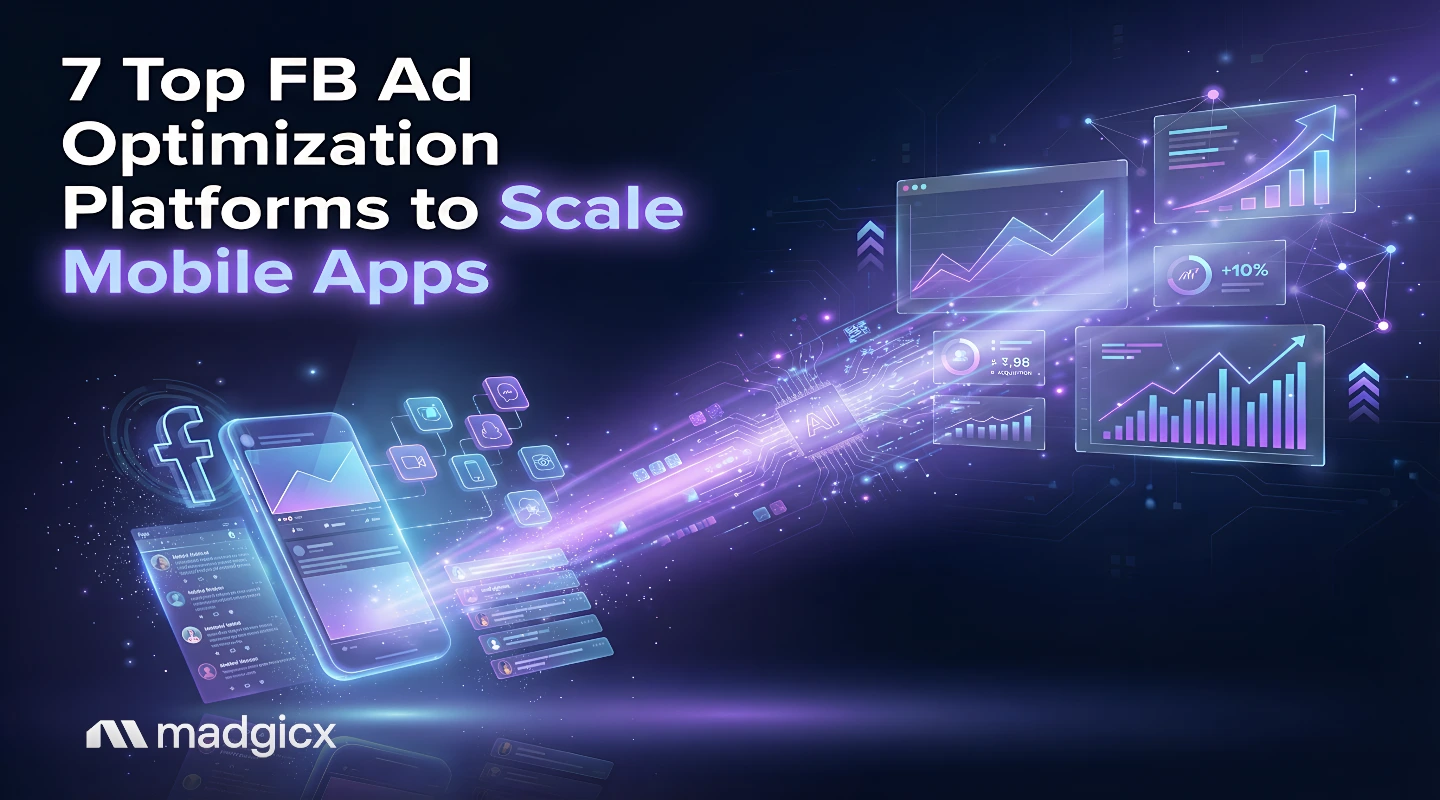
If you're running Facebook ads for mobile apps, you know the game has changed. Gone are the days of setting a simple "app install" campaign and watching downloads roll in.
Today, Meta’s advanced AI, constantly shifting algorithms, and the challenges of iOS 14.5 make precise targeting, budget control, and creative optimization more critical than ever. With rising CPAs, fierce competition for user attention, and complex testing requirements, relying on gut instincts is no longer enough. The right optimization platform can turn chaos into scale, helping your ads perform efficiently and effectively.
Manual optimization isn’t just inefficient anymore; it’s a fast way to burn budget and miss growth opportunities. This guide breaks down the top platforms for Facebook ads for mobile apps, giving you a clear, actionable framework to choose the tools that help your campaigns not just survive—but thrive.
Let's start with the big picture. If you're advertising a mobile app, Meta isn't just an option; it's the main event. Why? Because Meta is mobile. A mind-blowing 94% of Meta's ad revenue comes from mobile devices. That means your audience isn't just on their phones; they live there.
But it's not just about the sheer number of users—which, by the way, sits at a casual 2.91 billion monthly active users, according to SegmentStream. The real game-changer is the brain behind the operation: Meta Andromeda.
Meta Andromeda is Meta's proprietary machine learning infrastructure that uses deep neural networks for the retrieval stage of ad recommendations, enabling massive personalization and faster ad delivery.
Think of Andromeda as the powerful engine behind the curtain. It's an AI so advanced that it has fundamentally changed how ads are served. Instead of us media buyers manually picking precise interests, we now feed this system high-quality data and creative, and it finds the right users for us.
The results speak for themselves. This new infrastructure led to a +6% recall improvement and an +8% ads quality improvement, meaning it's better at finding relevant ads and showing higher-quality ones to users.
For us mobile app advertisers, this means two things:
So, if Meta's AI is so powerful, why does it feel like you're running uphill in ski boots sometimes?
We get it. You're doing everything right, but the results are unpredictable. It's because two massive roadblocks have been thrown onto the track, making the journey from ad spend to profitable user acquisition a treacherous one.
You know the story. Apple's App Tracking Transparency (ATT) framework arrived and turned our once-pristine data streams into a muddy trickle. For mobile apps, this was a direct hit. The signals that told us which ads were driving installs, in-app purchases, and subscriptions suddenly became blurry and delayed.
This "signal loss" isn't just an analytics headache; it directly starves the optimization engine. Meta's AI, as brilliant as it is, feeds on data. When you starve it of accurate, real-time conversion data, its ability to find your next best customer is crippled. Your cost per install (CPI) goes up, your return on ad spend (ROAS) goes down, and you're left wondering which part of your ad spend is actually working.
Ever launched a new campaign only to see the dreaded "Learning" status linger for what feels like an eternity? That's the second major hurdle we're all facing.
The Learning Phase is the initial period of a Facebook ad campaign where the delivery system gathers data to stabilize performance.
During this time, the algorithm is exploring, testing, and figuring out who is most likely to take your desired action (like installing your app). Performance is volatile, and costs can be all over the place.
To get out of this performance purgatory, Meta is very clear about the price of admission: an ad set typically requires at least 50 conversions per week, a key benchmark from our industry analysis. For mobile apps, especially those with longer conversion cycles or higher-value actions, hitting this threshold can be a massive challenge. If you're stuck in the learning phase, you're not scaling. You're just paying Meta for its education.
Alright, enough with the problems. Let's talk solutions. We didn't just pull a list of tools out of a hat. We approached this like seasoned media buyers building a tech stack for a multi-million dollar account.
We looked for platforms that solve the actual problems mobile app advertisers face today, focusing on a few key criteria that separate the nice-to-haves from the absolute must-haves.
Here’s how we judged them:
After rigorous evaluation, we’ve compiled the definitive list of top platforms to help you scale your mobile app on Meta. Here’s a quick overview before we dive into the details.
We built Madgicx to be the platform we always wished we had as media buyers. It’s a comprehensive all-in-one solution designed to be the central nervous system for your entire paid advertising operation.
Instead of you having to stitch together five different tools for attribution, automation, creative, and reporting, Madgicx brings it all under one roof.
What makes Madgicx stand out for mobile apps?
Madgicx is built for the lean, ambitious team that needs enterprise-level power without the complexity or price tag. Try Madgicx for free today.
If your ad spend is creeping into the "small country's GDP" territory (think >$250k/month) and your biggest challenge is getting a single, undeniable source of truth for attribution, Northbeam is a heavyweight contender.
Northbeam is an attribution platform first and foremost. It uses a sophisticated machine-learning model to tell you exactly where your conversions are coming from. For mobile apps with complex funnels, this clarity is invaluable.
The downside? It’s a precision instrument with a price tag to match, and it doesn't offer the campaign automation or creative tools that a platform like Madgicx does. It tells you what worked; you still need other tools to act on those insights.
AdStellar AI is laser-focused on solving one of the biggest bottlenecks in performance marketing: creative production and testing. Their platform uses AI to generate and launch a high volume of ad variations, helping you find winning combinations faster than any human could.
For mobile app advertisers, this is huge. It allows you to constantly feed Meta's algorithm fresh creative, fighting off creative fatigue and keeping your campaigns performing at their peak.
The trade-off is that AdStellar is a creative tool, not a full-funnel optimization suite. You'll still need a separate solution for deep analytics, attribution, and post-install event optimization.
Triple Whale made a huge splash in the e-commerce world with its beautiful, intuitive dashboard that centralizes all your key business metrics, from ad spend to net profit. Their "Pixel" provides an alternative attribution model that many Shopify brands rely on.
While primarily built for e-commerce, its analytics can be valuable for mobile apps with a strong web-to-app user journey. However, its mobile app-specific features are limited.
Motion is like a super-powered microscope for your ad creative. It gives you incredibly detailed reports on what's working and what's not. It automatically tags creative elements (e.g., "UGC," "testimonial") and shows you which components are driving the best performance.
For creative teams at mobile app companies, Motion is a goldmine of insights. The limitation is that it's purely an analytics tool. It provides the "why," but you need another platform to provide the "what to do next."
Ever wonder what your competitors are up to? Rival IQ tells you. This platform is all about competitive analysis. It tracks your rivals' social media activity, ad campaigns, and content strategies, giving you a clear benchmark for your own performance.
For a mobile app entering a crowded market, this intelligence can be crucial for positioning and strategy. However, it's an external-facing tool and doesn't connect to your ad accounts for internal optimization.
Adzooma is a great entry-level platform for small businesses just dipping their toes into ad automation. It offers a simple interface with pre-built rules to help you manage your campaigns on Meta, Google, and Microsoft Ads (e.g., "pause ad if CTR drops below 1%").
It’s a solid starting point, but it lacks the sophisticated AI and deep analytics needed for serious mobile app scaling. As your app grows, you'll likely need to graduate to a more powerful, AI-driven platform.
Let's talk money. One of our biggest frustrations is the lack of transparent pricing in the ad tech world. To help you budget, we’ve compiled the verified starting prices for the platforms on our list that make this information public.
Note: Prices are subject to change and may vary based on ad spend or feature tiers. Always check the provider's website for the most current information.
Choosing a tool is only half the battle. You need a strategy to wield it effectively. Here are the core frameworks that the most successful mobile app advertisers are using right now.
This is non-negotiable. It's crucial to improve your data signals. A powerful way to do this is with a Signals Gateway. Don't let the name scare you; the concept is pretty simple.
A Signals Gateway is a server-side infrastructure that provides a streamlined solution to collect, process, and transmit first-party user data directly to ad platforms like Meta's Conversions API (CAPI), bypassing browser-side tracking limitations.
In plain English, it creates a direct, more reliable pipeline from your server to Meta's. This data is richer, more accurate, and isn't blocked by privacy settings, giving Meta's AI the high-quality food it needs to perform.
Pro Tip: Don't get overwhelmed by CAPI. Start by implementing just one or two key server-side events, like "App Install" and "Purchase." Getting these high-value signals right is more impactful than trying to implement a dozen events imperfectly.
Platforms like Madgicx have this technology built-in, making it accessible without needing a team of developers.
As we mentioned, creative is your #1 lever for performance. But audiences get bored fast. This phenomenon is called Creative Fatigue, which is the decline in an ad's performance that occurs when an audience has been exposed to it too frequently.
On mobile, this happens at lightning speed. Research shows that advertisers have approximately 0.5 seconds to capture interest on mobile. You need a constant stream of fresh, engaging creative.
Pro Tip: Use the "2-Winner Rule" for creative testing. In any ad set, always have at least two high-performing "winner" ads running. When you introduce a new creative to test, run it against your winners. If it outperforms one of them, it becomes a new winner. This ensures you're always improving performance without disrupting what already works.
Creative intelligence platforms help you analyze top-performing ads, break them down into their core components, and tell you which ingredients are in your secret sauce.
The final piece of the puzzle is letting AI do the heavy lifting. A new category of tools features what we call an AI Agent.
An AI Agent is an advanced software system designed to perform tasks traditionally done by a human media buyer, such as analyzing campaign structure, audience selection, and creative pairing, based on performance data.
Think of it as a tireless, data-driven junior media buyer who works 24/7. It analyzes performance data in real-time, identifies opportunities and threats, and provides one-click implementation for recommended actions. This is what Madgicx's AI Marketer is designed to do, allowing you to scale your ad spend and testing without scaling your headcount. It's a prime example of performance marketing AI in action.
Ready to level up? The most sophisticated app advertisers are moving beyond platform metrics and integrating their own CRM data for true LTV (Lifetime Value) Optimization.
LTV Optimization is an advertising strategy that prioritizes acquiring users who are predicted to have a high long-term monetary value, rather than simply optimizing for the lowest cost-per-install (CPI).
Here’s a powerful strategy you can implement:
Why? Because you're already paying to acquire them! Wasting ad spend on your most loyal fans is a drain on your budget. By suppressing them, you force Meta's algorithm to find new customers who look just like your best ones.
As documented in a case study highlighted by Klaviyo, one brand that implemented a similar strategy saw a 61% Year-over-Year (YoY) increase in ROAS simply by reallocating wasted spend to new customer acquisition.
Think of it this way: An MMP (like AppsFlyer) is a neutral scorekeeper that attributes app installs to specific channels. An Meta ad optimization platform (like Madgicx) is the coach who uses that data to actively manage your campaigns and improve performance.
The most effective solution is to implement Meta's Conversions API (CAPI) via a server-side integration or a Signals Gateway. This sends event data directly from your server to Meta's, bypassing browser-level tracking restrictions and improving data accuracy.
No, and it shouldn't. AI tools are designed to augment, not replace, a skilled media buyer. They automate the repetitive, soul-crushing tasks, freeing up the human strategist to focus on high-level strategy, creative direction, and interpreting complex insights. The best results always come from a human + AI partnership.
Pricing varies widely, but a good rule of thumb is to choose a tool whose cost is easily covered by a 10-20% improvement in your ad performance. If a $45/month tool helps you save $500 in wasted ad spend and a few hours of your time, it's a fantastic investment.
Navigating mobile app advertising on Meta is complex, but it's far from impossible. The old ways of manual tweaking and guesswork are over. The winning formula for today and beyond is a strategic tech stack that embraces automation and enhances data.
The best approach combines Meta's native tools with a third-party optimization layer like Madgicx to handle automation, creative intelligence, and unified reporting. This is how you address signal loss, manage creative fatigue, and scale more effectively, without pulling your hair out.
By implementing these frameworks, you're not just hoping for better results; you're engineering them. And we're here to help you do it.
Ready to implement this stack? Start your free trial of Madgicx to unify your optimization, creative, and reporting in one AI-powered platform.
Madgicx’s AI Marketer constantly analyzes your campaigns, identifying underperforming ads, audience fatigue, and wasted spend. Get actionable, one-click recommendations to optimize creatives, adjust budgets, and scale the ads that drive the best results.
.avif)
Digital copywriter with a passion for sculpting words that resonate in a digital age.