Think Your Ad Strategy Still Works in 2023?
Get the most comprehensive guide to building the exact workflow we use to drive kickass ROAS for our customers.


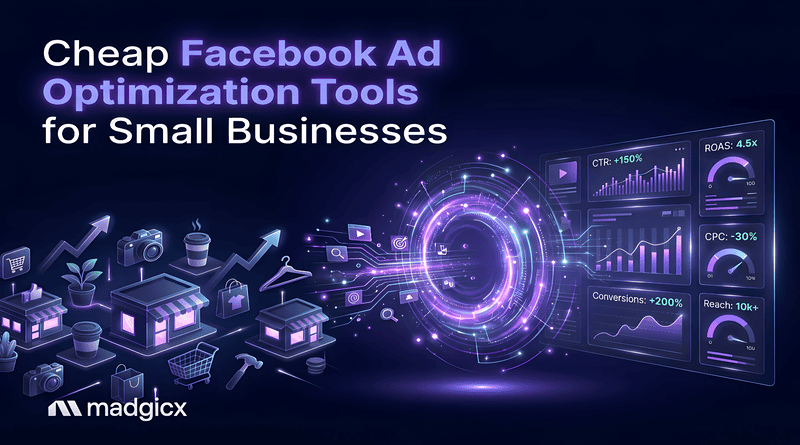
Running Meta ads on a small budget feels like a battle on two fronts. You're fighting to get your message in front of the right people while simultaneously fighting a volatile algorithm that seems to punish low spend with unpredictable results. One day your cost per acquisition is solid; the next, it's through the roof. It's a frustrating cycle that leaves many small business owners wondering if Facebook and Instagram ads are even worth it.
Here's the good news: the problem isn't your budget — it's your strategy. And the right tools, even at under $50 a month, can change everything. This guide covers why low-budget campaigns typically fail, the framework that fixes it, and the best affordable platforms to automate your way to stable, profitable results. For a broader look at getting started, see our guide to online ads for small business.
If you've ever split a small daily budget across multiple ad sets, you've experienced data fragmentation. It is also one of the reasons for campaign instability. When your budget is spread too thin, each ad set receives too little spend to gather meaningful data, and Meta's algorithm struggles to optimize delivery. See our guide to social media advertising for small business for context on where this fits in the broader picture.
This leads to several common pain points that compound each other:
The solution isn't a bigger budget — it's a smarter structure.
Experienced media buyers agree: for small budgets, a simplified account structure consistently outperforms complex ones. Instead of fighting the algorithm, this approach gives it exactly what it needs — consolidated data and room to optimize. For a deeper look at controlling spend effectively, see our guide to how to control your Facebook ad budget.
Here's the framework:
By adopting this structure, you create a clean data environment that helps Meta's own AI work for you, not against you. According to a Meta Official Earnings Report, their GEM model updates drove a 3.5% lift in ad clicks on Facebook and over a 1% gain in conversions on Instagram. And according to an Increv Benchmarking Report, AI bidding delivers a 27% higher ROAS than manual bidding — so giving the algorithm what it needs to operate isn't just good practice, it's a measurable performance advantage.
For a look at which platforms are built to support this kind of budget allocation at a small scale, see our guide to what platform offers smart budget allocation for Meta ads.
Once your campaign structure is simplified, affordable tools can automate creative testing, protect your budget, and scale what's working. Here are the top platforms — all under $50/month — ranked by overall value for small businesses.
At $45/month, Madgicx is the most capable platform on this list — and the only one that covers the full advertising stack in a single tool. Built for Meta advertisers at every budget level, it gives small businesses access to the same AI-powered optimization infrastructure that enterprise advertisers use, without the enterprise price tag.
For small businesses specifically, Madgicx removes the need to stitch together multiple tools. One platform handles the monitoring, the creative, the tracking, and the execution. Try us for free.
For just $15 per month, WASK offers a surprisingly robust suite of tools. You can design creatives, schedule posts, and use its AI-powered Target Audience Finder and Smart Optimizer to manage your budget automatically. It's an excellent all-in-one starting point for solo entrepreneurs who want a single low-cost dashboard for creative and basic campaign management.
Adship's Pro tier, priced at $49 per month, is built for eCommerce businesses that need to test creatives quickly. It automates the process of launching creative split tests, helping you identify winning ads faster and address creative fatigue before it hurts your ROAS. Strong fit for product-based businesses running catalog ads who need to iterate on creative without a big team.
Adzooma offers a permanently free plan that analyzes your ad account and provides actionable optimization opportunities. It flags issues, scores your campaigns, and surfaces prioritized recommendations — making it a strong no-cost tool for monitoring account health and catching problems before they compound. A useful addition to any small-budget stack even if you're using another platform as your primary tool.
AI creative generation, campaign building, and performance insights in one platform. Purpose-built for small budgets — positions itself explicitly around achieving strong ROAS without expensive tools.
Competitor ad intelligence, Meta/Google/TikTok ad audits, and AI growth recommendations. The free tier covers advertising analytics and automated ad audits, which is solid value at $0. Paid tier is just over $50 but I'm flagging it because the free plan alone is genuinely useful. Worth including if you want a competitive intelligence angle in the article.
AdCreative.ai's Starter plan begins at $39 per month and focuses on AI-powered ad creative generation for businesses that need fresh assets without relying on designers. The platform creates ad images, copy variations, and creative concepts optimized for conversions, helping marketers combat creative fatigue and scale testing faster. Its built-in performance scoring and creative insights make it especially useful for small teams that need a steady flow of new creatives without adding complexity or significant cost.
The right combination of tools depends on your biggest bottleneck. Here's how to build a cost-effective stack for your specific situation. For a broader look at how small businesses are putting AI to work in their marketing, see our guide to small business using AI for marketing.
Problem: Fast creative fatigue and rising acquisition costs on a tight budget.
Step 1 — Fix your conversion signal.
Optimize for Add to Cart or Initiate Checkout instead of Purchase. According to practitioner data, this generates more conversion signals, which stabilizes delivery and lowers costs. More signal = Meta's algorithm finds your buyers faster.
Step 2 — Keep creative fresh without a design team.
Creative fatigue is the fastest way to kill a winning campaign. Use AdCreative.ai to generate fresh ad variants trained on performance data, and Adship to automate split testing — so you're rotating new creative before fatigue tanks your ROAS, not after.
Step 3 — Scale what's working without guessing.
Once a winner emerges, use Madgicx's AI Marketer to monitor performance 24/7 and surface scaling decisions as one-click actions. No manual daily checks, no expensive mistakes from scaling too fast.
If you're starting from scratch and want one platform that handles optimization, creative, and tracking without multiple subscriptions, Madgicx at $45/month is the most complete option on this list.
If budget is the primary constraint and you need the absolute lowest entry point, WASK at $15/month covers the basics for a solo operator.
If creative testing and generation is your bottleneck, AdCreative.ai and Adship both solve it directly — AdCreative.ai leans on AI to generate and score variants, while Adship automates the split testing process.
If you want AI campaign building with performance insights at a small-business price, AdStellar at $49/month covers that ground. And if you want a free starting point, both Adzooma and Lebesgue offer genuinely useful no-cost tiers — Adzooma for account health monitoring, Lebesgue for competitor ad intelligence and automated audits.
What matters most is picking one tool and using it consistently, rather than cycling through platforms looking for a silver bullet. The framework — consolidated structure, clean data, incremental scaling — is what drives results. The tool is what makes it sustainable. For more on understanding what your ad spend is actually buying, see our guide to social network advertising cost.
Most practitioners recommend a minimum of $1,000–$1,500/month to generate enough conversion data for Meta's algorithm to optimize reliably. Below $500/month, limited signal makes stable performance very difficult to sustain. That said, budget size matters less than structure — a $1,500/month account with a consolidated campaign will consistently outperform a $5,000/month account split across ten underfunded ad sets.
The tools on this list work because they automate tasks that Meta's native tools don't automate well at the small scale — creative testing, budget protection rules, audience monitoring, and conversion tracking. They're not cutting corners on performance; they're removing the manual overhead that makes small-budget management so time-consuming. The results depend on your strategy and account structure, not solely on which tool you're using.
Using an optimization tool on top of a broken campaign structure. No tool can fix data fragmentation, excessive audience narrowing, or campaigns that never exit the learning phase — those are structural problems that need to be solved first. The right sequence is: simplify and consolidate your account structure, then layer in automation tools to protect and scale what's working. Applying automation to a fragmented account just automates the chaos faster.
Adzooma is a strong diagnostic tool — it tells you what to fix, but it doesn't fix it for you. If you have the time to act on every recommendation manually, it may be sufficient at the start. Once your campaigns are stable and you're spending more time on optimization tasks than on strategy, upgrading to a platform that automates execution (like Madgicx) typically pays for itself quickly in recovered budget and reduced management time.
Stop letting a small budget dictate your results. Success with Meta ads isn't about how much you spend — it's about how intelligently you spend it. By simplifying your campaign structure, letting Meta's algorithm work with consolidated data, and using affordable tools to automate the monitoring and testing work, stable and profitable campaigns are well within reach at any budget level.
The tools on this list start at $0 and cap at $49/month. The framework that makes them work costs nothing. Try Madgicx for free and see what AI-powered optimization looks like when it's working from accurate data and a clean account structure.
Madgicx gives small businesses the same AI-powered optimization, creative generation, and tracking that enterprise advertisers rely on — for $45/month.
.avif)
Digital copywriter with a passion for sculpting words that resonate in a digital age.