Think Your Ad Strategy Still Works in 2023?
Get the most comprehensive guide to building the exact workflow we use to drive kickass ROAS for our customers.


Ever feel like you're the chief plate-spinner at your own e-commerce circus? You're manually sending welcome emails, chasing down abandoned carts one by one, and staring at your Facebook Ads Manager, wondering if that ad spend is actually making you money or just vanishing into the digital ether.
It's exhausting. We get it. Effective marketing automation for e-commerce businesses is the answer, but most guides are incomplete. They focus on email and SMS but ignore the biggest lever for growth: your paid ads. This leaves your entire strategy feeling disconnected and, frankly, incomplete.
So, let's fix that. This guide is different.
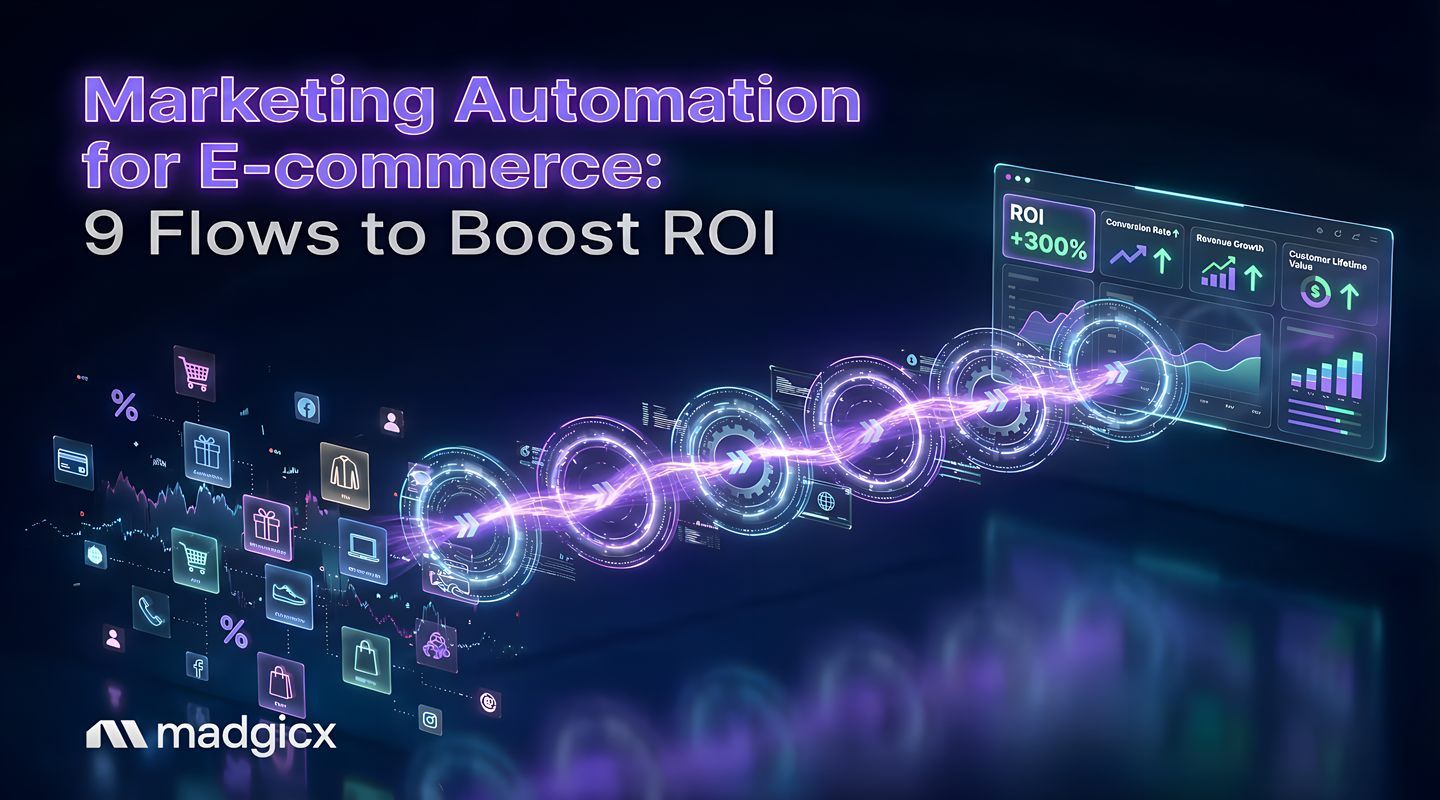
We're not just going to show you the essential flows that recover lost sales and boost lifetime value. We're going to show you how to connect them directly to your ad accounts to create a powerful, AI-powered revenue engine that works for you 24/7.
In simple terms, ecommerce marketing automation uses software to execute marketing tasks based on customer actions. Instead of manually sending emails or reminders, you create predefined 'flows' that trigger automatically when a customer signs up, abandons a cart, or makes a purchase. This delivers personalized, timely messages at scale, moving them from one stage of their journey to the next.
It means less manual work for you on channels you own (like email and SMS) and more intelligent spending on the channel that brings everyone to your door in the first place: paid advertising. A solid marketing automation strategy is the backbone of any scaling e-commerce brand.
Still on the fence? Let's look at the numbers, because this isn't just about saving time; it's about making a serious amount of money. 💰 The benefits of marketing automation are pretty staggering.
The data is crystal clear: automation isn't a "nice-to-have." It's the highest-leverage activity you can focus on to grow your store.
Okay, theory time is over. Let's get into the practical, money-making flows. We've broken them down into three phases so you know exactly where to start without getting overwhelmed.
This is the undisputed king of automation and your #1 priority. Someone liked your product enough to add it to their cart. Don't let them just walk away!
Pro Tip: For your Abandoned Cart flow, timing is everything. Send the first email 1-2 hours after abandonment. This is the sweet spot—fast enough to be relevant, but not so fast that it feels creepy. You're catching them while the purchase is still top-of-mind.
Think of your welcome series as your digital handshake. It's your first impression and your best chance to turn a curious subscriber into a loyal fan. Don't just send one email and call it a day.
Standard Flow: A 3-5 part email series for new subscribers.
Paid Ads Power-Up: Create an audience of "new subscribers who have not purchased." For the first 7-10 days after they sign up, show them ads that reinforce your welcome series messages. Show them your brand story video, UGC ads with top reviews, and carousels of your best-sellers. You're creating an immersive, multi-channel first impression.
You made the sale! High-five! But the journey isn't over. This is your golden opportunity to create a repeat customer and boost your lifetime value (LTV).
Standard Flow:
Paid Ads Power-Up: Segment your customers. Create an audience of "First-Time Buyers." After 30 days, start showing them ads for complementary products. Did they buy a coffee maker? Show them ads for your premium coffee beans. Madgicx can help you build these audiences directly from your data, making your e-commerce marketing automation feel far more connected. By analyzing historical conversion and revenue data, Madgicx refines audiences around buyer behavior and highlights high-value segments that consistently outperform.
Meet the abandoned cart flow's shy cousin. A shopper viewed a product page multiple times but never added it to their cart. They're interested, just not totally convinced yet.
Ever heard that it's cheaper to reactivate an old customer than to find a new one? It's true. This flow targets customers who haven't purchased in a while (think 90-180 days).
Standard Flow: A 2-3 email sequence.
Paid Ads Power-Up: Create a dedicated Meta ad campaign. The ad copy should be direct: "It's been a while! Here's 20% off to welcome you back." You're hitting them on email and their social feeds, doubling your chances of reactivation.
These are simple, powerful, and purely transactional automations that customers actually love because they're so helpful.
It's time to roll out the red carpet. Reward your best customers, and they'll reward you back with loyalty and word-of-mouth marketing. This flow is for your top 5-10% of spenders or most frequent buyers.
This is a no-brainer for any brand selling consumable products (like skincare, supplements, coffee, or pet food).
This is all about working smarter, not harder, by increasing the Average Order Value (AOV) of your existing customers.
Feeling inspired? Good. Now, let's turn that inspiration into action. Don't panic—you don't have to do it all at once. Here's a simple 5-step framework to get this all up and running in less than a week.
Step 1: Get Your Tech Talking. This is the non-negotiable first step. Integrate your e-commerce platform (like Shopify) with your email/SMS tool (like Klaviyo). Then, connect both to a paid media automation platform like Madgicx. This helps improve your tracking foundation and ensures all your tools are sharing data.
Step 2: Launch Your 3 Core Flows. Don't try to boil the ocean. Start with the heavy hitters from our roadmap: Abandoned Cart, Welcome Series, and Post-Purchase. Most tools have pre-built templates, so you can get these live in a single afternoon. Seriously.
Step 3: Add Your Secondary Flows. Once your core flows are running smoothly and bringing in revenue (give it a week or two), move on to Phase 2. Launch your Browse Abandonment, Win-Back, and Price Drop/Back-in-Stock automations.
Step 4: Layer on Smart Segmentation. Now you can get fancy. Move beyond basic triggers and start segmenting your audience by purchase history (RFM analysis), engagement level, and predicted lifetime value. This makes your messaging even more personal and effective.
Step 5: Fine-Tune and Scale with Ads. A/B test your email subject lines. Tweak your SMS offers. Most importantly, use the powerful new segments you've built to create high-intent retargeting campaigns and powerful lookalike audiences in Madgicx. This is how you close the loop and really scale.
Your tech stack doesn't need to be complicated or cost a fortune, especially if you're a small business using marketing automation software. For most stores, it boils down to three key components:
Pro Tip: The magic is in the integration. Your tools must talk to each other. Madgicx connects directly with Shopify to pull product and customer data, allowing you to build ad campaigns based on the exact same segments you use for email. This unified approach is a game-changer. In fact, data from Thunderbit shows that omnichannel marketing automation can produce 250% higher customer engagement rates than single-channel efforts.
Think of it this way: marketing automation is the big umbrella, and ecommerce automation is a specialized tool inside that toolbox. It focuses specifically on the triggers unique to online stores, like cart abandonment, purchase history, and browsing behavior. General marketing automation might also be for a B2B or SaaS company.
The best tools are the ones that play nicely with your e-commerce platform (like Shopify). Klaviyo and Omnisend are incredibly popular and effective for email/SMS. Madgicx specializes in the crucial next step: integrating paid ad automation into your strategy to create a truly unified system.
Absolutely, 100%. With stats showing that a tiny fraction of automated messages can drive over a third of your email revenue, it's one of the highest-ROI activities a small business can do. It saves you countless hours and generates sales you would otherwise miss. The ROI of marketing automation is undeniable.
Start simple! Choose an integrated toolset, connect your store, and launch the 3 core flows: Welcome, Abandoned Cart, and Post-Purchase. Use pre-built templates to make it easy and follow the marketing automation best practices to ensure you're set up for success.
It creates a multi-channel safety net. By automatically triggering a timed sequence of reminders across email, SMS, and retargeting ads, you catch shoppers' attention wherever they are. This allows you to bring a significant percentage of those high-intent, would-be-lost customers back to your site to complete their purchase.
Let's be real: implementing marketing automation is no longer optional for growing e-commerce brands. It's the price of admission. By starting with the 3 core flows—Welcome, Abandoned Cart, and Post-Purchase—you can immediately start recovering lost revenue, saving time, and increasing the lifetime value of every customer you acquire.
But the real competitive edge today comes from taking that next step. It's about connecting those powerful email and SMS flows to your paid advertising.
When you use a platform like Madgicx, you turn your rich customer data into an automated ad engine that works around the clock to help optimize your campaigns. Stop leaving money on the table. Stop spending your days on manual tasks that a machine can do better. It's time to build your automation machine and watch your revenue grow. You've got this.
Madgicx unifies your marketing intelligence, providing deep ad automation for Meta and performance insights across Google and TikTok. Get instant diagnostics with AI Chat and let AI Marketer provide 24/7 optimization recommendations for your ad accounts.
.avif)
Digital copywriter with a passion for sculpting words that resonate in a digital age.