Think Your Ad Strategy Still Works in 2023?
Get the most comprehensive guide to building the exact workflow we use to drive kickass ROAS for our customers.


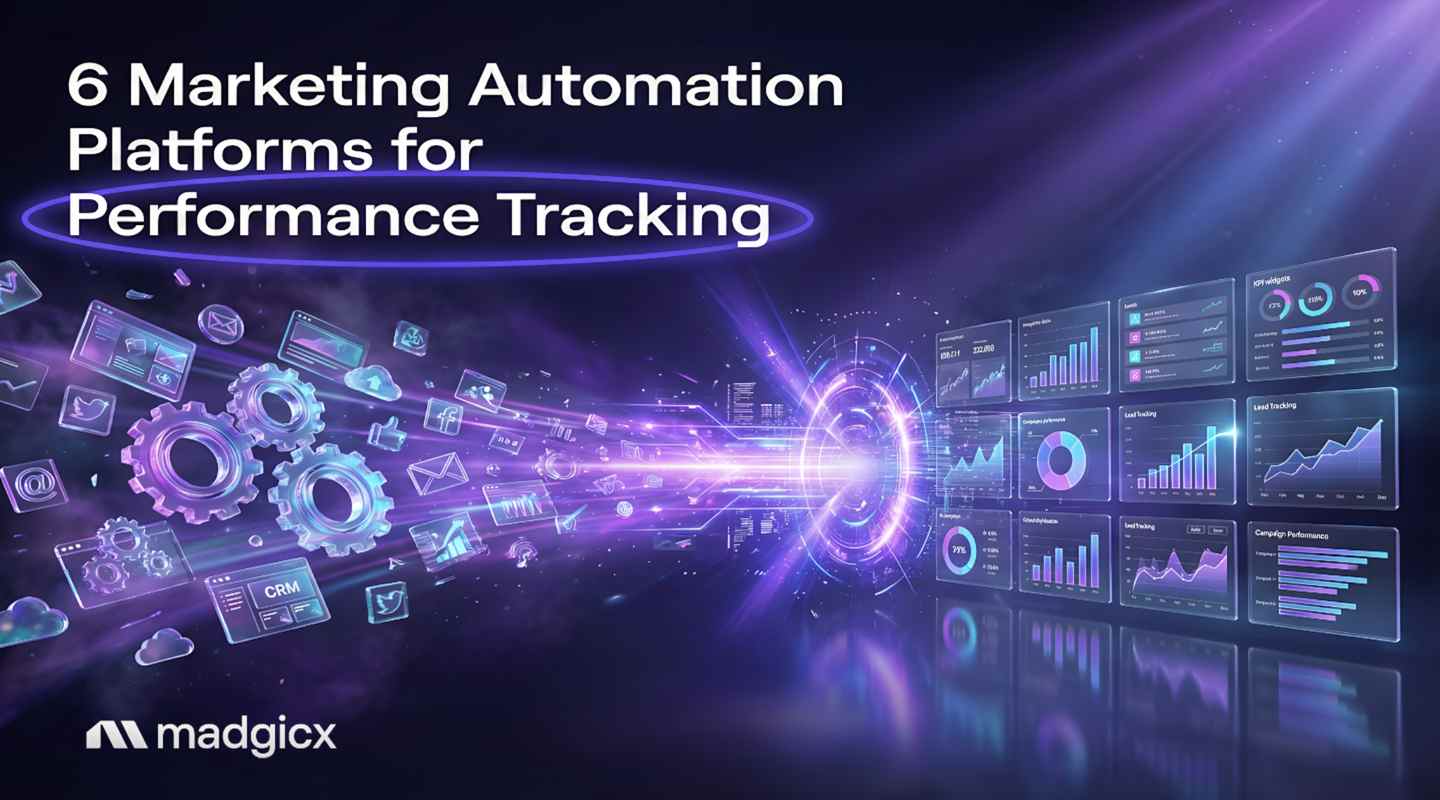
Drowning in data from your ad campaigns? If you're looking for the right marketing automation platform for performance tracking, you know the challenge. You have Google Analytics, ad managers, and third-party trackers all telling slightly different stories, making it impossible to know which campaign actually drove that last sale.
We've all been there. You know your attribution is shaky—industry benchmarks suggest that poor attribution can lead to 20-30% of ad spend being wasted. But the bigger, more frustrating problem is what we call "Action Paralysis." It's that feeling you get staring at all this performance data, but you're still the one manually pausing underperforming ads at 11 PM, tweaking budgets over your morning coffee, and trying to guess which audience to scale.
A marketing automation platform for performance tracking isn't just another dashboard. It's a tool that automatically pulls in your campaign data and then uses that data to help you optimize your ad spend in real-time. Most articles on this topic get it wrong, lumping these tools in with CRM automation. For a performance marketer, they're worlds apart.
This guide cuts through the noise and shows you the tools that don't just report on performance—they help you automate it.
Let's cut to the chase. The market is split into two camps: tools that act and tools that just report.
To make it simple, we've created an "Actionability Score" to show you how well each platform turns data into automated action. A high score means it helps you get things done; a low score means it just gives you more homework.
This is the most important part of the article. A deep understanding of marketing automation and this key difference will save you thousands of dollars and hundreds of hours.
These are the tools that actually do something with your data. They don't just track clicks and conversions; they use that data to recommend and execute actions inside your ad accounts.
Think of them as your AI co-pilot. They connect to your ad platforms (like Meta), analyze performance in real-time, and then run pre-set or AI-driven rules. This means suggesting which bad ads to pause, which good ones to scale, and how to reallocate your budget—often while you sleep.
They answer the question: "Okay, so what should I do with this data?" by helping you take action on it.
These tools are fantastic for what they do: tracking user journeys, building email lists, and managing customer relationships. They are the data-gatherers and the communicators.
However, when it comes to ad performance, they stop at the report. They'll show you a beautiful dashboard with your ROAS and CPA, but they leave all the optimization work entirely up to you.
They hand you a map but expect you to drive the car, make all the turns, and fill up the gas. They answer the question, "How did my ads do?" but offer no automated help to make them do better. For a performance marketer, a passive tool just creates more homework.
If you're here to reduce manual work and improve results, this is the list you care about. These are the platforms designed to take action.
Positioning: Madgicx is a comprehensive platform that combines server-side tracking with an AI-powered optimization engine to close the loop from data to action.
Best For: E-commerce brands, performance marketers, and agencies who want to move from manual analysis to AI-assisted optimization, making it a top choice for ecommerce marketing automation.
Key Features:
Pros: It's a true all-in-one solution that combines tracking, analysis, and execution. The AI-first approach is designed to save you countless hours, and the price point offers massive value.
Cons: The deepest integration and automation capabilities are focused on Meta (Facebook & Instagram), which is where most performance marketers live and breathe anyway.
Pricing: Plans start at $99/month - free trial available. See how Madgicx works for your business.
Positioning: A powerful tracker, super popular with affiliate marketers for handling complex campaigns with multiple traffic sources and offers.
Best For: Super-affiliates and performance marketers who live and die by tracking granular data points across a wide array of non-standard traffic sources.
Key Features: Voluum offers incredibly detailed reporting, A/B testing for landing pages, and rule-based traffic distribution. It's built to tell you exactly which banner, on which site, from which geo, led to a conversion.
Pros: The granularity of its tracking is top-notch. If you can put a tracking link on it, Voluum can probably track it.
Cons: It's a dashboard, not an engine. It tells you what's working with surgical precision, but it has no native integration to automatically pause the losing ad on Facebook or scale the winner on TikTok. You still have to do all the work yourself.
Pricing: Starts at $149/mo.
Positioning: A strong Voluum competitor that has carved out a niche with media buyers and agencies looking for solid multi-touch attribution.
Best For: Agencies and in-house media buyers running campaigns across multiple channels (e.g., Meta, Google, Taboola, Outbrain) and needing one unified view of attribution.
Key Features: RedTrack focuses on connecting the dots across a user's journey, offering attribution modeling and cookieless tracking solutions. It helps you see how different channels contribute to a final conversion.
Pros: Great for cross-channel attribution and provides a clean, consolidated dashboard for reporting.
Cons: Same problem as Voluum. It's a fantastic reporting tool, but it doesn't close the optimization loop. You get the data, but you're on your own to implement changes in each ad platform.
Pricing: Starts at $149/mo.
Positioning: An excellent tool for one specific job: getting more accurate conversion data from your e-commerce store back into your ad platforms.
Best For: Shopify store owners who are frustrated with the data mismatch between their store's backend and what Facebook Ads Manager is reporting.
Key Features: AnyTrack uses a combination of client-side and server-side tracking to capture events and sync them with platforms like Facebook (CAPI) and Google Analytics. It's designed to be a plug-and-play data pipeline.
Pros: Strong e-commerce integrations and a clear focus on solving the attribution problem for store owners.
Cons: It's a data pipeline, not an optimization tool. It sends better fuel (data) to your car's engine (Meta's algorithm), but it doesn't have a driver (an automation engine) to steer the car. You're still responsible for all campaign management decisions.
Pricing: Starts at $50/mo.
To give you a complete picture, we have to mention the giants in the "passive" category. These are powerful platforms, but they simply aren't built for real-time ad optimization.
Positioning: A leader in inbound marketing and CRM. Its ad tools are built for reporting on how ads influence the customer journey, not for granular, real-time campaign optimization. It tells you a lead came from a Facebook ad; it doesn't help you optimize that ad's budget.
Positioning: A powerful tool for email sequences and lead scoring, often featured in lists of marketing automation software for small business. Like HubSpot, its connection to paid advertising is purely for reporting and audience syncing, not for performance automation.
Feeling overwhelmed? Don't be. With the marketing automation market projected to reach $81.01 billion by 2030, it's clear this is a critical decision.
Here's how to decide:
Pro Tip: The ROI of an active platform isn't just in better ad performance; it's in getting your time back. Calculate the value of your "Actionability Gap" to see the true potential savings.
A good platform is one that not only tracks performance but also helps you automate optimizations based on that data. It should close the loop between insight and action. For performance marketers who live and die by their results, an active optimization platform like Madgicx is built for exactly that.
You track it with the same core KPIs you always have: ROAS, CPA, and Conversion Rate. The difference is, a great automation platform doesn't just show you these metrics—it uses them as triggers to make smart decisions, constantly working to improve those very KPIs for you.
For ad performance automation, the only KPIs that really matter are the ones tied to your bottom line: Return on Ad Spend (ROAS), Cost Per Acquisition (CPA), and ultimately, Customer Lifetime Value (LTV). Your platform should help you optimize for these goals, not just display them on a pretty dashboard.
Honestly? Not entirely. Since iOS14, native platform attribution has become increasingly unreliable. Relying on it alone is like driving with a foggy windshield.
The marketing automation landscape is noisy, but it all boils down to one simple question: do you want a tool that gives you more homework, or one that helps you get it done?
Passive trackers and CRM tools are great, but they give you data that requires your action. They add to your to-do list.
Active optimization platforms like Madgicx are designed to deliver results. By connecting improved tracking directly to an AI optimization engine, you can finally close the loop and move from endless analysis to streamlined automation.
Your next step is to stop manually tweaking campaigns, adopt marketing automation best practices, and let an AI co-pilot take the wheel.
Tired of switching between tracking reports and your ad manager to make decisions? The best platforms connect the dots by using AI to instantly diagnose performance issues and help you optimize campaigns 24/7 based on real-time data. It's time to stop just tracking and start automating.
.avif)
Digital copywriter with a passion for sculpting words that resonate in a digital age.