We’ve all been there. You're on that end-of-month client call, walking them through the paid media results. You're feeling good, the numbers are solid, and then it happens.
The client leans into their webcam and asks, "But how do we <em>know</em> this is the best we can do? My cousin's friend runs a Shopify store, and she said we should use green buttons."
And just like that, the HiPPO (Highest Paid Person's Opinion) rears its ugly head.
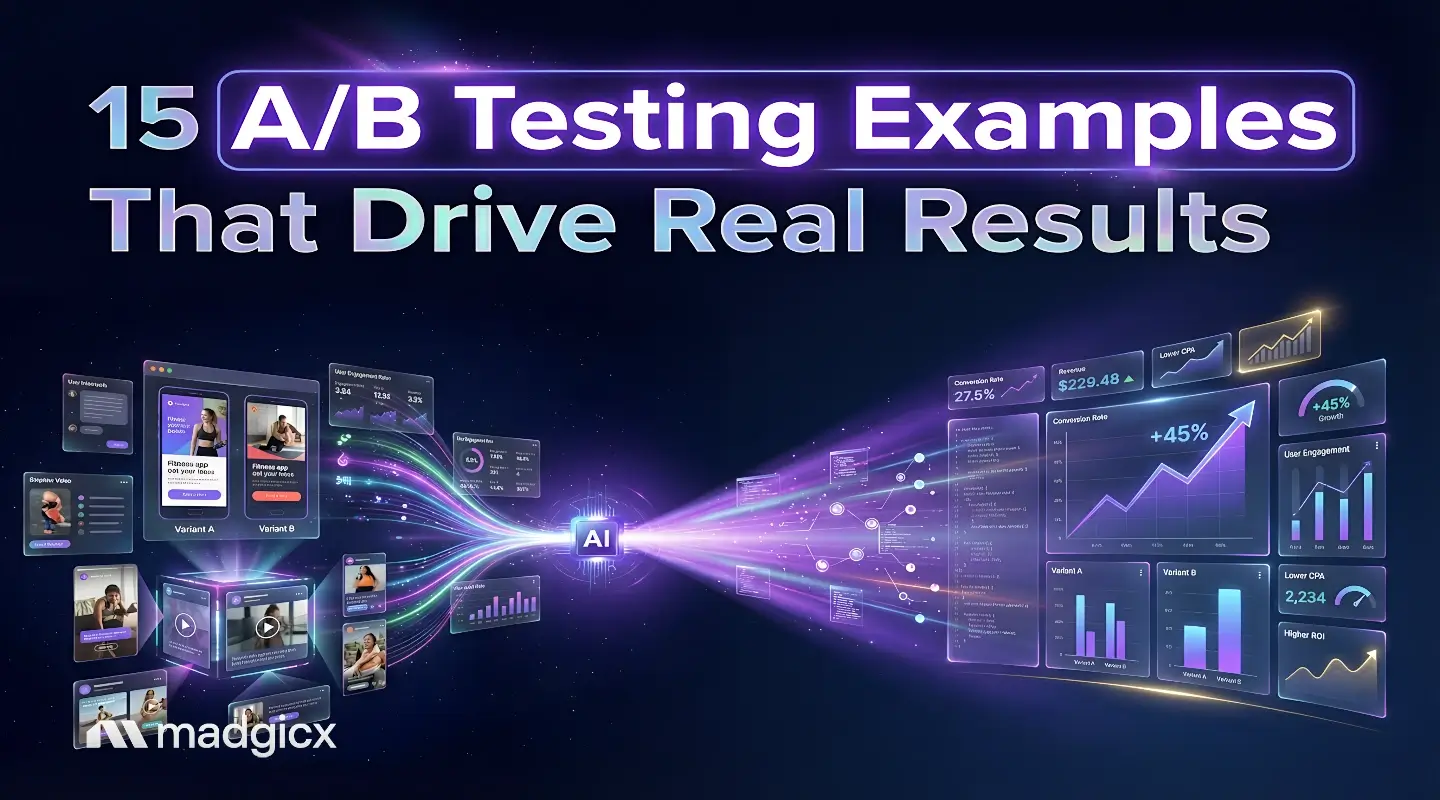
Moving your clients from opinion-based marketing to data-driven decision-making is the absolute core of a successful agency relationship. Your most powerful weapon in this fight is A/B testing. To help you move from opinion to data, we've compiled 15 powerful A/B testing examples from real-world scenarios that you can apply today.
Also known as split testing, A/B testing is a simple, controlled experiment where you compare two or more versions of something—an ad, a landing page, an email—to see which one performs better. It’s how you turn "I think" into "I know." It's so fundamental that a staggering 77% of companies now use A/B testing to improve their conversions.
This guide isn't just another list of random ideas. It's your agency-focused playbook for running tests that drive real results, build unshakable client trust, and make your entire team smarter.
What You'll Learn in This Playbook
In this playbook, we’re arming you with everything you need to build a killer experimentation program for your clients. We'll cover:
- How to prioritize tests across your entire client portfolio for maximum impact.
- High-impact test examples for both e-commerce and B2B.
- A proven playbook for getting meaningful results on those tricky low-traffic client accounts.
- How to frame and report your test results to build trust and secure more budget.
Before You Test: The Agency's Prioritization Framework
As an agency, your time is your most valuable asset. You can't afford to run "shadow tests"—those little experiments on things that ultimately don't matter. To avoid this trap, you need a simple, repeatable prioritization framework. We love the ICE score. It’s easy to explain to clients and keeps everyone focused on what truly matters.
- Impact: How much will this move the needle on the client's main KPI? (A checkout page test has a much higher potential impact than an "About Us" page test).
- Confidence: How certain are you that this change will produce a lift, based on past data, case studies, or your own expertise?
- Ease: How many hours will this take your team (or the client's dev team) to implement? A simple headline change is a 10/10 for ease; a full checkout redesign is a 2/10.
Pro Tip: Create a shared spreadsheet with your client to score and rank test ideas together. This creates immediate buy-in, manages expectations, and stops those "hey, can we just test this real quick?" emails in their tracks.
High-Impact E-commerce A/B Testing Examples
For e-commerce clients, small improvements can lead to massive revenue gains. Here are some high-impact A/B testing examples you can roll out for your D2C clients tomorrow.
Example 1: The Sticky Add-to-Cart Button (Mobile)
- The Test: On mobile product pages, test a standard, static "Add to Cart" button against a version that "sticks" to the top or bottom of the screen as the user scrolls.
- The Result: This is one of the most reliable tests. It typically delivers an 18-32% conversion lift. Why? It removes friction and keeps the most important call-to-action ever-present.
- The Agency Takeaway: This is a perfect "first test" for a new e-commerce client. It’s relatively easy to implement and has a high probability of delivering a quick, demonstrable win that builds instant credibility.
Example 2: The Simplified Checkout Flow
- The Test: Pit your client's standard multi-page checkout against a streamlined one-page or accordion-style checkout.
- The Result: Simplifying the path to purchase almost always leads to better performance. A simplified flow can reduce checkout abandonment by 15-28%. Fewer clicks, fewer fields, and less thinking lead to more revenue.
- The Agency Takeaway: This is a higher-effort test with a massive impact. Use it to show a client you’re thinking strategically about their entire funnel, not just driving top-of-funnel clicks.
Example 3: The Urgency Signal Test
- The Test: On product and collection pages, test adding (or removing) social proof and scarcity signals. Think "Only 3 left in stock!" or showing "Sold Out" items to create a sense of high demand.
- The Result: Booking.com became famous for mastering this. These psychological triggers tap into FOMO (Fear Of Missing Out) and can significantly increase the perceived value and urgency of a purchase.
- The Agency Takeaway: This is a great test for clients in fast-fashion or electronics. It proves you understand conversion psychology, not just ad metrics.
Example 4: The SMS Frequency Test
- The Test: During a major promotion (like Black Friday), test sending a higher frequency of SMS messages to your client's subscriber list.
- The Result: Men's jewelry brand JAXXON did exactly this and saw a 249% increase in ROI from their SMS campaigns. They proved that during peak buying season, more relevant touchpoints can equal more revenue.
- The Agency Takeaway: This shows your clients you’re thinking cross-channel and positions you as a holistic growth partner.
Powerful Lead Gen & SaaS A/B Testing Examples
For B2B clients, the game is about landing quality leads. These tests are designed to improve MQLs and drive bottom-line results.
Example 5: The "Benefit vs. Obligation" CTA
- The Test: On a free trial landing page, test a CTA that frames the action as an obligation (e.g., "Start Free Trial") versus one that frames it as a benefit (e.g., "Get Premium Access").
- The Result: The travel deals platform Going ran this exact test and saw a 104% increase in trial starts. It reframed the offer from a commitment to a reward.
- The Agency Takeaway: Words matter. This test is a brilliant way to show your B2B clients that your expertise extends to conversion copywriting and user psychology.
Example 6: The Dynamic Text Alignment
- The Test: Ensure the headline on your landing page perfectly matches the ad copy the user clicked. Test a generic landing page headline against a dynamically aligned one.
- The Result: This is all about maintaining "scent." When the user's journey feels seamless, trust increases. Campaign Monitor implemented this and saw a 31.4% lift in conversions.
- The Agency Takeaway: This is a must-do for any agency running paid search or social campaigns. It shows you’re sweating the details and optimizing the entire user journey.
Example 7: The "Value-Based" Pricing Presentation
- The Test: On the pricing page, test different ways of framing the value. For example, test showing a discount as a percentage ("30% Off") versus a concrete dollar amount ("Save $50").
- The Result: The "Rule of 100" suggests that for products over $100, a dollar amount discount feels more substantial. Testing this framing can lead to significant lifts.
- The Agency Takeaway: This demonstrates advanced strategic thinking. You’re not just testing buttons; you’re testing perceived value.
The Low-Traffic Client Playbook: A/B Testing Examples for Small Sites
How can you run a test for a client who only gets 1,000 visitors a month? Waiting for 95% statistical significance isn't an option. The answer is to change the rules of the game.
- Go for Big Swings: Forget button colors. Test the core value proposition, the entire hero section, or the page layout. These changes produce larger effects that are easier to detect with less data.
- Embrace Directional Confidence: Aim for 80-90% confidence to maintain velocity. Frame it to the client as "strong evidence" rather than "absolute proof."
- Supplement with Qualitative Data: Use marketing tools like heatmaps or session recordings to add context. A "losing" variant with high engagement is still a valuable learning.
Example 8: The Homepage Hero Overhaul
- The Test: Don't just change the headline. Test two completely different hero sections. Version A might feature a product-focused hero with a "Shop Now" CTA. Version B could be a lifestyle-focused hero with a "Discover Our Story" CTA.
- The Result: This "big swing" uncovers fundamental insights about audience motivation with limited traffic.
- The Agency Takeaway: This can uncover fundamental insights about what motivates your client's audience, providing strategic direction for months.
Example 9: The Pricing Page Anchor Test
- The Test: On a SaaS pricing page, test showing a very high-priced "Enterprise" plan next to the main self-serve plans.
- The Result: This is a classic example of price anchoring. The high price of the enterprise plan makes the other plans seem far more affordable, often increasing conversions on mid-tier plans.
- The Agency Takeaway: This is a sophisticated psychological test that requires minimal traffic to be effective in principle. It’s a perfect high-impact, low-data experiment.
Beyond the Landing Page: Testing Ads & Emails
The real magic happens when you treat the entire funnel as one big testing ground.
Example 10 (Paid Social): Creative Concept Testing
- The Test: Instead of minor variations, pit two fundamentally different ad concepts against each other. For example, a raw UGC testimonial video vs. a polished studio ad. Use Madgicx’s AI Ad Generator to quickly create distinct visual versions for each concept, so you can launch both angles side by side and let performance data reveal which direction truly resonates.
- The Result: This quickly identifies the creative direction that resonates most, improving ROAS and engagement.
- The Agency Takeaway: This helps you quickly identify the creative direction that resonates most. Use Madgicx's AI Chat to get quick diagnostics on ROAS, CPA, and CTR, helping you make faster decisions as part of your Creative Concept Testing strategy.
Try Madgicx’s AI tools for free.
Example 11 (Paid Search): RSA Pinning Strategy
- The Test: In Google's Responsive Search Ads (RSAs), test pinning a specific, high-intent headline (like your brand name) in position 1 versus letting Google's algorithm choose freely.
- The Result: Pinning high-intent elements often boosts relevance and click-through rates in competitive auctions.
- The Agency Takeaway: This shows you’re an expert in the nuances of each ad platform, not just a "set it and forget it" manager.
Example 12 (Email): The Personalized Subject Line
- The Test: A classic for a reason. Test a subject line with [First Name] personalization against a generic one.
- The Result: Simple personalization can increase open rates by 26%. Marketers who consistently test subject lines can see open rates up to 49% higher.
- The Agency Takeaway: This is an easy win that reinforces the value of the data your client is collecting.
Example 13 (Email): The "From Name" Test
- The Test: Test sending an email from your client's "BrandName" versus a more personal "Sarah from BrandName."
- The Result: Personal from names build trust and curiosity, often lifting open rates by 10-20% in tests.
- The Agency Takeaway: This subtle test can have a big impact on open rates by influencing trust and curiosity, showing you’re thinking about the human-to-human connection.
Reporting That Sells: How to Present Test Results
Running the test is half the battle. How you present the results is what separates good agencies from great ones. A simple, clear report structure tells a story:
- The Hypothesis: "We believed that simplifying the checkout would reduce friction and increase conversions."
- The Variants: Show clear screenshots of the original (Control) and the new version (Variant).
- The Results: Display the primary KPI (e.g., Conversion Rate), the lift, and the confidence level.
- The Learning & Next Step: Explain what you learned and what you'll do next.
Example 14: Framing a "Win"
Don't just say "Conversion rate increased by 15%." Translate that into business impact.
"This 15% lift in conversion rate is projected to generate an additional $75,000 in annualized revenue. Our next step is to roll this winner out to 100% of traffic."
Example 15: Framing a "Loss" or "Inconclusive" Test
Never call it a failure. Call it a learning.
"Our hypothesis that users wanted more product details wasn't validated. This is an incredibly valuable learning, as it saves us from investing in the wrong area. The data now suggests the primary friction point is in shipping, so our next test will focus there."
Pro Tip: Use a tool like Madgicx's One-Click Report to pull cross-channel data into a single dashboard. This makes it simple to show clients how a landing page test directly impacted the ROAS of your ad campaigns.
Frequently Asked Questions (FAQ)
How long should we run a test for a small client?
Always run tests for a full business cycle (at least 7 days). For low-traffic clients, you may need 2-4 weeks. The key is to focus on big changes that produce a larger signal and be comfortable accepting lower confidence levels (like 80-85%) to maintain momentum.
What's a good A/B testing tool for an agency?
For agencies managing multiple ad accounts, a platform like Madgicx is ideal as it integrates ad optimization and cross-channel reporting. For pure on-site testing, tools like VWO or Convert.com are strong options.
How do I handle a client who wants to test everything?
Lean on the ICE prioritization framework. Politely guide the conversation back to impact. Explain that your team's time is best spent on tests with the highest potential to affect their bottom line, not on minor changes that won't move the needle.
What if a test that won on desktop fails on mobile?
This is common. You should always analyze results by device and, ideally, run separate experiments for desktop and mobile. User context and behavior are completely different, so a win on one device doesn't guarantee a win on the other.
Conclusion: Build an Experimentation Engine
A/B testing isn't about finding the one perfect button color. It's about building a systematic engine for learning what your clients' customers truly want.
By prioritizing high-impact ideas, getting creative with low-traffic accounts, and reporting on learnings (not just wins), you transform your agency from a service provider into an indispensable growth partner.
The next time a client comes to you with an "idea," you'll have the framework to turn their opinion into a data-driven test that delivers real, measurable value.
See how Madgicx can help you build that engine.


.avif)