A  Dynamic Creative Optimization Guide for Agencies

Category
AI Marketing
Date
Feb 5, 2026
Feb 5, 2026
Reading time
11 min
On this page
dynamic creative optimization

Master Dynamic Creative Optimization (DCO) to scale your agency and boost client ROAS. Learn our proven, step-by-step workflow for launching DCO campaigns.

Picture this: It’s Monday morning. You’re juggling 15 client accounts, and your inbox is already overflowing. Client A wants fresh creative by EOD. Client B is asking why their ROAS dipped over the weekend. Client C just sent a Slack message with a single, terrifying question mark.

You’re stuck on a creative treadmill, and your team is stretched so thin you can practically see through them. Sound familiar?

We get it. The core challenge for any growing agency is delivering hyper-personalized ads at scale without burning out your team. How can you possibly create unique, relevant ads for every single audience segment for every single client? It feels impossible.

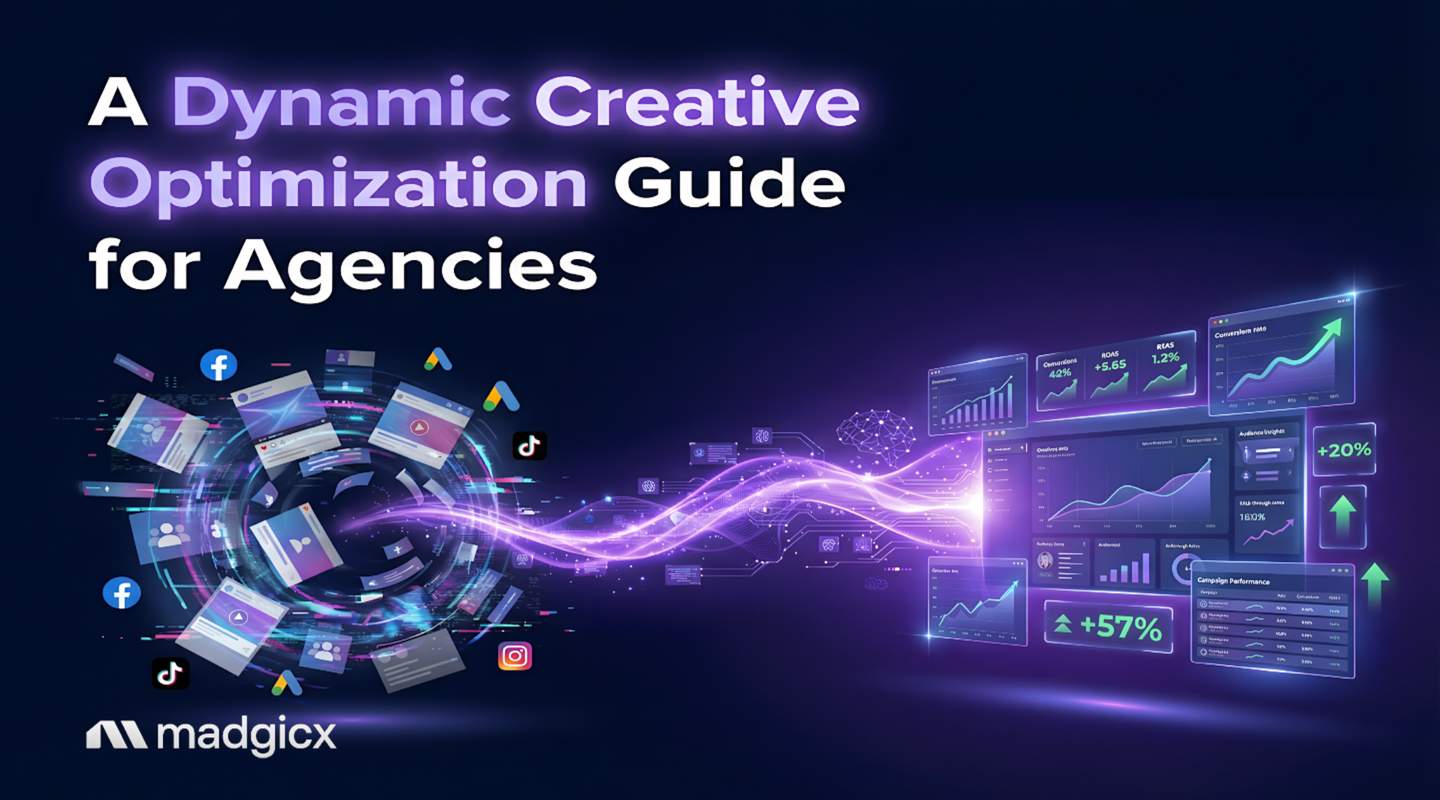
But what if it wasn't? Top agencies are using a strategic approach called Dynamic Creative Optimization (DCO). Think of it as an AI-powered system that acts like a super-fast creative director, automatically building and testing thousands of personalized ad variations in real-time. It takes all your best assets and finds the winning combo for each person who sees your ad, boosting client ROAS and making you look like a hero.

We wrote this playbook to help you implement DCO across your client roster, finally break free from the creative treadmill, and scale your agency the smart way.

What is Dynamic Creative Optimization (DCO)?

Dynamic Creative Optimization (DCO) is an advertising technology that automates the creation of personalized ads. It takes individual creative assets—like images, headlines, and calls-to-action—and combines them in real-time to find the highest-performing variation for each specific user.

For an agency, DCO isn't just another three-letter acronym; it's a fundamental shift in how you operate and a competitive advantage you can offer clients. It's a game-changer.

This isn't just about saving time; it's about future-proofing your agency. The DCO market is projected to grow to $2.26B by 2034, and a recent survey found that a staggering 99% of agencies consider DCO a significant part of their strategy. If you're not offering it, you risk being left behind.

And for those clients on long-term retainers? DCO is your secret weapon against creative fatigue. Instead of running the same three ads into the ground, you’re constantly serving fresh, relevant combinations, keeping audiences engaged and performance strong.

How DCO Works: A Workflow for Agencies

So, how does this all actually work? It’s not as complicated as it sounds, especially when you break it down into a simple workflow you can replicate across all your client accounts. Here’s the process you can use to train your team:

  1. Data Ingestion: This is the foundation. You connect all relevant data sources, including the client’s product catalog, audience data (like CRM lists or pixel events), and contextual signals (like location or device). The more data you feed the system, the smarter its decisions become.
  2. Creative Assembly: Here’s where your team’s strategy shines. You upload all the individual creative components: different headlines, various images or videos, and multiple call-to-action options. If you need inspiration, our guide to generating fresh ad ideas can be a huge help. Then, you define the creative "rules" or templates—for example, a specific headline only appears with a certain product category.
  3. Real-Time Optimization: This is where the AI magic happens. When a user is about to be served an ad, the DCO algorithm analyzes their data profile and assembles an ad variation likely to resonate. It’s like having a hyper-efficient testing machine running for every single impression.
  4. Performance Analysis: The final, crucial step. A good DCO platform breaks down performance by each individual element. You can see which headline drives the most clicks, which image resonates with a specific audience, and which CTA closes the deal. These insights are pure gold ✨ for optimizing current campaigns and informing future creative strategy.
Pro Tip: Create a visual flowchart of these four steps to onboard new team members and clients quickly! A simple diagram can make the entire process feel less intimidating and way more manageable.

The Core Benefits of DCO for Agencies and Clients

This is the part you can basically copy and paste for your next client proposal. The benefits of DCO are a win-win, designed to make your agency more profitable and your clients happier.

For Your Agency:

  • Scalability: DCO allows you to manage more clients without proportionally increasing your headcount. The tech automates tedious creative testing, freeing up your team to focus on high-level strategy and client relationships.
  • Efficiency: Say goodbye to manually creating dozens of ad variations for A/B testing. DCO automates the process, saving your team hundreds of hours and enabling faster campaign launches.
  • Profitability: By offering DCO as a premium service, you can increase retainer values. More importantly, by improving team utilization and efficiency, you can directly boost your agency's profit margins.

For Your Clients:

  • Improved Performance: Personalized ads simply perform better. By delivering more relevant creative, DCO is designed to improve key metrics like Click-Through Rate (CTR) and Return on Ad Spend (ROAS).
  • Personalization at Scale: Your clients can finally speak directly to their different customer segments. A new visitor might see a welcome discount, while a loyal customer sees a new product. This level of relevance builds a stronger brand connection.
  • Faster Learnings: Instead of waiting weeks for an A/B test to conclude, DCO provides rapid insights into what’s working. You can quickly identify winning ad creative elements and double down on them, accelerating campaign performance.

How to Set Up & Manage DCO Campaigns

Ready to roll up your sleeves? Here’s a step-by-step agency workflow for launching DCO campaigns that get results.

  1. Client & Goal Alignment: Before you touch Ads Manager, get crystal clear on the client's KPIs. Are they focused on ROAS, CPA, or lead volume? This will dictate your entire optimization strategy.
  2. Asset & Data Feed Collection: Create a standardized client intake checklist for all creative assets: high-res images, videos in all aspect ratios, approved copy, and a clean product feed. Remember, garbage in, garbage out.
    Pro Tip: Use a shared cloud folder (like Google Drive) with a clear naming convention (e.g., ClientName_Campaign_Headline_01.txt) for every asset. This will save you hours of headaches.
  3. Define Your Creative Framework & Variables: Map out your testing plan. What are the key variables? For an e-commerce client, it might be Images (Product vs. Lifestyle), Headlines (Benefit vs. Scarcity), and CTAs ("Shop Now" vs. "Learn More").
  4. Choose Your Platform: Decide if Meta's native tool is enough or if you need the power of a third-party platform.
  5. Campaign Setup in Meta Ads Manager: When setting up your campaign, toggle on the 'Dynamic Creative' option at the ad set level. This is where you'll add all your different creative components.
  6. Launch & Monitor: Give the campaign enough time and budget to learn. We recommend a minimum learning period of 7-15 days before making big judgments.
  7. Analyze Element Performance: This is the most important step. In Ads Manager, use the "Breakdown" menu and select "By Dynamic Creative Asset." Here, you can see the performance of each individual headline, image, and description.
  8. Iterate & Scale Winners: Once you've identified a clear winning combination, pull it out and run it in its own dedicated ad set. This allows you to put more budget behind a proven winner while the DCO campaign continues to test.

DCO on Meta: Advantage+ vs. Third-Party Tools

This is a question we get all the time: "Can't I just use Meta's built-in tools?" The answer is yes, but it depends on your agency's goals and how serious you are about scaling.

When to use Advantage+ Creative:

Meta's native solution is a fantastic starting point. It's free, integrated into Ads Manager, and perfect for clients with smaller budgets or simpler campaign needs.

When to use a Third-Party Tool (like Madgicx):

As your client portfolio grows, managing Dynamic Creative campaigns inside Ads Manager alone quickly becomes limiting. This is where a platform like Madgicx adds serious value.

With Madgicx, agencies can:

  • Scale Creative Testing Faster: Use the AI Ad Generator to turn product images and proven ads into dozens of test-ready variations in minutes, making it easy to launch and iterate on dynamic-style creatives at scale.
  • Optimize Based on Real Performance Data: The AI Marketer continuously monitors your Meta campaigns, identifies creative fatigue and top performers, and recommends budget shifts to maximize ROAS.
  • Diagnose Results with AI-Powered Insights: AI Chat helps you understand why certain combinations work by answering performance questions in real time, so you can double down on winning creative patterns.

If you’re managing multiple clients, running high-volume testing, or actively scaling spend, third-party solutions like Madgicx become essential.

Try Madgicx’s AI tools for free.

How to Report on DCO Performance to Keep Clients Happy

Here’s where you truly separate your agency from the pack. DCO gives you a treasure trove of data to prove your value and guide your client's entire marketing strategy. Instead of just sending a spreadsheet, your DCO reports should tell a story.

Focus on these three areas:

  • Creative Element Performance: Show the client which headlines, images, and copy points are resonating. "Our tests showed that headlines mentioning 'Free Shipping' increased CTR by 25%. We recommend incorporating this on the website's product pages."
  • Audience Insights: Report on which creative combinations work best for different audiences. "We discovered that our prospecting audience in California responds best to lifestyle imagery, while the retargeting audience in New York converts better with direct product shots."
  • Test Learnings & Next Steps: Frame everything as a learning opportunity. "The test between video A and B was inconclusive, but we learned that hooks under 3 seconds hold attention better. Next month, we'll produce three new short-form video hooks."

This level of reporting positions you not just as a media buyer, but as an invaluable strategic partner. The problem? Compiling this kind of report can be a massive time-sink. This is exactly why we built the One-Click Report at Madgicx. You can pull all your DCO performance data from Meta, Google, and TikTok into a single, beautiful dashboard to share directly with clients.

Frequently Asked Questions (FAQ)

What's the difference between DCO and Meta's standard Dynamic Ads?

Great question! Dynamic Ads are primarily for retargeting—they pull from a product catalog to show people items they've already viewed. DCO is much broader. It can be used for both prospecting and retargeting and lets you test a wider range of creative components like headlines, primary text, and brand messaging.

How much budget do my clients need for DCO to be effective?

While there's no magic number, you need enough budget for the algorithm to gather data. As a general guideline, we tell agencies to aim for a minimum of $50-$100 per day for a DCO campaign. Anything less, and the learning phase may take too long to produce reliable results.

How do I explain the value of DCO to a skeptical client?

Focus on the "work smarter, not harder" angle. Frame it as a way to guarantee their ad spend is optimized. Instead of guessing which ad will work, you’re using a data-driven system to find high-performing combinations faster, which is designed to improve their return on ad spend.

Can DCO really replace a creative team?

Absolutely not. DCO empowers your creative team; it doesn't replace them. It automates the tedious, repetitive task of manual A/B testing. This frees up your strategists and designers to do what they do best: brainstorm high-level concepts, develop new angles, and produce the killer source assets that fuel the DCO engine.

Start Scaling Your Agency with DCO

Let's bring it all home. Dynamic Creative Optimization is no longer a "nice to have" for agencies; it's an essential part of your operational toolkit. It’s your key to driving better client results, boosting your team's efficiency, and building an agency that can scale profitably.

Here’s your next step: Review your top 3 clients. Identify where creative testing is the biggest bottleneck or where performance has gone stale. Propose a pilot DCO campaign as a way to inject new life and learnings into the account.

Kick things off with the free Madgicx trial.

Think Your Ad Strategy Still Works in 2023?
Get the most comprehensive guide to building the exact workflow we use to drive kickass ROAS for our customers.
Scale Your Agency with Smarter Creative Production

Madgicx helps you turn product images and winning ads into dozens of test-ready creative variations with the AI Ad Generator, so you can scale dynamic-style testing in minutes. The AI Marketer identifies fatigue and top performers, while AI Chat explains what’s driving results. Together, they make DCO faster and easier to manage across client accounts.

Create High-Performance Ads Faster
Category
AI Marketing
Date
Feb 5, 2026
Feb 5, 2026
Annette Nyembe

Digital copywriter with a passion for sculpting words that resonate in a digital age.

You scrolled so far. You want this. Trust us.