Think Your Ad Strategy Still Works in 2023?
Get the most comprehensive guide to building the exact workflow we use to drive kickass ROAS for our customers.


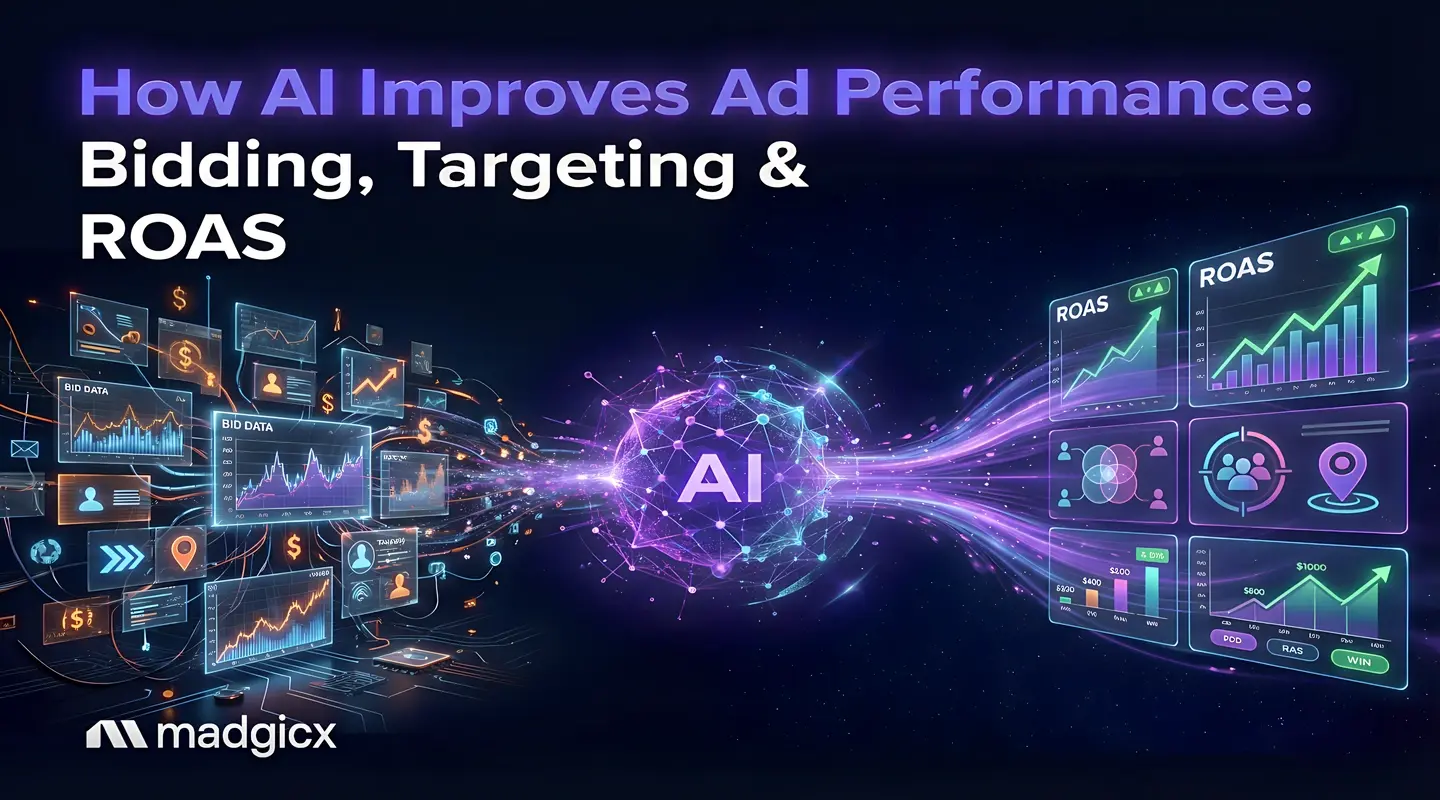
AI platforms help improve ad performance by using machine learning to analyze vast datasets and optimize key campaign elements. They streamline real-time bidding, identify high-value audiences through predictive analytics, dynamically test and assemble ad creatives, and allocate budgets to help maximize return on ad spend (ROAS) with reduced manual intervention.
If you've ever felt like you need an extra set of hands (and maybe a super-powered brain) just to keep up with your Facebook and Google ads, you're not alone. We get it.
In a world with disappearing cookies and ad platforms that get more complex by the day, trying to manually optimize everything is like trying to catch rain in a thimble. It's exhausting, and let's be honest, you're bound to miss more than a few drops.
This is where AI automation stops being a "nice-to-have" and becomes your most valuable player. We're going to pull back the curtain and show you exactly how AI works under the hood. We'll break down the core mechanisms, compare automation across platforms, and give you a simple workflow to manage it all without losing your mind.
Before we get into the nitty-gritty, let's clear something up. When we talk about AI in advertising, we're not talking about sentient robots plotting to take over your ad account (though on a bad Monday, it can definitely feel that way!).
In the context of paid ads, AI is a system designed to automate complex decisions at a scale and speed that no human could ever match. It sifts through mountains of data to find patterns, predict outcomes, and suggest adjustments to your campaigns in near real-time.
A core component of this is predictive analytics.
Predictive analytics in advertising is the use of data, statistical algorithms, and machine learning techniques to identify the likelihood of future outcomes based on historical data.
Essentially, it's about making a highly educated guess about which user is most likely to convert, which ad creative will perform best, and how much you should bid to win an auction profitably. It's your secret weapon for staying ahead.
It's no wonder that, according to a report from Bloomreach, 32% of marketers worldwide use AI with marketing automation for paid advertising. And that number is climbing faster than your CPA on a bad day.
So, how does this all actually work? It's not just magic. AI can improve your ad performance by becoming your tireless assistant in four critical areas of campaign management.
Think about this: every time your ad has a chance to be shown, it enters a lightning-fast auction. AI-powered bidding, often called Smart Bidding, analyzes hundreds of signals in milliseconds—things like device, time of day, location, and user behavior—to decide the optimal bid for that specific impression.
Smart Bidding is an automated bid strategy in platforms like Google Ads that uses machine learning to optimize for conversions or conversion value in every auction.
Instead of setting one flat bid and hoping for the best, you tell the machine your goal (e.g., a target cost per acquisition), and it does the heavy lifting. This is the engine behind Google's Target CPA/ROAS strategies and Meta's Advantage+ campaign budget, which fluidly shifts money to higher-performing ad sets so you don't have to—a key function of any modern ad tech platform for improving efficiency.
Long gone are the days of just targeting "women, 25-34, interested in yoga." AI goes so, so much deeper. By analyzing your existing customer data, AI can build incredibly powerful Lookalike Audiences.
Lookalike Audiences (or Similar Segments) are groups of users created by AI algorithms that share characteristics with an existing high-value audience, such as past purchasers or leads.
These aren't just simple copies. The AI identifies thousands of subtle shared attributes to find new customers you might never discover on your own. This is the core of AI-driven targeting optimization. Some advanced systems, like one noted by ContextSDK, even use over 180 mobile signals to instantly determine a user's activity. That's not just smart; it's borderline psychic.
Creative fatigue is real, and it's a silent killer of good campaigns. We've all been there—manually testing every combination of image, headline, and call-to-action is a one-way ticket to burnout. This is where Dynamic Creative Optimization (DCO) comes in to save the day.
Dynamic Creative Optimization (DCO) is a technology that automatically assembles personalized ad creatives by combining different components like images, headlines, and calls-to-action in real-time for individual users.
You feed the platform a library of assets—images, videos, headlines, descriptions—and the AI mixes and matches them to create a more relevant ad for each person. This is the tech behind Google's Responsive Ads and Meta's Dynamic Experiences, and it's a powerhouse for finding winning combinations at scale. Our guide on the Meta ad creative optimizer dives deeper into this.
Perhaps the biggest time-saver is AI's ability to act as your 24/7 campaign monitor. It constantly reviews performance, identifying underperforming ads that are burning cash and recommending budget reallocations to the ads that are actually making you money. 💰
This means you can move away from constantly babysitting your campaigns, checking them twice a day, and stressing out over every fluctuation. AI doesn't sleep. It doesn't take a lunch break. It doesn't forget to check your ads when you're stuck in a meeting. It's always on, always learning, and always looking for ways to improve your ad performance and ROAS.
Alright, we've talked theory. But does AI actually deliver in the real world? You bet.
According to recent studies, AI-driven advertising optimization has delivered impressive results, including a 32% reduction in cost per click (CPC) and a 38% boost in click-through rates (CTR).
A tech company using AI-driven Facebook campaigns saw a 37% increase in conversions, primarily because the platform identified high-value audience segments that the team never would have found manually. This is the power of AI working for you.
These improvements weren't just lucky breaks. They were systematic gains achieved by letting AI do what it does best—analyzing patterns at massive scale and optimizing decisions in real-time.
Not all AI is created equal. Each major ad platform has its own approach to automation. Here's a quick comparison.
The results from leveraging these tools really do speak for themselves. According to research from Seer Interactive, L'Oréal Vietnam used Performance Max to achieve a 4.1X higher ROAS, and in another case, ForRent.com saw a 26% increase in CTR after implementing Dynamic Search Ads. That's huge.
Over on Meta's side, the Universal Business Council reported that Meta's AI-powered ad tools helped improve conversion rates by over five percent in many campaigns. The proof is in the performance.
Okay, so you're sold on AI. But how do you actually manage it? The goal isn't to "set it and forget it." The goal is to become a strategic partner to the AI. Here's a simple workflow we use to get it right.
AI is powerful, but it's not a mind reader. You need to give it the right ingredients. This means setting clear campaign goals (a specific CPA or ROAS target), providing a sufficient budget for the "learning phase," and uploading a diverse range of high-quality creative assets. Remember: garbage in, garbage out.
Pro Tip: Start with one campaign. Instead of switching all your campaigns to an AI strategy at once, pick one to test. This creates a controlled experiment, letting you compare the AI-managed campaign against your manually-run campaigns to clearly see the uplift.
"Automated" does not mean "unsupervised." You still need to keep an eye on things. But instead of drowning in spreadsheets, you can use smarter tools. This is where a platform like Madgicx becomes your secret weapon. Madgicx’s AI Marketer continuously monitors your Meta ad account in the background, automatically scanning for performance issues and opportunities across your campaigns. It looks for things like:
On top of that, you have our AI Chat, which lets you ask questions like:
It gives you quick, clear answers without having to dig through Ads Manager for an hour. It’s like having an analyst on speed dial.
Try both these tools for a week (for free).
Based on the insights from your monitoring, you can now act like a true strategist. Is creative performance dipping? It's time to feed the AI a fresh batch of ads. Is the AI struggling to find the right audience? Give it a new seed audience to build lookalikes from. Your job shifts from being a button-pusher to being the conductor of the AI orchestra, leveraging AI-driven solutions for marketing automation to guide the strategy.
Let's be real—AI isn't a silver bullet. It has its limitations, and being aware of them is the smartest thing you can do.
The biggest complaint we hear is the "black box" problem. Native tools like Advantage+ are incredibly powerful, but they often don't tell you why they're making certain decisions. This can leave you feeling powerless and frustrated when performance suddenly changes.
Other risks include algorithmic bias, creative becoming stale if left unchecked, and the AI struggling in accounts with very low conversion volume.
Pro Tip: This is where an intelligence layer on top of the native AI becomes essential. The "black box" is a huge issue, but it's one you can solve. Using Madgicx's AI Chat gives you the transparency you're missing. By analyzing the data and explaining performance shifts in simple terms, it can turn the black box into a glass box, letting you see inside and understand what's really driving your results and leading to Facebook ads ROI improvement.
Smart Bidding uses AI to automatically set bids in real-time for each auction to achieve a specific goal (like Target CPA or ROAS). Manual bidding is you setting a fixed bid yourself, which doesn't adapt to the unique context of each individual auction. Think of it as autopilot vs. flying the plane yourself in a storm.
Not yet, and perhaps not ever. AI is brilliant at handling data analysis and repetitive tasks at scale, but it can't replace human strategy, creativity, and intuition.
The most successful advertisers use AI as a powerful assistant. This frees them up to focus on high-level strategy, creative direction, and actually understanding the customer—the stuff that really moves the needle.
AI helps address signal loss by using conversion modeling and predictive analytics. It analyzes patterns from opted-in users to model the behavior of users who have opted out, giving you a more complete picture of performance. It also excels at creating powerful lookalike audiences based on your first-party data (like customer lists), which are unaffected by cookie deprecation.
Dynamic Creative Optimization (DCO) is an ad technology that automatically builds personalized ads for each user. You provide a set of creative components (images, headlines, descriptions, CTAs), and the AI algorithm mixes and matches them in real-time to serve the combination most likely to resonate with that specific individual. It's your personal ad-building robot.
So, there you have it. AI isn't just a buzzword; it's a fundamental shift in how we manage paid advertising. It helps improve performance by streamlining bidding, targeting, and creative optimization at a speed and scale that humans simply can't match.
But here's the thing: the real key to success isn't just turning on the AI and hoping for the best. It's about forming a strategic partnership between you—the brilliant marketer—and the machine. You provide the strategy, creative spark, and business goals; the AI provides the tireless, data-driven execution.
Platforms like Madgicx provide that crucial layer of intelligence and control on top of the native platform AI, turning black boxes into transparent growth engines. We help you understand why things are happening so you can make smarter decisions, scale your Meta advertising, and enhance your Google Ads analysis.
Ready to put a real AI analyst to work for your business?
Madgicx's AI Marketer and AI Chat analyze your campaigns around the clock, diagnose performance issues, and provide timely recommendations designed to boost your ROAS. Get the power of an AI-powered analyst working for you.
.avif)
Digital copywriter with a passion for sculpting words that resonate in a digital age.