Think Your Ad Strategy Still Works in 2023?
Get the most comprehensive guide to building the exact workflow we use to drive kickass ROAS for our customers.


You know the scene. You’re on a call with a key client. Their campaign has a killer click-through rate, the ad creative is popping, but the cost per lead is making everyone sweat.
They look at you, spreadsheets open, and ask the million-dollar question: "So… what's next?"
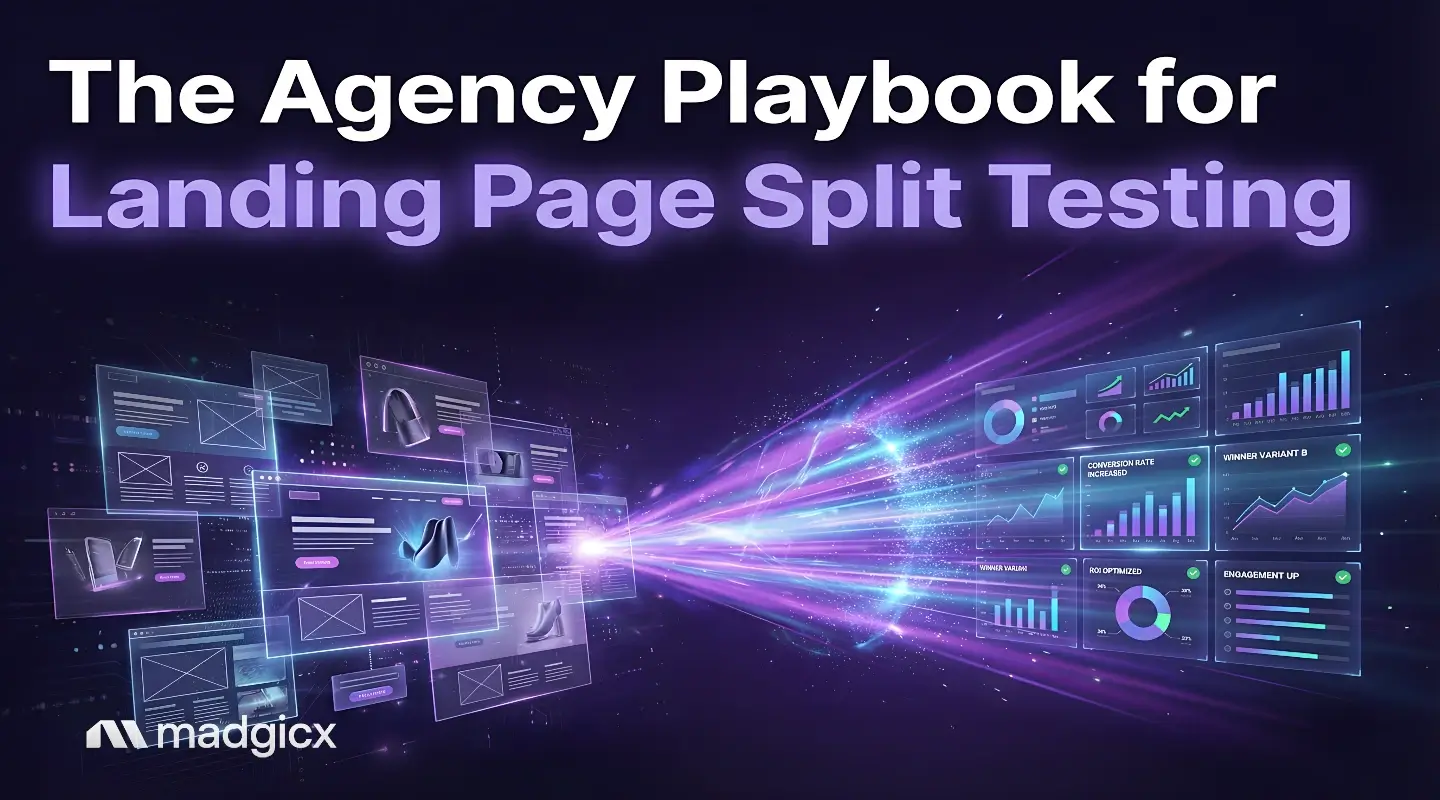
This is the moment where top-tier agencies separate themselves from the pack. It’s where guesswork dies and data-driven growth is born. The answer isn't just another ad variation; it's landing page split testing.
So, what is it, really? Landing page split testing is a controlled experiment where you show different versions of a page to your audience to see which one gets more people to do what you want—whether that’s filling out a form, buying a product, or booking a demo. It’s the scientific method for proving your value.
A well-optimized landing page can boost conversions by up to 300%, according to Firework. That's a number that makes clients very, very happy. This playbook isn't about a one-off test; it's about giving your agency a repeatable, scalable testing engine to drive consistent growth for your entire client roster.
Let's dive in.
Let's get the formal definition out of the way so we can get to the good stuff.
Landing page split testing (or A/B testing) is an experimental method where two or more page variations are shown to random visitor segments to identify which version maximizes a conversion goal.
But for an agency like yours? It's so much more than that. It’s your secret weapon. ⚔️
Look, running ads is table stakes. Any agency can do that. But systematically improving the conversion rate on the other side of the click? That’s where you become indispensable. Split testing isn't a cost center; it's a direct investment in client retention and your agency's growth.
Here’s why it’s a total game-changer:
Pro Tip: The next time you have a Quarterly Business Review (QBR), make the results of a successful split test the hero of your presentation. Lead with the business impact, not just the ad spend.
Running one test is easy. Running dozens of tests across multiple clients without losing your mind? That requires a framework. Here’s a simple, repeatable process to manage it all.
The first question is always: "What are we really trying to achieve here?" As an agency pro, you know the answer is rarely as simple as "more conversions." We have to balance quantity with quality.
For a B2B SaaS client, the goal might not be more form fills, but more qualified demo requests from their ideal customer profile. For an e-commerce client, it might not be just more sales, but a higher Average Order Value (AOV).
Get crystal clear on the business objective before you even think about changing a button color.
A good hypothesis isn't a random guess; it's an educated prediction based on data and a core part of effective concept testing in marketing. We love the classic "If I change X, then Y will happen because of Z" framework.
Quick Tip: The best place to find your "because" is hiding in your ad accounts. Use a platform like Madgicx to analyze ad-level performance. If ads mentioning "Free Shipping" have the highest CTR, that’s your first test!
You can't test everything at once. You need to prioritize. The ICE framework is a simple way to score your test ideas and decide what to run first.
Add up the scores. The ideas with the highest total score are your top priorities. This helps you focus your team's precious time on the tests most likely to deliver quick, meaningful wins for your clients.
Now it's time to launch. But be careful. Here are the most common mistakes we see agencies make:
Stuck on what to test? Start here. This isn't an exhaustive list, but these are the elements that consistently deliver the biggest bang for your buck.
Having the right tools makes all the difference. But it's not just about the conversion optimization software that runs the test; it's about the intelligence you bring to it.
Here’s a pro move that most agencies miss. Before you even log into a landing page builder, you should be in your advertising intelligence platform.
Position Madgicx as your essential first step. Use its ad-level insights to see which creative angles and value props are already winning on Meta, Google, and TikTok. This data helps reduce the guesswork in your hypotheses and focuses your efforts on ideas already proven to resonate. ✨
Once you have your data-backed hypothesis from Madgicx, you need a tool to build and run the test. Here are the most popular options for agencies:
While Madgicx isn’t a traditional landing page A/B testing builder, its Landing Page Performance widget inside the 360° Meta Audit gives agencies a clear breakdown of which landing pages are receiving spend and how they’re performing. This makes it easier to identify which URLs deserve deeper A/B testing and budget allocation — without digging manually through Ads Manager.
Unbounce is built for speed. Agencies can quickly launch and test landing pages without relying heavily on developers, making it ideal for fast-moving campaigns. Its AI-powered traffic routing automatically sends visitors to the variant most likely to convert, helping teams optimize performance without manually splitting traffic.
Instapage focuses heavily on personalization and post-click optimization. Agencies running large ad accounts can create tailored landing page experiences that match specific ads, audiences, or campaigns. Its collaboration tools and personalization features make it especially useful for teams managing multiple clients and ad variations.
Leadpages offers a straightforward, cost-effective way to build and test landing pages. It’s well-suited for smaller agencies or clients who need reliable landing page functionality without complex customization. The platform prioritizes ease of use and quick setup, making it accessible for lean teams.
Convert.com is a robust A/B testing platform designed for teams that prioritize data ownership and privacy compliance. It offers advanced experimentation capabilities, making it a strong fit for agencies working with high-traffic sites or clients that require more technical control over testing environments.
GrowthBook is an open-source experimentation platform that gives agencies full flexibility and customization. It’s best suited for teams with in-house developers who want to integrate A/B testing directly into their product or website infrastructure while maintaining full control over data and deployment.
The world of digital advertising is always changing. Here’s how to handle three of the biggest challenges facing agency testers today.
We get it—the rise of automated campaigns like Performance Max and Advantage+ is a headache for split testing. You can't just assign a specific URL to an asset group or ad. So, what do you do?
The strategy shifts from page-level redirection to campaign-level experiments. In Google Ads, use the "Experiments" feature to run a pre/post analysis or a geo-split test. For Meta, you can duplicate a campaign and run it with the new landing page URL. It’s not a perfect A/B test, but it’s a sound workaround for navigating these black-box systems.
We’ve all been there. A sudden spike in clicks that doesn't translate to real users. Bot traffic can completely skew your test results if you're only looking at top-of-funnel metrics.
How to fight back:
With Apple's ITP and the end of third-party cookies, tracking users for A/B tests is getting trickier. Client-side scripts are becoming less reliable.
This is where the industry is moving toward server-side solutions. Using a server-to-server tracking system like the one in Madgicx helps create a more accurate and durable data connection between your client's website and the ad platforms. It's no longer a "nice to have"; it's essential for accurate measurement.
You ran the test. You have a winner. Now comes the most important part: reporting the results in a way that makes your client want to high-five you.
First, you need to ensure your result is real by reaching statistical significance. In simple terms, this means you're confident (usually 95% confident) that the result isn't just random chance. You can use a free online calculator to check this.
Pro Tip: Don't just report the conversion rate lift. That's an agency metric. Report on the business impact.
Use this simple reporting framework to tell a story that shows your true value:
When you frame your results this way, you're not just a vendor; you're a revenue driver. And remember, the average landing page conversion rate across industries is only 9.7%. When you show a client you've doubled that, you become a hero.
It depends on their baseline conversion rate and the lift you expect. A good rule of thumb is to aim for at least 1,000 unique visitors and 100 conversions per variation. If a page gets low traffic, you may need to test more dramatic changes (like a whole new layout vs. a button color) to see a result faster.
Patience is a virtue here! Run a test for at least two full business cycles (e.g., two weeks) to smooth out daily fluctuations. More importantly, run it until you reach at least 95% statistical significance. Don't stop it early, even if one version looks like a clear winner.
Great question. A/B testing and split testing are basically the same thing—we use them interchangeably to compare two distinct versions (Version A vs. Version B). Multivariate testing is more complex; it tests multiple variable combinations at once (e.g., two headlines and three images) to see which combination performs best. It's powerful but requires a lot more traffic.
We've all been there. The key is to manage expectations from the start. Explain statistical significance and the risk of making decisions on bad data. You can say something like, "I know Version B is looking strong, and that's exciting! But the data is still inconclusive. If we stop now, we risk choosing a false winner and leaving long-term growth on the table. Let's trust the process together to get a reliable result we can build on."
In today's competitive landscape, the agencies that win are the ones that can prove their impact on the bottom line. Landing page split testing is your most powerful tool for doing exactly that.
Remember the key takeaways:
The next time a client asks, "What's next?" you won't have to guess. You'll have a data-backed plan to grow their business—and in turn, your own.
Madgicx brings your entire workflow into one platform — from landing page performance insights to AI-powered ad generation, optimization recommendations, advanced data visualization, and one-click reports.
.avif)
Digital copywriter with a passion for sculpting words that resonate in a digital age.