Ever launched a perfectly good ad, watched it get almost no spend, and wondered if Meta had personally decided to ignore you? 🙃 We've all been there. More often than not, the reason sits in a part of Meta's system most advertisers have never heard of until recently.
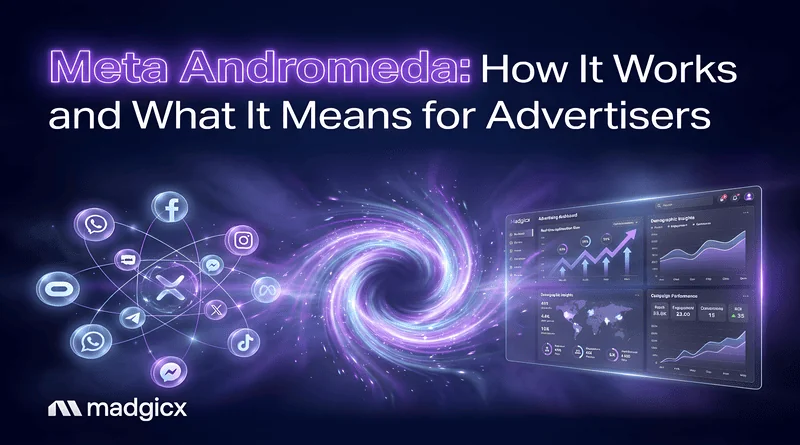
Meta Andromeda is the machine learning system Meta uses to pick a shortlist of ads for each person before any ad is ranked. It narrows "tens of millions of ad candidates" down to "a few thousand relevant ad candidates," and only then do Meta's ranking models choose what you actually see.
So if your ad doesn't make that shortlist, it never gets a chance to win.
In this guide, we'll break down what Andromeda does, what it doesn't do, and exactly how to build creative that gets picked.
Andromeda needs diverse creative to choose from, so speed matters. Madgicx's AI Ad Generator bulk-creates high-quality image ads from product images, existing ads, or Ad Library examples, so you can test new concepts quicker.
What You'll Learn
- What Meta Andromeda is, where it sits in Meta's ad system, and why it changes how your ads get delivered
- The real numbers Meta has shared about Andromeda, and what each one actually means
- A 7-step plan to set up your creative and campaigns so Andromeda has strong options to pick from
- Bonus: the myths about Andromeda that waste the most budget (and what to do instead)
What Is Meta Andromeda?
Here's the thing: Meta can't run a full, expensive prediction on every single ad for every single person. There are simply too many ads. So it works in stages, and Andromeda is the first one.
Meta describes Andromeda as its "proprietary machine learning (ML) system design for retrieval in ad recommendation," according to Engineering at Meta. The Meta Andromeda update was announced on December 2, 2024, in a post titled "Supercharging Advantage+ automation with the next-gen personalized ads retrieval engine."
Think of it like a casting call. Andromeda is the casting director who looks at millions of hopefuls and sends a few thousand to the audition. The ranking models are the judges who pick the final cast. Your ad can be brilliant, but it has to get through the door first.
Retrieval vs. ranking: the two stages that matter
If you'd like the bigger picture of how Meta's AI learns from your campaigns, our guide on how machine learning powers Facebook ads walks through the whole system.
The Meta Andromeda Update: What Changed
So why did Meta rebuild its ad retrieval system? Because the old way couldn't keep up.
According to MediaPost, Meta's previous matching engine relied on isolated model stages and rule-based heuristics, making it harder to handle the growing volume of ads in each request. The Meta Andromeda update replaced that approach with a deep neural network designed to evaluate far more ads, far faster.
That extra capacity is the important bit for you. A bigger model can tell the difference between more ads and more people, which means your creative now carries more of the "who is this for" signal than it used to.
What Andromeda Is NOT (Myths That Waste Budget)
Now for the part most hot takes skip. A lot of advice online blames Andromeda for everything, and that leads to some expensive overreactions.
Andromeda does not rank ads, run the auction, or handle targeting. It only narrows the pool of eligible ads. Here are the myths we see most:
- "Andromeda killed my results." Jon Loomer calls this correlation without causation. Check tracking, budget, offer, and creative age before blaming the algorithm.
- "I need 50 ads in every ad set now." Loomer tested 25 and 50 ads in an ad set and saw no clear benefit. Volume without variety just splits your data.
- "My old ads are dead." Older ads, even single static ads, can still perform well under Andromeda, per the same source.
- "Small tweaks count as new creative." They don't. As Jon Loomer puts it, "Unless they're distinctly different enough, any variation is unlikely to make a meaningful impact on performance."
Sound familiar? If you've been duplicating the same ad with a new background color and calling it a test, you're not alone. Let's fix that next.
Why Creative Is Now Your Targeting
Here's the shift in one sentence: Meta's AI reads your ad to work out who it's for. Meta's own guidance for Andromeda is creative diversification, and Meta says "Creative diversification will help advertisers get the best results," as quoted by Jon Loomer.
Creative diversification means running ads that are truly different from each other in format, visual, and message, so Meta has distinct options to match to different people. A skincare brand, for example, might run one video for busy parents, one static ad on ingredients for skincare nerds, and one carousel of before-and-after results for first-time buyers. Same product, three different "doors" in.
Once you have a few distinct ads, multi-asset tools help you stretch them further. Our guide to dynamic creative shows how one ad can test many combinations at once.
How to Set Up Your Ads for Meta Andromeda
So, what do you actually change on Monday morning? Here's how to set up your account for Andromeda without losing your mind:
- Fix tracking first. Andromeda learns from your conversion data, so clean signals come before anything else. If you haven't yet, set up the Conversions API alongside your pixel.
- Build 3 to 5 truly different concepts. Change the format, the visual, and the message, not just the file name, as recommended by Jon Loomer.
- Mix formats and sizes. Use video, static images, and carousels, with placement sizes such as 9x16 and 4x5.
- Give Meta text options. Meta lets you add up to five primary texts and five headlines per ad. Write them for different buyers and pain points.
- Use multi-asset features. Flexible format and dynamic creative let a handful of ads produce many variations.
- Keep ad sets focused, not flooded. Start with a few strong, distinct ads and add more based on results, rather than dumping 50 lookalike variations in at once.
- Keep your proven winners running. Older ads can still perform, so don't switch off a winner just because it's not new.
Pro Tip: Name every concept by its angle (for example "price-anchor_static" or "ugc-review_video"). When you look at results later, you'll see which angles Andromeda favors, not just which file won.
Wondering whether Advantage+ campaigns or manual setups suit this better? Our Meta Advantage+ comparison breaks down when AI beats manual control.
Andromeda and Ad Fatigue: Keep the Shortlist Fresh
But wait, there's a catch. Even great, diverse creative wears out. When people see the same ad too often, results slide, and Andromeda has fewer fresh options to pick from.
The fix is a steady refresh rhythm, not a panic rebuild. Watch frequency and click-through rate on your top ads, and have the next concept ready before the current one fades. Our guide to ad fatigue covers the warning signs and 7 ways to avoid it.
This is also where a little help goes a long way. Madgicx's AI Marketer performs daily account audits and flags weaknesses and scaling opportunities, so you spot tired ads before they drain budget. And if you'd rather just ask, Madgicx MCP lets you connect Claude or ChatGPT to your Madgicx account and ask about performance in plain English.
Quick Tip: Keep a simple "creative bank" doc with one line per tested concept: angle, format, result. After a few months, it becomes your best brief for what to make next.
Frequently Asked Questions (FAQ)
Is Meta Andromeda the same as Advantage+?
Andromeda and Advantage+ are related but not the same. Andromeda is Meta's ad retrieval system, the step that shortlists a few thousand ads from tens of millions. Advantage+ is Meta's suite of automated campaign and creative features. Meta introduced Andromeda as a way of "supercharging Advantage+ automation," according to Engineering at Meta. In practice, Advantage+ features give Andromeda more options to retrieve, so the two work best together.
When did Meta launch Andromeda?
The Meta Andromeda update was publicly released back in December 2024 in a post on its engineering blog. According to Search Engine Land, the system began rolling out in late 2024 and became a core part of Meta's ad infrastructure in 2025. If you noticed delivery patterns changing over that period, this shift is part of the reason, though it's rarely the only one.
How many ads should I run per ad set under Andromeda?
Meta hasn't published an official number. Distinct concepts matter far more than raw volume. Jon Loomer tested 25 and 50 ads in a single ad set and saw no clear benefit, according to Jon Loomer. A practical starting point is 3 to 5 truly different concepts, each with a few text and format options, then adding more as you learn which angles win.
Does Andromeda replace audience targeting?
Andromeda itself doesn't handle targeting; it narrows the pool of eligible ads. What has changed is how much your creative influences who sees an ad. Because the system picks ads per person, the format, visual, and message tell Meta who the ad is for. Many advertisers now pair broader targeting with more diverse creative, and let the ad do more of the targeting work.
Conclusion: Give Andromeda Better Choices
Here's what to take away:
- Andromeda is Meta's retrieval system. It shortlists a few thousand ads from tens of millions before ranking picks the winners.
- Creative now does much of the targeting. Distinct formats, visuals, and messages give Meta clear signals.
- Volume isn't variety. A few truly different concepts beat 50 near-copies.
- Clean tracking and a steady refresh rhythm keep your ads on the shortlist.
Your next step: pick your best-selling product and build three ads this week that differ in format, angle, and persona. Then watch which one Andromeda favors. If you want to speed up the creative part, Madgicx can help you produce and test more concepts in less time. Try Madgicx free today. 🚀