An AI media buyer uses AI to plan, run and optimize paid ads. See how it works, how to roll it out, whether to build or buy, and where humans stay in control.
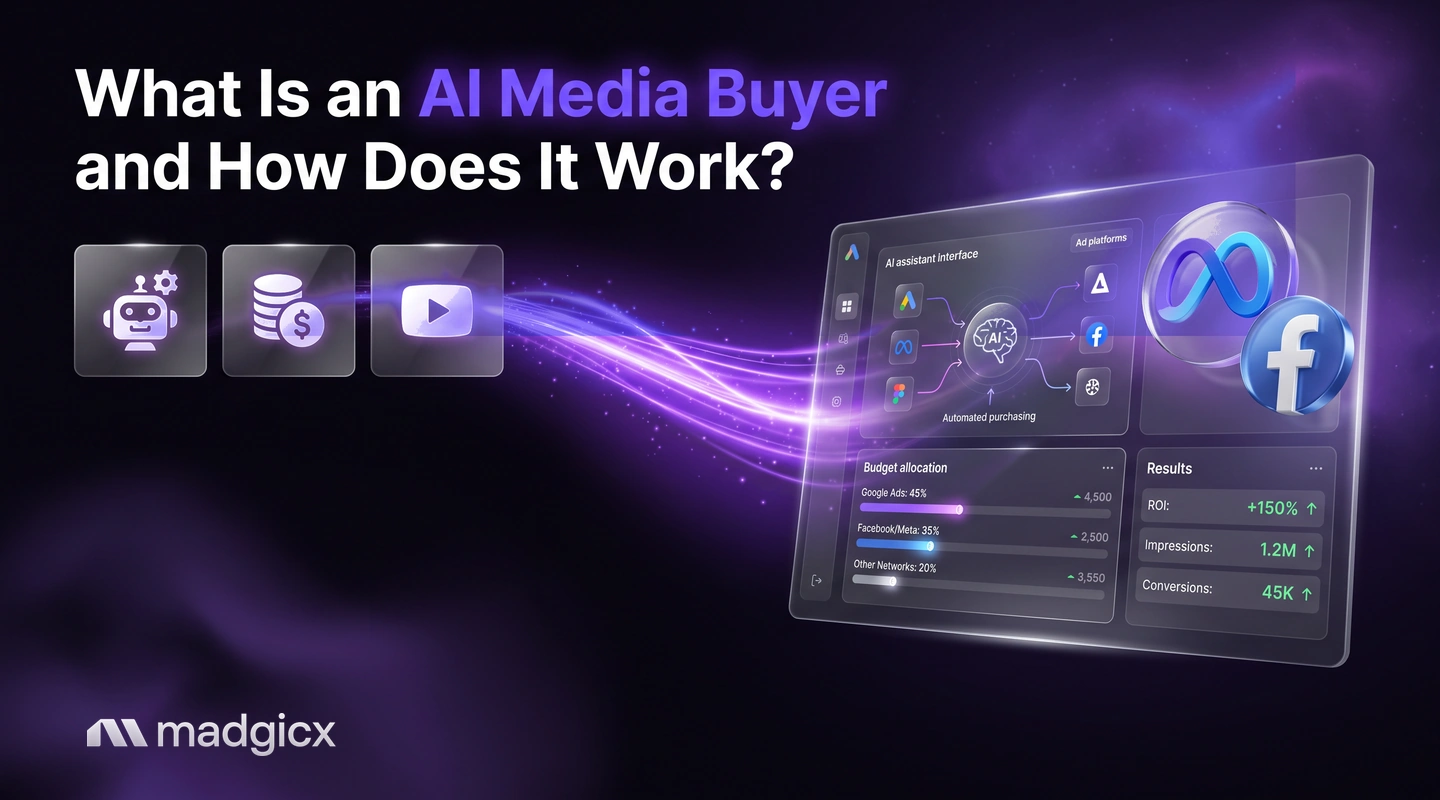
An AI media buyer is software that uses AI to plan, run and optimize paid advertising: it reads your ad data, finds what is working and what is wasting money, and prepares or makes changes to budgets, bids, audiences and creative. It works by connecting to your ad accounts, collecting results and conversion data, using models to predict what will perform, and turning that into recommendations or actions.
Madgicx is the agentic AI advertising platform for Meta ads, and AI Marketer is its AI media buyer for Facebook and Instagram. It audits your ad accounts every day and prepares recommendations that you review and approve in one click, so you keep the decisions and skip the busywork.
AI Marketer audits your Meta account daily and recommends budget, audience and creative changes you approve.
How is an AI media buyer built?
Most AI media buyers share the same parts, whatever the vendor calls them.
- Data layer. Connections to ad accounts, your store and tracking, plus a pipeline that cleans the data and turns it into measures the models can use.
- Models. Predictive models estimate which audiences, creatives and placements will convert, and what each action is worth.
- Decision layer. Rules and models turn predictions into bid, budget and creative decisions.
- Action layer. Recommendations you approve, or changes the tool applies inside limits you set.
- Feedback loop. Results flow back so the next decision improves.
How does an AI media buyer use your data?
Everything starts with data integration. An AI media buyer pulls spend, results, audience and creative data from your ad accounts, and ideally your store, so it can judge results against revenue, not clicks. Quality matters more than volume: if tracking misses sales, the models learn from a smaller, skewed group of buyers.
That is why tracking sits in the data layer. Madgicx Cloud Tracking hosts Meta's Conversions API Gateway and Signals Gateway for you and sends conversions to Meta from the server, so Meta sees and attributes more of them. Madgicx's One-Click Report brings Meta, Google Ads, TikTok, Shopify and Klaviyo data into one place for reporting.
How do predictive models make bidding decisions?
Models score the likely value of a person, an ad or a placement, then the system acts on those scores: raise or lower a bid, move budget, flag an ad that is tiring. Rule-based automation does the same with fixed conditions you write yourself ("pause if CPA is above X"). AI adds a layer that finds opportunities you did not write a rule for. Madgicx offers both: Automation runs rules on the conditions you set, and AI Marketer prepares recommendations from its daily audit. For the mechanics, see how AI ad optimization suggestion logic works.
How does an AI media buyer manage budgets across channels?
It compares the return of campaigns and ad sets and proposes moving money from weaker to stronger ones. Cross-channel tools do the same across platforms. Madgicx optimizes Meta ads only, and shows Google Ads, TikTok, Shopify and Klaviyo data in reporting so you can read results side by side. Budget changes in Madgicx happen through Copilot actions, on approval.
How does it handle creative fatigue and rotation?
Creative fatigue is when an ad shows to people so often, or for so long, that results drop. An AI media buyer watches trends in cost and engagement per creative to catch it early. Creative Insights breaks down every creative, including video, and flags fatigue, and the AI Ad Generator makes new image ads from a prompt, an image or any ad in the Meta Ad Library, so the replacement is ready.
What is the difference between an AI media buyer and a human one?
A human media buyer reviews accounts on a schedule, relies on experience and handles strategy, client talks and creative direction. An AI media buyer reads every ad every day, spots patterns across many campaigns at once, and prepares changes quickly. The strongest setup pairs them: the AI does the checking and preparing, and the person decides what is worth doing. That is the model Madgicx follows, with every recommendation reviewed before it goes live.
How do you roll out an AI media buyer in phases?
- Fix the data. Check conversion events, values and tracking before anything else.
- Connect and read. Connect your account and read its audit without changing anything. Compare its findings with your own view.
- Approve small changes. Complete a few recommendations a week and watch the results.
- Add creative. Use creative analysis and generation to keep fresh ads flowing.
- Scale what works. Extend the approach to more campaigns or accounts, keeping budget limits and review points.
Should you build, buy or adopt an AI media buyer?
Building your own means data engineers, model maintenance and continuing platform changes, which rarely pays off outside very large advertisers. Buying a tool is faster. Adopting your ad platform's own AI is the baseline: Meta's built-in tools, such as Advantage+ and automated rules, are the benchmark any outside tool should beat for your account. Prices below were checked in November 2026.
| Tool | What it does | Best for | Price |
|---|---|---|---|
| Madgicx | Daily audit, recommendations you approve, Copilot, image ads, tracking | E-commerce brands and agencies on Meta | From $45 a month, priced by ad spend; 7-day free trial |
| AdStellar | Builds, launches and adjusts Meta campaigns from a chat | Teams that want fast Meta campaign builds | TeamOne $100 a month; 7-day trial with $100 in credits |
| Albert.ai | Self-optimizing campaigns across many channels | Large advertisers buying by quote | Custom quote |
| Optmyzr | Rule Engine, AI Sidekick, campaign launcher, reports | PPC teams starting with Google Ads | From EUR 209 a month billed annually; 14-day trial |
| Smartly.io | Feed-based campaign generation, triggers, creative at scale | Large brands and agencies producing creative at scale | Quote only |
Albert.ai's FAQ says it does not develop creative or write ad copy, and Smartly.io sells by quote. For a Meta-first team, a specialized tool is usually the better fit; for a wider map of vendors, see our guide to autonomous media buying tools and the roundup of AI media buyers for e-commerce.
When should humans stay in control?
AI media buyers are good at pattern-finding and routine changes. People stay better at judgment calls:
- Margins and stock. The AI doesn't know your inventory, promotions or margin targets unless you tell it.
- Strategy and offers. Choosing what to sell, to whom and at what price is yours.
- Large budget moves. Review them before they go live.
- Brand and creative direction. AI can make variations; you decide what the brand says.
Read more in whether AI can replace a media buyer.
How to get started with an AI media buyer on Meta using Madgicx
- Connect your Meta ad account and let AI Marketer audit it.
- Read the recommendations and complete or dismiss each one.
- Ask Copilot why a result changed or which audience performs best.
- Add Madgicx Cloud Tracking so Meta sees more of your conversions.
- Use Creative Insights and the AI Ad Generator to keep creative fresh.
Try Madgicx free for 7 days and see what an AI media buyer finds in your account
FAQ
What is an AI media buyer and how does it work?
An AI media buyer is software that reads your ad data, predicts what will perform, and prepares or makes changes to bids, budgets, audiences and creative. It connects to your ad accounts, learns from results and feeds them back into the next decision.
What does an AI media buyer do?
It audits accounts, finds wasted spend and winning ads, recommends budget and creative changes, and reports results. On Meta, Madgicx's AI Marketer does this daily and you approve each change.
How much do AI media buyers cost?
Prices range from flat subscriptions to quotes. As of November 2026, Madgicx starts at $45 a month priced by ad spend, AdStellar is $100 a month, and Albert.ai and Smartly.io sell by quote.
Can AI completely replace a human media buyer?
No. A human-in-the-loop setup works best: AI handles data and routine changes, and you handle strategy, creative direction and approvals.
Should I build my own AI media buyer?
Rarely. Building needs data engineering and constant maintenance, so most advertisers buy a tool built for their channel.