Think Your Ad Strategy Still Works in 2023?
Get the most comprehensive guide to building the exact workflow we use to drive kickass ROAS for our customers.


Are your account managers spending more time prospecting than optimizing? Sound familiar? It’s a story we hear from agencies all the time. Manual lead generation is a major bottleneck to agency growth, and for many, scaling a client base feels like an expensive, uphill battle.
But what if you could build a machine that helps find, nurture, and convert high-intent leads? A system that frees up your team to focus on what they do best: strategy and client success.
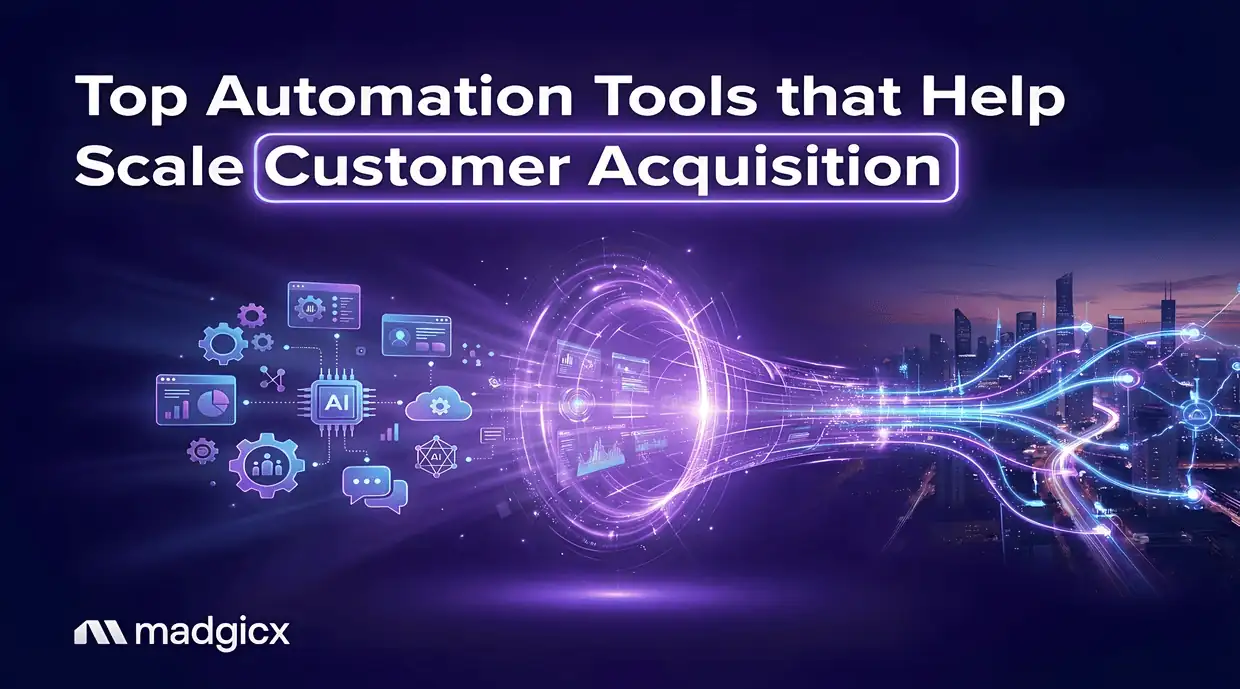
Successful agencies aren't just working harder; they're building smarter with an automated acquisition stack. We've covered the benefits of using a marketing automation platform for customer acquisition before, and in this guide, we'll show you exactly how to construct that engine, layer by layer. We'll break down the essential tools for each stage and show you how to assemble a powerful, cost-effective system that drives predictable growth.
Let’s be honest, manual prospecting is a grind. It’s time-consuming, repetitive, and the returns can diminish quickly.
Every hour your team spends digging through LinkedIn for contacts is an hour they aren’t spending on client strategy, creative testing, or performance analysis—the things that actually move the needle. When you factor in salary and opportunity cost, the real price of manual acquisition is staggering. According to Prospeo, the baseline cost of acquisition reaches $18 per lead before a single message is even sent.
This is where a layered automation stack comes in. It’s a solution designed to break free from the "more clients, more headcount" trap. In fact, according to Prospeo, businesses that pivot to integrated automation platforms see a 451% increase in qualified leads. Imagine what that could do for your agency’s pipeline.
Pro Tip: An "automation stack" isn't a single tool. It's a combination of specialized platforms that work together to handle different parts of the acquisition journey, from finding prospects to converting them into clients. It’s about making different systems talk to each other to create a seamless, automated workflow.
Before you can automate anything, you need a central hub for all your data. A Customer Relationship Management (CRM) platform is the operational nucleus for any modern acquisition strategy. It’s your single source of truth for your entire sales pipeline.
For agencies, the choice generally boils down to two main ecosystems:
Quick Tip: For most small to mid-size agencies, HubSpot's Professional tier offers a strong balance of power and cost to get started. While it comes with a mandatory onboarding fee (around $3,000), it gives you the core automation features you need without the enterprise-level complexity.
Great automation runs on great data. The intelligence layer of your stack is all about identifying high-quality, high-intent prospects before you even think about reaching out.
Here are the key categories of intelligence tools:
Pro Tip: Think of a tool called Clay as the "glue" for your intelligence layer. It allows you to chain together data from multiple sources (like Apollo and LinkedIn) to build hyper-targeted prospect lists that are difficult to create with a single tool.
Alright, so you’ve got your CRM foundation and a steady stream of high-intent prospects. Now it’s time to engage them at scale—without sounding like a robot.
This modern outbound stack is all about efficiency and personalization:
Here’s the thing. All the tools we’ve discussed are brilliant for engaging known prospects. But how do you fill the top of your funnel with a steady stream of new potential customers at scale?
This is the critical missing piece in most "automation stack" guides, and it's where paid advertising comes in. Choosing from the top tools to automate paid traffic acquisition is essential for fueling your entire system.
Madgicx is an AI-powered advertising platform designed to help you optimize finding and converting cold audiences on Meta, while consolidating reporting from Google and TikTok. It’s the engine that pours a steady stream of high-intent traffic onto your website, giving tools like Leadfeeder and Intercom a constant supply of leads to work their magic on.
Here’s how Madgicx complements the rest of your stack:
Pro Tip: If your CRM and outreach tools are the engine of your car, Madgicx is the high-octane fuel that helps it go. Without a scalable way to drive new traffic, even the best sales automation stack will eventually run out of road.
This all sounds great in theory, but what does it actually look like in practice? Here is a tangible, actionable example of a lean but powerful acquisition stack you can build.
The Lean Agency Stack:
For a monthly cost that can be a fraction of a single SDR's salary, this stack gives a small agency the power to compete with much larger players. You’re no longer limited by headcount; you’re empowered by a system that leverages intelligent automation to scale efficiently. That’s the real game-changer.
No. Start with your biggest bottleneck. For most agencies, that's either managing client data (CRM) or generating new leads (Paid Acquisition). A great starting point is a core stack of a CRM like HubSpot + an advertising platform like Madgicx. You can layer on other tools as you scale.
They are highly complementary. HubSpot manages the customer lifecycle for known contacts. Madgicx manages the paid advertising campaigns that feed new, unknown leads into the top of your funnel, which then get passed to HubSpot.
Sales automation focuses on 1-to-1 communication with known prospects (e.g., personalized email sequences). Marketing automation, specifically with a tool like Madgicx, focuses on 1-to-many communication with unknown audiences (i.e., paid ads) to generate brand new leads at scale.
A basic stack can be configured in a week. Start by setting up your CRM and connecting your paid ad accounts to Madgicx for an immediate win. Then, you can layer in prospecting and engagement tools over the first 1-2 months.
Building a scalable agency isn't about hiring more people to do more manual work. It’s about building efficient, automated systems that deliver more consistent results for your clients and your business.
By layering intelligence, engagement, and powerful paid acquisition tools on top of a solid CRM foundation, you create a client acquisition machine that works around the clock. This frees your team to focus on high-value strategic work and makes your agency more profitable and scalable.
Ready to make the switch from selling time to selling systems? Your first step is to streamline your most critical, data-heavy process: paid advertising.
With AI Marketer generating high-performing lookalikes and Audience Launcher giving you 100+ ready-to-deploy audiences, you can stop guessing and start scaling your Meta campaigns with targeting that’s built to convert.
.avif)
Digital copywriter with a passion for sculpting words that resonate in a digital age.