Which tools help automate paid traffic acquisition? Six compared on job, fit and price, with a five-step rollout, guardrails and what automation costs.
The tools that help automate paid traffic acquisition fall into four jobs: optimizing campaigns (Madgicx, Optmyzr), launching ads (AdStellar), producing creative at scale (Smartly.io), and feeding clean data into all of it (Cometly, Funnel.io). For advertisers who buy traffic on Meta, Madgicx covers the most of those jobs in one platform: it audits the account, prepares actions you approve in one click, runs automation rules, generates creative and reports on results.
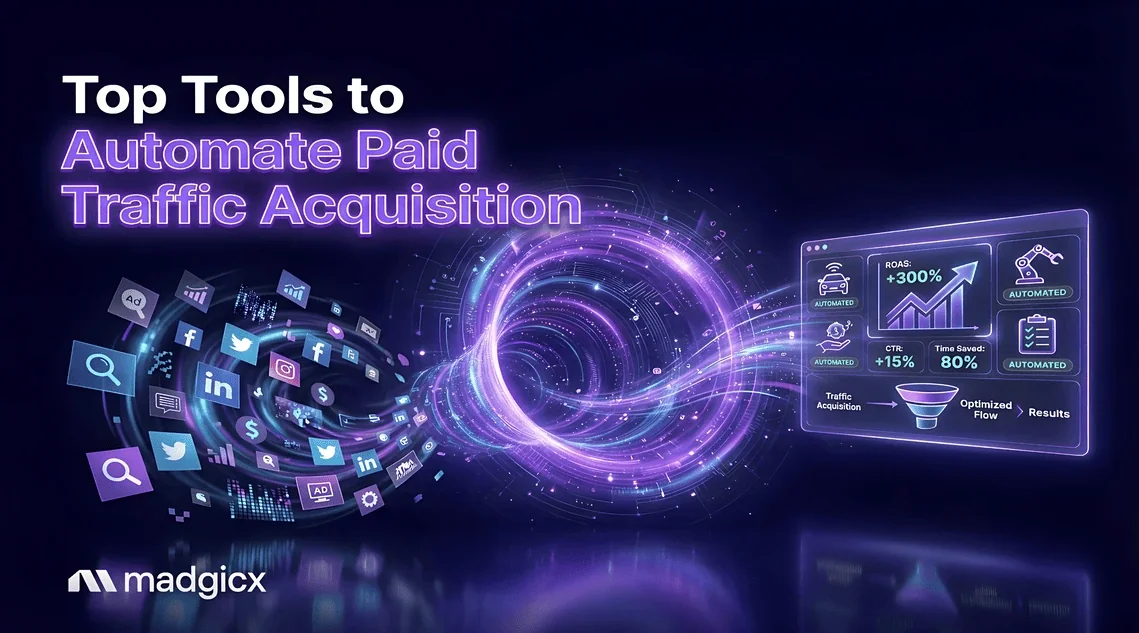
Paid traffic acquisition means buying visitors through ads on platforms such as Meta, Google and TikTok. Automating it means software does the repetitive work (checking results, pausing waste, moving budget, building reports) while you set the goals and approve the changes. Below are six tools, how to roll out automation in five steps, what to automate first, and what it costs, with prices as of November 2026.
Automation runs your rules 24/7, Copilot builds campaigns from a brief, and AI Marketer recommends changes.
Which tools help automate paid traffic acquisition?
| Tool | Job it automates | Best for | Price |
|---|---|---|---|
| Madgicx | Meta audit, prepared actions you approve, rules, creative, reporting, server-side tracking | E-commerce brands and agencies on Meta | From $45 a month, priced by ad spend; 7-day free trial |
| Optmyzr | Rule-based PPC management with Google Ads at the core | PPC teams and agencies that start with Google Ads | From EUR 209 a month billed annually at the lowest spend bracket; 14-day free trial |
| AdStellar | Building and launching Meta campaigns from plain-English instructions | Teams that want an AI agent to build Meta campaigns | $100 a month plus AI credits; 7-day free trial |
| Smartly.io | Creative at scale from templates and product feeds, triggers, reporting | Large brands and agencies | Quote only |
| Cometly | Server-side attribution and conversion data | Advertisers who need cleaner conversion data | See its pricing page |
| Funnel.io | Moving marketing data from many sources into BI tools | Agencies with data teams | See its pricing page |
The tools in detail
1. Madgicx
Madgicx is the agentic AI advertising platform for Meta ads. AI Marketer audits your campaigns, finds where budget is wasted and which ads to scale, and prepares the actions for you to approve in one click. Automation runs custom rules and prebuilt tactics around the clock. Copilot answers questions about any ad account from your own data, so you can ask why cost per acquisition rose. Creative Insights shows which creatives win and flags fatigue, One-Click Report and the Business Dashboard cover reporting, and Madgicx Cloud Tracking sends conversions to Meta from the server so Meta sees more of them.
Madgicx optimizes Meta ads only; its reporting also covers Google Ads, TikTok, Shopify and Klaviyo. Plans start at $45 a month, priced by ad spend, and extra ad accounts are $9 each. It includes a 7-day free trial.
2. Optmyzr
Optmyzr is a PPC platform for agencies and teams that manage Google Ads first. Its Rule Engine runs weekly or monthly on Essentials, daily on Premium, and hourly on request on Enterprise, and an AI Sidekick assistant helps with analysis. Its pages also list Meta, LinkedIn, Microsoft Ads and Amazon Ads. At the lowest spend bracket (up to EUR 25K a month), Essentials is EUR 209 a month billed annually, or EUR 299 billed monthly. It offers a 14-day free trial with no credit card. It suits teams that like to build detailed if-this-then-that logic themselves.
3. AdStellar
AdStellar is an AI media buyer for Meta. From a chat, its agent analyzes performance, adjusts budgets and creates and launches ads, and you can set rules in plain English. Launches go to Meta only. It has one plan, TeamOne, at $100 a month with AI credits at $2 per 1,000, and a 7-day free trial with $100 in free credits. It fits teams whose main need is building and launching new Meta campaigns fast.
4. Smartly.io
Smartly.io is for large brands and agencies producing creative at scale. Campaign blueprints tied to a product feed generate many campaigns, triggers switch ads on or off by performance, weather or time of day, and budget moves between selected campaigns by predicted performance. It also forecasts creative performance before launch. It sells by quote and asks you to book a demo.
5. Cometly
Cometly focuses on attribution and server-side tracking, helping advertisers improve the reliability of their conversion data and work with Meta's Conversions API. It is a data component, not a full campaign management platform, so it feeds better data into the tools that optimize. Madgicx includes server-side tracking through Madgicx Cloud Tracking.
6. Funnel.io
Funnel.io is an ETL tool: it collects and cleans marketing data from many sources and sends it to BI tools such as Tableau or Google BigQuery. It is not a reporting tool itself, so someone still builds the reports. It suits agencies with a data team. For ready-made reports, see how to automate Meta ads reporting.
How do you roll out paid traffic automation in 5 steps?
Step 1: Set goals and limits
Choose a target CPA or ROAS and a daily spend cap per account and campaign. The cap is your circuit breaker if a rule misfires.
Step 2: Fix tracking
Automation optimizes on the conversions it can see. Confirm purchases and values reach Meta, ideally from the server too.
Step 3: Connect your accounts and let data build up
Most tools work better with a few weeks of history. Connect the accounts, read the audit, and hold off on switching everything on at once.
Step 4: Automate one low-risk task first
Pick the biggest time sink and automate that. Add the next task only when the first runs cleanly.
Step 5: Review weekly and expand
Check whether automated changes match your strategy, then widen the scope. Our guide to AI media buying tools shows how the pieces fit together.
What does Meta's own automation cover, and where do tools fit?
Meta Ads Manager has built-in automated rules that check campaigns, ad sets and ads and then update them or notify you. Examples include pausing a low-performing ad when it hits a metric or raising a budget based on ROAS. They are a good baseline: they work inside Meta, at the ad account level. A platform like Madgicx adds analysis of what to change and why, creative tools, cross-channel reporting and prepared actions on top.
What are the best low-risk automations to start with?
- Alerts. Notify you when CPA or spend crosses a limit, with no change to the ads.
- Reporting. Send or refresh weekly reports automatically.
- Pausing clear losers. Pause an ad set after it spends a set amount with no conversions.
- Fatigue flags. Flag ads whose frequency climbs while click-through rate falls.
Leave budget increases and new campaign launches for later, and keep a human approval on those.
What guardrails should automation have?
- Approval steps. With Madgicx, you review and approve prepared actions in one click.
- Spend caps. Daily limits per account and campaign.
- Minimum data. Do not act on an ad set until it has enough results.
- A change log. Know what changed and when, so you can undo it.
What mistakes do people make when automating paid media?
- Automating before tracking works. Bad data produces bad decisions.
- Too many rules at once. When results drop, you cannot tell which rule caused it.
- Judging too fast. A one-day dip is noise. Use trends over several days.
- Buying a tool by channel list alone. Check which channels it can change and which it only reads.
- No review. Automation still needs a person to set goals and check results.
How do you choose a tool by team and platform mix?
- Mostly Meta, e-commerce: Madgicx.
- Google Ads first: Optmyzr.
- Need to build and launch Meta campaigns fast: AdStellar.
- Large brand with templated creative: Smartly.io.
- Cleaner conversion data or data pipelines: Cometly or Funnel.io, alongside an optimization tool.
If you run Google and Meta together, pair a Meta optimizer with a Google tool and use one reporting view across both. Madgicx's reporting covers both, and its Google MCP analyzes Google Ads accounts from your AI assistant. See also our overview of growth platforms for paid social and search automation.
What does paid traffic automation cost?
As of November 2026, entry plans run from $45 a month (Madgicx) to about $100 a month plus credits (AdStellar) and EUR 209 a month at the lowest bracket (Optmyzr), while enterprise tools such as Smartly.io sell by quote. Most scale with ad spend, so model the cost at your planned spend, and add extra ad accounts, credits and onboarding. Our guide to AI tools and paid media ROI helps you weigh cost against return.
Automate your paid traffic acquisition with Madgicx
Connect your Meta ad account, read the AI Marketer audit and approve the actions that fit your goals. Turn on Automation rules for the checks you want running all the time, use Creative Insights to spot tired ads and generate replacements with the AI Ad Generator, and share results with One-Click Report. Madgicx is an Official Meta Business Partner, trusted by 200,000+ advertisers and rated 4.6 out of 5 on G2 from 220+ reviews.
Start your 7-day free trial and automate your first Meta task today
FAQ
Which tools help automate paid traffic acquisition?
Madgicx, Optmyzr, AdStellar and Smartly.io automate optimization, launching and creative, while Cometly and Funnel.io supply attribution and data pipelines. For Meta ads, Madgicx covers the most jobs in one platform.
What is paid traffic acquisition?
It is buying website visitors through ads on platforms such as Meta, Google and TikTok. You pay per click, view or conversion, and measure results in cost per acquisition and return on ad spend.
What are the best AI marketing operations automation tools for reporting?
Madgicx's One-Click Report and Business Dashboard bring Meta, Google Ads, TikTok, Shopify and Klaviyo data into one place and can be shared by link or PDF. For raw data pipelines into BI tools, Funnel.io is an option.
What should I automate first in paid media?
Start with low-risk tasks: alerts, reporting and fatigue flags. Add pausing clear losers next, and keep budget increases and launches behind your approval.
Does automation replace a media buyer?
No. It handles repetitive checks and prepares actions, while you set goals, review changes and make strategy calls.