Think Your Ad Strategy Still Works in 2023?
Get the most comprehensive guide to building the exact workflow we use to drive kickass ROAS for our customers.


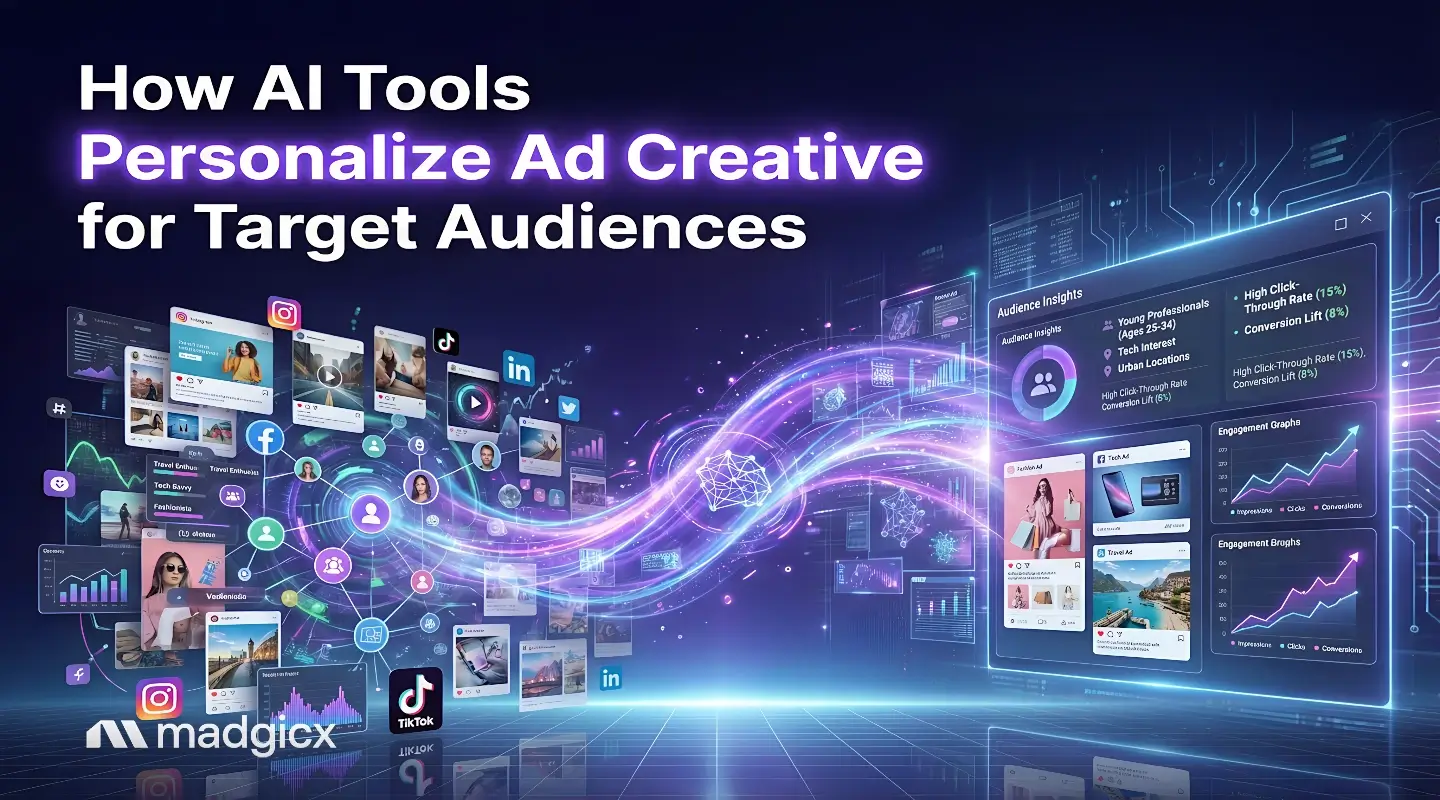
You’ve been running the same three ad creatives for weeks, and your performance is starting to look a little… stale. Sound familiar? We get it. The pressure to deliver fresh, relevant ads to an audience that’s seen it all is immense.
And with the changing landscape of third-party cookies, it feels like we're all advertising with new constraints. Here's the thing: your customers are practically begging for a more tailored experience.
According to IBM, a staggering 71% of consumers now expect personalized content. Static, one-size-fits-all ads just don’t cut it anymore. This guide is your roadmap. We’re going to break down exactly how AI personalization works, the ad creation tools you need, and how you can use it to finally escape the creative hamster wheel.
Let’s be honest, the term “cookie apocalypse” sounds a bit dramatic, doesn’t it? But for us media buyers, it’s not far off. For years, we relied on third-party cookies to follow users around the internet, serving them ads based on their browsing history.
Now, with privacy regulations tightening and browsers phasing out those cookies, that old playbook is toast. And users are driving this change. A study from AI Digital revealed that by late 2023, 84.1% of US consumers expressed significant concern regarding online data privacy.
So, this forces a massive shift in our strategy. We’re moving from the old world of deterministic tracking (knowing exactly who a person is) to a new world of probabilistic modeling.
This just means using AI to make highly educated guesses based on the signals we do have, like first-party data from your website or CRM. It’s about building a real relationship with your audience and using AI to understand them on a deeper level—without invading their privacy.
So, if we can’t rely on third-party tracking like we used to, how do we show people relevant ads? Simple: we let AI do the heavy lifting.
AI Ad Personalization is the use of artificial intelligence to automatically customize ad creative for individual users in real-time based on their data and context.
It’s a powerful solution for the post-cookie world. Instead of showing the same generic ad to a broad audience, AI personalization helps create a more relevant ad experience for each impression.
Pro Tip: This is way beyond basic audience segmentation. We’re not just talking about creating one ad for "moms in California" and another for "dads in Texas." Think of it this way: AI personalization operates at a super granular level, considering dozens of signals in the split second it takes for an ad to load. It decides in real-time whether this specific person, right now, is more likely to click on an ad with a blue background or a red one, a "Shop Now" button or a "Learn More" button.
If AI personalization is the strategy, then Dynamic Creative Optimization (DCO) is the engine that makes it run. It’s the tech that brings the whole thing to life.
Dynamic Creative Optimization (DCO) is an ad technology that uses AI to assemble and optimize ad components (like images, text, and CTAs) in real-time to create the most effective ad for a specific viewer.
Let's break down how it actually works:
The result? More relevant, highly optimized ads designed to work harder for your budget.
It’s no wonder that, according to Evercopy, dynamic ads can increase conversion rates by up to 3x compared to their static counterparts.
So, what data is the AI actually using to make these real-time decisions? It's a mix of different signals, or "triggers," that give the AI context. Here are the big ones:
By combining these triggers, AI can create a remarkable level of relevance that feels helpful, not creepy.
Alright, you’re sold on the concept. But how do you actually do it? You need the right tools. The market is flooded with AI advertising tools, but they generally fall into a few camps. Some are great at writing copy, others focus on generating images, and a few help with optimization.
The challenge? Using a patchwork of different tools creates data silos and a clunky workflow. Many of us find more value in a single platform that can handle the core process: creative generation, optimization, and reporting. This is where automated ad launch tools become invaluable.
To help you navigate the landscape, we’ve compared some of the popular players. Our methodology focused on platforms that address multiple parts of the advertising workflow.
Madgicx is built differently as an all-in-one ad platform. It combines a powerful AI Ad Generator for high-volume creative with an AI Marketer for 24/7 optimization recommendations. Add in AI Chat for instant insights and One-Click Reports, and you get the entire advertising workflow in one place.
Jasper AI focuses primarily on content and copy generation. While it is fantastic for generating scalable, on-brand copy using Generative NLP (Natural Language Processing), it does not provide visual generation, ad launching, optimization, or reporting features.
Evercopy focuses on ad creative generation using hybrid modeling. Its key benefit is creative decay scoring, which helps identify when ads are losing effectiveness. While it supports omni-channel creative generation, its optimization and reporting capabilities are limited compared to a full-funnel platform.
This all sounds great in theory, but does it actually work? The proof, as they say, is in the pudding—and the numbers here are pretty wild. Big brands are already seeing massive returns from embracing AI-driven personalization.
According to reports from sources like AI Digital and M1-Project:
The message is clear: brands that master AI personalization aren't just getting small gains; they're creating a significant competitive advantage.
Okay, this is where things get really cool. This is where AI goes from being a simple tool to your strategic co-pilot.
By analyzing performance data at scale, AI can help you identify your true Ideal Customer Profile (ICP) and uncover profitable new audience pockets you never knew existed. This is the power of micro-segmentation.
Micro-segmentation is the practice of using AI to divide a target audience into extremely small, dynamic groups based on shared behaviors, intent signals, and predicted outcomes.
We're way past broad demographics here. We’re talking about segments like "weekend shoppers who buy on their second visit from an Instagram ad after 9 PM" or "price-sensitive users who respond to 'Free Shipping' offers but ignore percentage discounts."
Pro Tip: Don't try to boil the ocean. Start your micro-segmentation journey by asking simple questions. Use a tool like AI Chat to ask, "Which placement (e.g., Feed vs. Stories) has the best CPA for my top campaign?" or "Compare the ROAS between men and women aged 25-34." These small wins build momentum and reveal quick optimization opportunities. ✨
Trying to find these manually is nearly impossible. But for an AI, it’s a manageable task. And the payoff is huge. According to M1-Project, brands that activate first-party data for micro-segmentation can double their revenue impact and reduce acquisition costs by 30% to 50%.
That’s the whole idea behind a tool like Madgicx's AI Chat. It’s designed to be your data detective. You can simply ask it questions like, "Which age group has the highest ROAS in my Advantage+ campaign?" or "Show me my top 5 performing ads from last week." It sifts through the data for you, uncovering the insights you need to find and scale your best micro-segments. Frequently Asked Questions
AI ad personalization is the overall strategy of tailoring ads to individuals. DCO is a specific technology used to execute that strategy by assembling ad variations in real-time. Think of AI personalization as the "what" (the goal) and DCO as the "how" (the tool that gets you there).
Costs vary widely. Creative tools like Jasper often use seat-based subscriptions (around $69/month per user). Others use credit-based models. All-in-one platforms like Madgicx offer tiered subscription plans based on your monthly ad spend, which gives you a predictable cost for a full suite of creative, optimization, and analytics tools.
Yes, it absolutely can if not governed properly. An AI model is only as good as the data it's trained on, and if that data has historical biases, the AI can amplify them. That's why responsible AI platforms work to mitigate this with tools for monitoring model behavior and promoting fair ad delivery. It’s critical to partner with platforms that are transparent and committed to ethical AI.
Absolutely not. Think of AI as the world's best (and fastest) assistant, not your replacement. It excels at the tasks we humans find tedious: crunching massive datasets, running thousands of micro-tests, and performing repetitive optimizations. This frees you up to focus on what you do best: high-level strategy, creative thinking, brand storytelling, and interpreting the complex "why" behind the data.
Look, this shift to a privacy-first, post-cookie world isn't something to fear—it's a massive opportunity. It's a chance to stop interrupting what people are interested in and become what they're interested in. AI-driven personalization is the key that unlocks this future.
By leveraging technologies like DCO, generative AI, and micro-segmentation, you can deliver truly relevant experiences that drive better results. We’ve seen the proof in the 450% CTR lifts from major brands.
The most successful advertisers of tomorrow won't be the ones who let AI run their campaigns, nor the ones who ignore it. They will be the ones who master the art of collaboration—combining AI's speed and precision with uniquely human strategy and creativity.
The easiest way to get started is with a unified platform that brings creative, optimization, and analytics under one roof. It just simplifies everything.
Ready to see what AI can do for your creative and your results?
Stop the creative bottleneck and scale your ad performance. Madgicx combines a powerful AI Ad Generator with an AI Marketer to help you create, launch, and optimize your Meta campaigns.
.avif)
Digital copywriter with a passion for sculpting words that resonate in a digital age.