Automated growth systems optimize ad spend by moving budget, bids and creative toward what works. See the five-step setup, ad fatigue signals and how Madgicx does it.
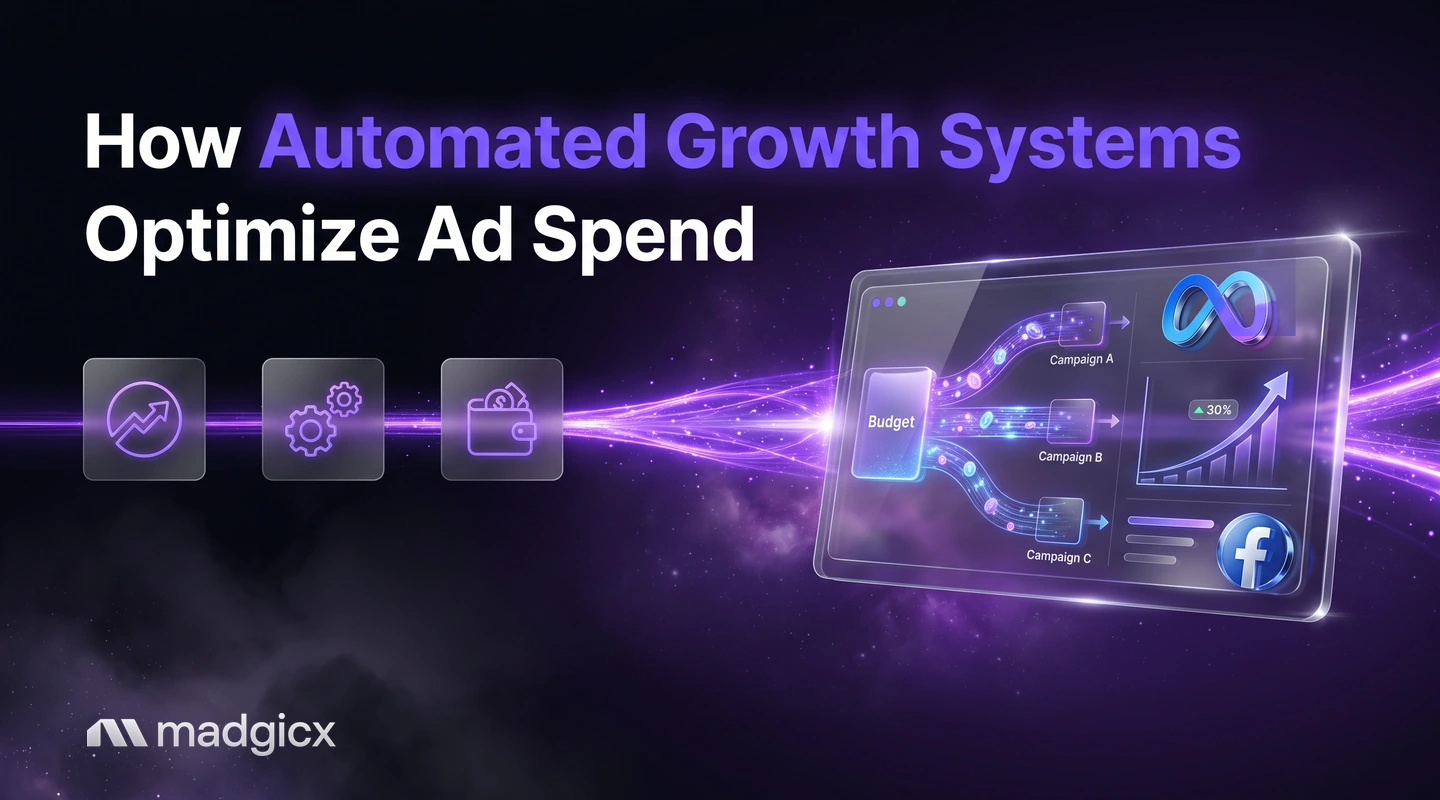
Automated growth systems optimize ad spend by watching your ad data around the clock, spotting which campaigns, ad sets and creatives return the most revenue, and moving budget, bids and creative toward them while cutting what wastes money. A good system does four jobs in a loop: collect clean conversion data, analyze it, act on it (shift budget, pause, refresh creative), and learn from the result.
On Meta, Madgicx does this with AI Marketer, which audits the ad account, finds what is working and prepares recommended actions that you review and approve in one click, plus automation rules that run on the conditions you set. According to Stape.io, around 23% of online advertising budgets (about $20 billion a year) is wasted on unoptimized campaigns, and creative fatigue is a big part of it.
Automation moves budget by your rules 24/7, and AI Marketer recommends shifts you approve.
How do automated growth systems optimize ad spend?
An automated growth system replaces the daily check-and-tweak routine with software that works through the same steps faster and more often. These are the main levers it pulls.
It reads performance signals continuously
The system pulls spend, ROAS, CPA, CTR, CPM and frequency for every campaign, ad set and ad, and compares each against your goal and its own recent trend. A person checks once or twice a day. Software can check all of it, all the time, so a bad ad set is flagged in hours, not at the end of the week.
It moves budget toward what works
The core of spend optimization is allocation: more money to ad sets that beat your target, less to those that miss it. With Madgicx, budget changes are prepared as actions you approve, so you stay in control of where the money goes. Our guide to AI tools for ad budget allocation goes deeper on how this works.
It adjusts bids
Bid and cost controls decide how much you pay for each result. Madgicx includes AI bidding inside Ads Manager 2.0, and Meta's own bid strategies remain the baseline it works on top of.
It enforces rules you set
Automation rules act on conditions: pause an ad set when CPA passes a limit, or raise a budget when ROAS holds above a threshold for a few days. Madgicx's Automation runs custom rules and prebuilt tactics around the clock on Meta campaigns. Meta also has its own automated rules, which are a good baseline to compare against.
It keeps creative fresh
Creative fatigue quietly drains budget. Madgicx's Creative Insights breaks down every creative and flags fatigue so you know when to refresh, and the AI Ad Generator produces new image ads from a prompt, an image or any ad in the Meta Ad Library.
What data does an automated system need?
An optimizer is only as good as the conversions it can see. If Meta misses part of your sales, any system built on that data will favor the wrong ads. Check three things before you automate:
- Conversion tracking. Make sure purchases or leads reach Meta, ideally from the server as well as the browser. Madgicx Cloud Tracking sends conversions to Meta from the server so Meta sees and attributes more of them.
- A clear goal. Decide on a target CPA or ROAS. Our break-even ROAS calculator gives you the floor.
- Enough volume. Rules and AI need data to act on. Very small budgets give noisy signals, so give each ad set time before judging it.
How do you build an automated growth system in 5 steps?
Step 1: Set the goal and the guardrails
Write down your target ROAS or CPA, your daily spend limit and the point at which an ad set should pause. These become the rules the system follows.
Step 2: Fix tracking first
Confirm that conversions arrive with the right value, and that your attribution setting matches how you judge results. Fix gaps before adding automation.
Step 3: Connect the account and read the audit
Connect your Meta ad account to Madgicx and review the AI Marketer audit. It lists optimization opportunities and prepared actions so you see what the system would change and why.
Step 4: Turn on rules and approvals
Start with a few rules: pause on high CPA, flag high frequency, scale on strong ROAS. Review recommendations daily at first and approve the ones you agree with.
Step 5: Review results weekly and adjust
Check whether spend moved to better ad sets, whether CPA fell and whether creative stayed fresh. Tighten or loosen the rules based on what you see. Our Meta ads benchmarks help you judge whether a number is good for your industry.
Single tools or a connected system?
A single tool does one job: a rule engine, a reporting dashboard, a creative generator. A connected system joins tracking, analysis, creative and action in one place, so each part feeds the next. When tools are separate, you copy data between them and the insight arrives late.
| Option | What it automates | Fits | Price |
|---|---|---|---|
| Madgicx | Meta audit, prepared actions you approve, rules, AI bidding, creative analysis and generation, server-side tracking | E-commerce brands, agencies and media buyers running Meta ads | From $45 a month, priced by ad spend; 7-day free trial |
| Optmyzr | Rule Engine, AI assistant, reporting and campaign launching, with Google Ads at the core | PPC teams and agencies that manage Google Ads first | From EUR 209 a month billed annually at the lowest spend bracket (as of November 2026) |
| Albert.ai | Self-optimizing campaign management across many channels | Large advertisers that buy by quote | Custom quote |
| Smartly.io | Creative from templates and feeds, triggers, reporting | Large brands and agencies producing creative at scale | Quote only |
| Meta's own tools | Automated rules, bid strategies and Advantage+ inside Ads Manager | Any advertiser on Meta, as the baseline | Part of Meta Ads Manager |
How does automation prevent ad fatigue?
Ad fatigue is a good example of a problem that automation handles well. It happens when people see your ad so often that they tune it out, and it shows up in the numbers before you notice it by eye.
The signals to watch together
- Rising frequency. On cold audiences, performance often starts to slip once frequency passes about 3 to 4, and above 7 to 8 fatigue is very likely.
- Falling CTR. Look for a steady drop over 3 to 5 days on the same creative, not a single bad day.
- Rising CPC and CPM. Costs climb as Meta works harder to find people who will engage.
- Rising CPA. If cost per result rises with no change to offer, price or landing page, fatigue is a likely cause. Understory lists a rising CPA in a stable campaign among the top signs marketers cite.
- Negative feedback. More people hiding or reporting your ad is a clear warning.
Read them together: rising frequency, falling CTR and rising CPA is the clearest confirmation.
What the system does about it
- Flags fatigue early. A frequency rule can flag or pause an ad set past your limit, and Creative Insights flags tired creatives.
- Keeps new creative ready. Aim for 2 to 3 fresh variants to rotate in. The AI Ad Generator helps fill that pipeline. Adobe reports that AI-driven creative optimization can cut wasted ad spend by up to 37% compared with static creative.
- Prepares the fix. AI Marketer surfaces the action for you to approve, so nothing slips through in a busy week.
For more on catching it before ROAS drops, read how deep learning models detect ad fatigue. If your creative has already tired, the usual fix is to pause the ad, find which element worked (hook, offer, format or audience), launch a new ad set with fresh creative instead of editing the old one, and judge it over 5 to 7 days.
What goes wrong when you automate ad spend?
- Bad data in. Missing conversions lead to wrong decisions. Fix tracking first.
- Rules that are too tight. A rule that pauses after one bad day cuts off ad sets that would have recovered. Use trends over several days.
- Too many changes at once. Frequent edits can restart Meta's learning phase. Make fewer, better-timed changes.
- No one reviews. Automation saves time but still needs a person to set goals and approve actions.
What about privacy and data rules?
Automated systems work on ad performance and conversion data, so you remain responsible for how that data is collected. Get consent where the law requires it, follow Meta's advertising and data policies, and send only the customer data you are allowed to share. Server-side tracking does not remove these duties; it changes how the data travels.
Automate your ad spend optimization with Madgicx
Start by connecting your Meta ad account. AI Marketer audits it, finds what is working and prepares actions for you to approve. Add Automation rules for the checks you never want to miss, use Creative Insights to see which ads are tiring, and generate new images with the AI Ad Generator. Madgicx Cloud Tracking helps Meta see more of your conversions, so the optimization works from better data. Madgicx is an Official Meta Business Partner, trusted by 200,000+ advertisers and rated 4.6 out of 5 on G2 from 220+ reviews. To see how this fits your own account, read about the AI Marketer. You can also ask your own AI assistant about wasted spend with the Madgicx Facebook MCP.
Try Madgicx free for 7 days and see where your ad spend can work harder
FAQ
How do automated growth systems optimize ad spend?
They track performance continuously, move budget toward the campaigns and creatives that beat your goal, adjust bids, and enforce rules such as pausing high-CPA ad sets. The result is less money spent on ads that do not convert.
What frequency is too high for Facebook ads?
On cold audiences, performance often starts to slip above a frequency of 3 to 4, and above 7 to 8 fatigue is very likely. For warm retargeting audiences, a higher number such as 5 to 7 is usually fine. Read frequency together with CTR and CPA, not alone.
Can automation fully prevent ad fatigue?
It can prevent most of the costly damage by flagging the early signs faster than manual checks. Audiences always tire of repeated creative in the end, so you still need fresh creative ready to rotate in.
What data do I need before automating ad spend?
You need reliable conversion tracking, a target CPA or ROAS, and enough results for the system to learn from. Server-side tracking helps Meta see more of your conversions.
Does Madgicx act on my account without my approval?
AI Marketer finds what is working and prepares recommendations and actions that you review and approve in one click. Automation rules run on the conditions you set.