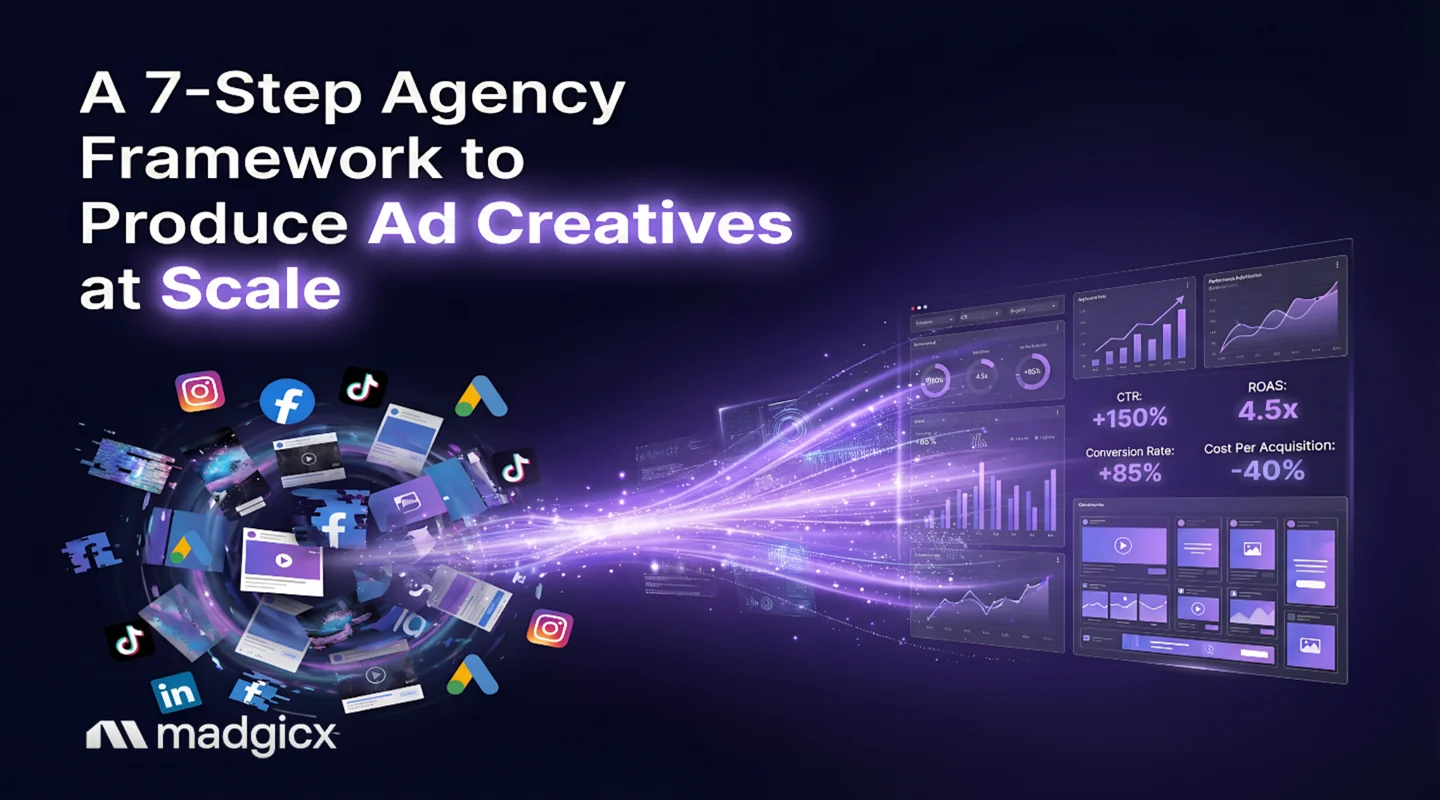
Agencies produce ad creatives at scale with a repeatable system, not one-off design. Here are the seven steps, plus templates, QC checks, costs and tools.
Agencies produce ad creatives at scale by running a fixed system instead of designing ads one by one: a strategy and brief per client, concepts built in batches, AI-assisted production, a quality check before launch, a structured test, and a weekly loop that feeds results into the next batch. Madgicx supports the AI-assisted production and the performance analysis in that system, with the AI Ad Generator for image ads and Creative Insights for what wins.
Below are the seven steps, how to set up templates by client vertical and workspaces for many brands, how to train a team on the process, what the work costs, and which tools help, with prices checked in November 2026.
Creative Insights shows each client's winning patterns, and the AI Ad Generator turns them into new ads.
Why is scaling ad creative so hard for agencies?
Making one good ad is a craft problem. Making hundreds a month across many clients is a process problem. Four bottlenecks show up in almost every agency:
- Ad fatigue: audiences tire of an ad, so the ad that worked last week slows down this week.
- Platform diversity: a 9:16 video for Reels does not drop into a LinkedIn carousel unchanged.
- Personalization: more audience segments mean more variations of each concept.
- Limited people: few agencies have designers and copywriters on standby for every client.
It is worth solving because creative is one of the biggest levers on ad performance. According to Kantar, a strong creative strategy can drive up to 4x higher profitability.
The 7-step framework to produce ad creatives at scale
Step 1: Define the creative strategy and team structure
Creative strategy is the plan for what an ad will say, how it will look and how it connects with the target audience to reach a business goal. Write it down per client before anyone opens a design tool: who you are talking to, what they care about, and the one thing every ad must say.
Then pick a team shape that fits your volume:
- Lean team (3 to 5 people): a creative strategist who owns strategy and performance data, a copywriter, and a designer who also edits video.
- Scale team (10+ people): a creative director for brand consistency, strategists, a project manager for timelines, specialist copywriters, designers and video editors, and a media buyer who launches ads and reports results back.
Step 2: Standardize intake with a master brief and vertical templates
The most common point of failure is a weak brief. Use one master creative brief for every client, so everyone works from the same page. It should hold:
- The objective: the one goal of the ad.
- The audience: who they are and what problem they have.
- The key message: the one thing a viewer should remember.
- Mandatories and restrictions: logo, URL, claims to include or avoid.
- Deliverables and specs: every asset, size, format and placement.
Next, build a small template system for each client vertical. A fashion brand needs a lifestyle image with a price badge; a supplements brand needs a before-and-after or review layout; a SaaS client needs a clean screenshot with one benefit headline. Each template fixes the layout, the safe zones, the type sizes and the slots for product, headline and proof, so a designer or an AI tool only fills the slots.
Step 3: Batch concepts in creative buckets built on performance data
Generate ideas in themes instead of one at a time, and start from what already works in each account. A hook, angle and proof matrix keeps the batch varied: pick three hooks, three angles and two proof types, and you have 18 combinations to brief. Common buckets:
- User-generated content (UGC) style: authentic-looking videos or images that read like a customer.
- Testimonials and social proof: review screenshots and customer quotes.
- Product demos: the product in use.
- Problem and solution: name the pain, then show the product as the fix.
- Educational: a quick tip that builds authority.
Step 4: Run production as a batch with AI and specialist tools
Creative automation means generating many ad variations by combining assets under a set of rules or templates. One case study from Hunch reported an 82% lower cost per lead after adopting it. A workable batch workflow:
- Schedule the batch. Produce one batch per client per week or fortnight, with fixed deadlines for briefs, drafts, review and launch.
- Generate core assets. Collect product images, footage and customer quotes into one folder per client.
- Write copy variations. Draft headlines and primary text with an AI assistant, then edit them in the client's voice.
- Build the image ads. The Madgicx AI Ad Generator creates image ads from a prompt, an image or any ad in the Meta Ad Library, ready to edit and use. Video and UGC-style video still come from your editors or a separate video tool.
- Launch in bulk. Use an automated ad launch tool or the Madgicx Ad Launcher to put the variations live together.
Step 5: Add quality-control checkpoints before launch
Volume without checks creates expensive mistakes. Put four checkpoints between production and launch:
- Brief match: does the ad say the key message and carry every mandatory item?
- Brand check: logo, colors, fonts, tone and claims match the client's guidelines.
- Technical check: sizes, safe zones, legible text on a phone, working links and correct UTM tags (the Facebook UTM Builder helps here).
- Client approval: one named approver per client and a deadline, so reviews do not stall a batch.
Step 6: Test in a structured way and track what works
A creative testing method compares performance in a controlled way to find which elements drive results. As a rule of thumb, set aside 10 to 20% of the ad budget for creative testing, and divide it by the number of concepts you test:
Creative testing budget = (total ad spend x 10 to 20%) / number of concepts
Track the same few numbers for every concept: cost per result, ROAS, click-through rate and how long the ad holds up. Creative Insights breaks down every creative, including video, to show what makes winning ads win and flags fatigue, and the Madgicx Copilot answers questions such as "compare the CTR of my UGC ads with my testimonial ads" from your own account data. Feed the winners back into Step 3. Our guide to A/B testing frameworks for agencies shows how to structure the tests.
Step 7: Adapt each winner for every platform and refresh on a schedule
Build a "transcreation" step into the workflow, so a winner on one platform is rebuilt, not just resized, for the next:
- Meta (Facebook and Instagram): vertical 9:16 video for Reels and Stories, with the hook in the first 3 seconds. UGC-style content and polished brand assets both work.
- TikTok: native feel, trending audio, fast cuts and on-screen text.
- LinkedIn: clean graphics, data visuals and carousels with a clear business value.
Plan a refresh every 7 to 14 days for accounts that spend heavily, and refresh sooner when fatigue shows. A refresh can be as small as a new headline or a new first three seconds.
How do you set up workspaces for many brands?
Give every client its own folder structure, template set, brand sheet and ad account, and keep the naming the same across all of them: client, vertical, concept, hook, version. Same names make results comparable and let any team member pick up any account. In Madgicx, one plan covers many ad accounts at $9 per extra ad account, so each client's Meta account stays separate while your team works from one login.
How do you train a team on systematic production?
Teach the system, not the tools. Run a one-hour walkthrough of the brief, the templates and the checkpoints, then have each new person produce a practice batch for a past client and compare it with the real results. Keep one shared document with the brief, the QC checklist and three examples of approved ads per vertical. Review the weekly results together, so designers see which concepts won and why.
How much does producing ad creatives at scale cost?
Cost comes from three places: people, software and testing budget. The levers that move it most are templates (less design time per ad), batching (fewer context switches) and cutting weak concepts fast (less spend on losers). On the software side, the prices below are as of November 2026.
What tools help agencies produce ad creatives at scale?
| Tool | What it does for creative production | Best for | Price (Nov 2026) |
|---|---|---|---|
| Madgicx | Image ads from a prompt, image or Meta Ad Library ad; creative analysis and fatigue flags | Agencies running Meta ads | From $45 a month, priced by ad spend; 7-day free trial |
| AdCreative.ai | Images, banners, product-to-video and UGC-style video, with a score before launch | Marketers who want images, video and copy from one tool | Starter $39 a month, Professional $249, Ultimate $999; 7-day free trial with 20 credits |
| AdManage | Bulk launch and bulk edit across Meta, TikTok, Google and more, plus AI ad generation from credits | Teams that launch large batches of ads | From GBP 199.99 a month for one ad account |
| Motion | AI tags each Meta creative by format, theme, offer and hook, and reports what works | Creative teams that want detailed reports | Starter $999 a month for up to $50,000 of spend; Pro and Growth through sales |
For more options, see our lists of AI ad creation tools for agencies and agency tools.
How to produce ad creatives at scale with Madgicx
Madgicx covers the two ends of the workflow. For production, the AI Ad Generator turns a product image, a prompt or a proven ad into image variations you can edit. For the learning loop, Creative Insights shows which creatives win and when they tire, and AI Marketer prepares recommendations that you review and approve in one click. Madgicx is an Official Meta Business Partner, trusted by 200,000+ advertisers, and rated 4.6 out of 5 on G2 from 220+ reviews.
Try the AI Ad Generator and Creative Insights with a 7-day free trial
FAQ
How do agencies produce ad creatives at scale?
They use a repeatable system: a master brief, templates by client vertical, concepts built in weekly batches, AI-assisted production, quality checks before launch and a structured test that feeds the next batch.
What is the best way to automate video ad production for agencies?
Start with a template and a proven hook, then use a video tool or your editors to produce variations of it. Madgicx generates image ads only, so pair it with a separate video tool for UGC-style testimonials.
How much of the ad budget should go to creative testing?
A common rule of thumb is 10 to 20% of total ad spend, divided across the number of concepts you test.
How often should you refresh ad creatives?
Plan on every 1 to 2 weeks for heavy spenders, and sooner when fatigue shows. A small change, such as a new headline or a new first 3 seconds, counts.
What team structure works for an in-house creative team?
Start with a lean team: a creative strategist, a copywriter and a designer who also edits video. Add a creative director and a project manager once you pass about 10 people.
How can AI help with creative production beyond generating images?
AI can draft copy variations, break down which creatives and elements win, flag fatigue and answer questions about your results from your own account data.