Compare AI-powered ad agencies with ad automation platforms, learn rule-based automation vs AI and the questions to ask before you automate.
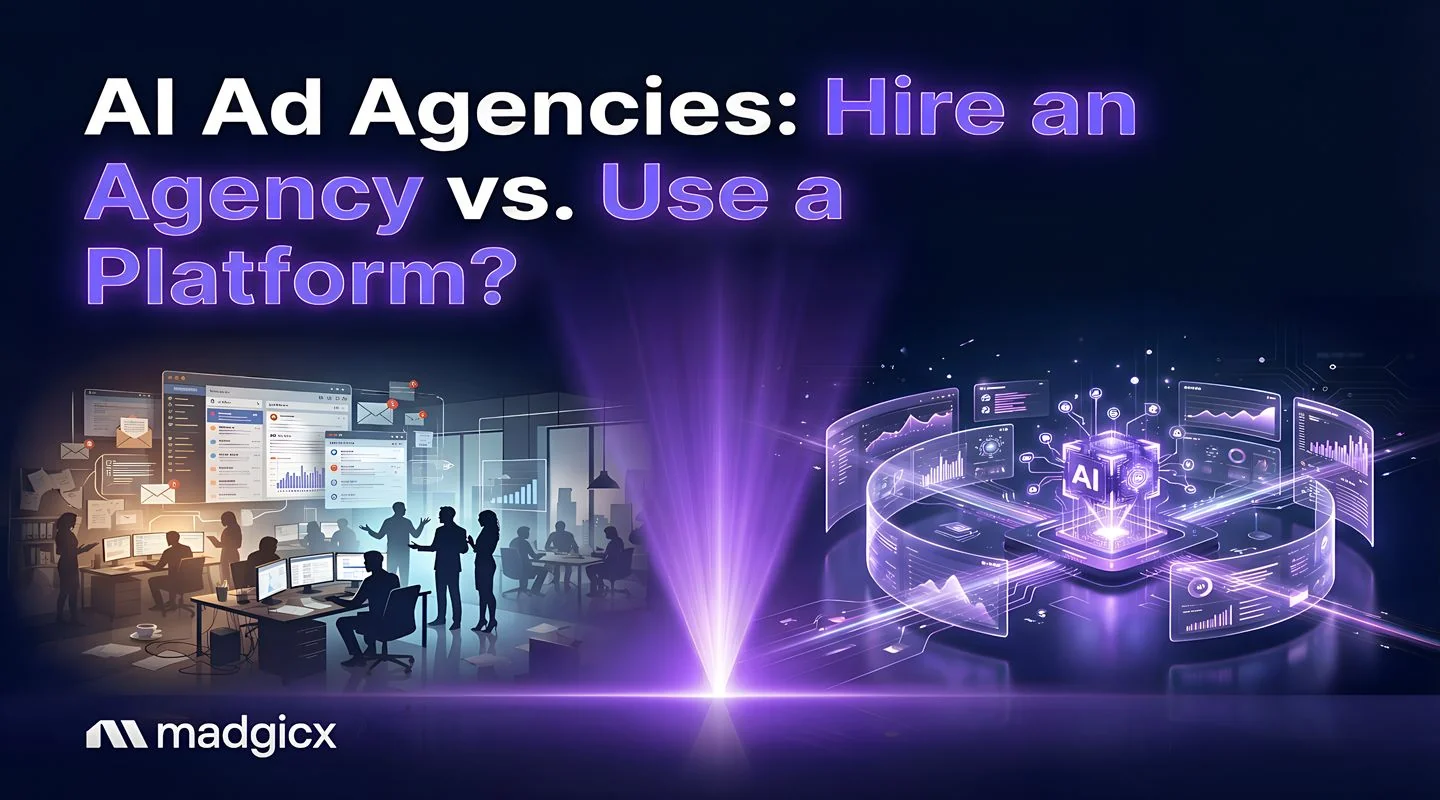
Ad agencies that use automation to manage campaigns include Superside (creative production), InBeat (B2B lead generation) and WebFX (full-service digital marketing), while the platforms that bring automation in-house include Madgicx for Meta ads, Fluency for agency campaign launches and Albert.ai for large advertisers. An agency is a service you hire. A platform is software your team uses.
Neither is better in every case. The choice comes down to time, expertise and control. This guide compares both models as of November 2026, explains rule-based automation versus AI, and ends with questions to ask before you automate your campaigns.
AI Marketer audits your account every day and recommends what to change. You approve each one.
What is AI-powered ad management: service or software?
An AI-powered agency is a service provider that uses AI and automation software to manage, optimize and report on advertising campaigns for its clients. An ad automation platform is software that lets a business or agency automate repetitive advertising work in-house, such as bid and budget management, audience testing and creative testing.
| Question | AI-powered agency | Ad automation platform |
|---|---|---|
| Who runs the campaigns? | The agency's team | Your team, with AI doing the analysis |
| What do you buy? | A result, delivered as a service | Software and the data to act on |
| Price model | Retainer or share of spend, quoted per client | Subscription, often scaled to ad spend |
| Control and visibility | What the agency reports to you | Every change and number in your accounts |
| Best fit | No in-house expertise, or broad strategy needs | An in-house marketer who needs better tools |
What is the difference between rule-based automation and AI?
Rule-based automation does what you tell it: "pause an ad when cost per purchase passes this number." It is predictable and good for routine controls. AI adds analysis: it reads the whole account, finds patterns a rule would not catch and recommends what to do next. See our explainer on AI agents versus agentic AI for Meta ads for the plain-language version.
Meta has its own automation, too. Its Advantage+ campaign budget spreads one campaign budget in real time across ad sets with the best opportunities, according to the Meta Business Help Center. Third-party platforms work alongside it, adding audits, creative analysis and recommendations.
Madgicx combines both: rules you set run your Meta campaigns 24/7, and AI Marketer adds recommendations that you approve in one click.
Which ad agencies use automation to manage campaigns?
These three agencies are known for building automation into their work. Agencies quote by scope, so ask each for a proposal.
1. Superside
Superside is a creative-as-a-service company rather than a typical ad agency. It automates project management and connects you with a network of designers, so it can produce ad creative, videos and landing pages quickly. It does not manage your campaigns.
- Best for: enterprise-level creative at scale.
- Price: see its pricing page.
2. InBeat
InBeat focuses on lead generation for B2B and SaaS companies. It relies on marketing automation to build campaign sequences that nurture leads and uses AI to refine targeting and messaging for specific business audiences.
- Best for: B2B and SaaS lead generation.
- Price: ask the vendor.
3. WebFX
WebFX is a full-service digital marketing agency. It uses its own platform, MarketingCloudFX, to track leads across channels, which gives clients a detailed view of return on investment.
- Best for: small and mid-size businesses that want one full-service marketing partner.
- Price: ask the vendor.
Which ad automation platforms do agencies and brands use?
1. Madgicx
Madgicx is the agentic AI advertising platform for Meta ads. AI Marketer audits your accounts and prepares recommendations and actions for you to approve, Copilot answers questions about your account from your own data, and the AI Ad Generator makes image ads from a prompt, an image or any ad in the Meta Ad Library. Its reporting covers Meta, Google Ads, TikTok, Shopify and Klaviyo, but it optimizes Meta ads only.
- Best for: e-commerce brands and agencies scaling on Meta.
- Price: from $45 a month, priced by ad spend, with a 7-day free trial.
2. Fluency
Fluency is built around agency operations. Its strength is workflow automation: templated campaign structures that an agency can launch across many client accounts quickly, which speeds up onboarding new clients.
- Best for: large agencies managing many clients.
- Price: see its pricing page.
3. Albert.ai
Albert.ai describes self-optimizing campaign management that shifts spend between audience segments as performance changes. Its home page shows Bing, Instagram, Facebook, YouTube, TikTok and DV360. It manages campaigns in your existing ad accounts and, per its FAQ, does not develop creative or write ad copy.
- Best for: large advertisers that buy by quote and run many channels.
- Price (as of November 2026): custom quote. Its pricing page lists no plans and no free trial.
How do the platforms compare?
| Platform | Core strength | Channels | Price |
|---|---|---|---|
| Madgicx | AI recommendations you approve, plus creative tools | Optimizes Meta; reports on Google Ads, TikTok, Shopify, Klaviyo | From $45 a month; 7-day free trial |
| Fluency | Templated campaign launches for agencies | See its site for its list | See its pricing page |
| Albert.ai | Self-optimizing spend across segments | Bing, Instagram, Facebook, YouTube, TikTok, DV360 | Custom quote |
How does AI plan and create campaigns step by step?
- Audit. The AI reads the account and shows what works and what wastes spend.
- Plan. You set the goal and budget; the AI proposes where to put the money.
- Build. You create campaigns, ad sets and ads with help. In Madgicx, Copilot builds them in chat and creates them paused, so nothing goes live until you say so.
- Create. You generate fresh creative from a prompt, an image or a reference ad.
- Review. You approve the AI's recommended changes and let rules handle routine ones.
How do you coordinate bids, budgets and alerts across platforms?
Platforms that touch several networks can compare cost per result in one place and move budget toward what works. Others, like Madgicx, go deep on one network and report on the rest. Either way, set alerts for what matters most: a spike in cost per purchase, a drop in spend or a tired ad. Madgicx suggests metric alerts based on your own numbers and keeps one list of what needs attention, including Meta's own recommendations. For budget limits, see our guide to controlling your Facebook ad budget.
How is creative production automated at scale?
Creative automation covers generating new ads, analyzing which ones work and refreshing the ones that tire. Superside does it with designers and automated project management. Madgicx does it with software: the AI Ad Generator makes image ads, and Creative Insights breaks down every creative, including video, and flags fatigue so you know when to refresh.
What tools do agencies need for reporting and client work?
Agencies need one report per client, built from several data sources, that clients can open without a login. Madgicx's One-Click Report brings Meta, Google Ads, TikTok, Shopify and Klaviyo into one place and shares by link or PDF. Pair that with a plan for tracking: Madgicx Cloud Tracking sends conversions to Meta from the server, so clients' ads are judged on more of the sales they drive.
How do you choose between an agency and a platform?
Hire an agency if you have no time, no in-house media buyer or a need for broad strategy beyond ads. Use a platform if you have someone who can own the ads, want to see every change and want to move faster. Do the math on both: an agency fee replaces a salary, while a subscription still needs a person to use it. Our guide on Meta ad automation versus outsourcing walks through the trade-off.
What should you ask before you automate your campaigns?
- Which changes go live without my approval?
- Which ad accounts and data sources does it connect to?
- How do conversions reach Meta, and is tracking included?
- Who owns the ad account, the data and the creative if I leave?
- What does the total cost look like, including ad spend and any minimum term?
- How will I see results, and how often?
How do you automate campaign management with Madgicx?
Connect your Meta ad account and let AI Marketer audit it. Approve the recommended actions you agree with, set automation rules for routine changes, generate new creative with the AI Ad Generator and share a One-Click Report with your team or clients. Plans start at $45 a month, priced by ad spend; see the pricing page.
FAQ
Which ad agencies use automation for managing ad campaigns?
Superside, InBeat and WebFX each build automation into their work, for creative production, B2B lead generation and lead tracking. Many other agencies do the same, so ask any agency which tools it uses and what they change.
What is the real difference between an AI agency and AI software?
An AI agency is a service you hire, and its team manages your ads with AI tools. AI software is a tool your own team uses to automate and optimize campaigns.
Will automation replace ad managers?
No. AI handles data-heavy and repetitive work, which frees ad managers to focus on strategy, creative direction and understanding customers. The best ad managers learn to use these tools.
How much do AI advertising services cost?
Agencies quote by scope, so ask for a proposal. Software is usually a subscription: Madgicx starts at $45 a month, priced by ad spend, and Albert.ai sells by quote as of November 2026.
What is the ROI of marketing automation?
It comes from less manual work and better decisions made faster. Track cost per result, return on ad spend and hours saved before and after you automate.