Eleven AI marketing platforms for ecommerce, matched to the job each does: ads, email, support, recommendations, search, data and fraud.
The best AI marketing platforms for ecommerce are Madgicx for Meta ads, Triple Whale for store and ad data, Klaviyo for email and SMS retention, Gorgias and Tidio for customer support, Rebuy for product recommendations, Jasper for copy, Algolia for site search, Improvado for data pipelines, Photoroom for product photos and Signifyd for fraud prevention. No single tool covers all of it, so pick by the problem that costs your store the most.
For paid acquisition on Meta, Madgicx is the agentic AI advertising platform for Meta ads: it audits your account, prepares optimization actions you approve, generates image ads and pulls your Shopify and Klaviyo data into reports. The rest of this guide maps 11 platforms to the ecommerce jobs they do, then shows how to set up your first one. Prices were checked in November 2026 where a tool's facts were available.
AI Marketer audits your Meta ads daily, and One-Click Report puts results next to Shopify and Klaviyo data.
The 11 best AI marketing platforms for ecommerce at a glance
| Platform | Ecommerce job | Best for | Price |
|---|---|---|---|
| Madgicx | Meta ad optimization, creative, reporting, tracking | Stores scaling on Facebook and Instagram | From $45 a month, priced by ad spend; 7-day free trial |
| Gorgias | Customer support in one inbox, with AI replies | Stores with high ticket volume | See its pricing page |
| Klaviyo | Email and SMS flows with predictive analytics | Retention and repeat purchases | See its pricing page |
| Jasper | Ad copy, product descriptions and blog drafts | Content at scale in your brand voice | See its pricing page |
| Triple Whale | Store, ad and email data in one dashboard | DTC brands that want one view of their numbers | Free plan, then paid plans priced by store revenue |
| Rebuy | Product recommendations, upsells and cross-sells on Shopify | Raising average order value | See its pricing page |
| Tidio | AI chatbot on your site | Answering shoppers around the clock | See its pricing page |
| Algolia | AI-powered site search | Stores where shoppers search for products | See its pricing page |
| Improvado | Marketing data aggregation | Larger brands with many data sources | Ask the vendor |
| Photoroom | AI product photography | Clean product images without a studio | See its pricing page |
| Signifyd | Order fraud screening | Cutting chargebacks | Ask the vendor |
What does an AI marketing platform do for an online store?
An AI marketing platform uses machine learning and language models to automate, analyze and optimize marketing tasks. For a store that means tools that find your best ads, write and send flows, recommend products, answer customers and show which channels earn money. ODSC reports that 77% of marketing departments now use AI, so the question is less whether to use it than where to start.
Start with your biggest bottleneck. If acquisition costs are rising, look at ads. If shoppers leave before buying, look at recommendations, search and checkout recovery. If support eats your hours, look at chat. Solve one problem, prove the return, then add the next tool.
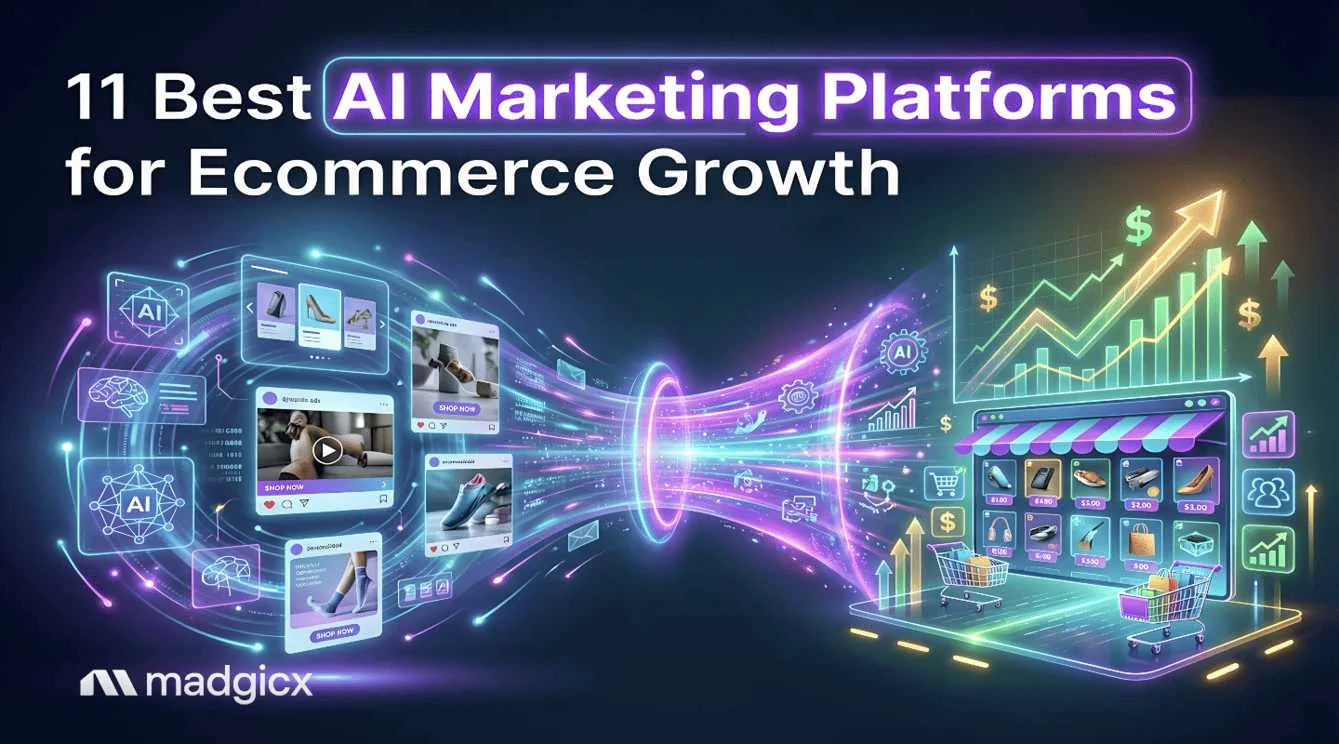
The 11 best AI marketing platforms for ecommerce growth
1. Madgicx
Madgicx is built for stores that sell through Meta ads. AI Marketer audits your Facebook and Instagram accounts, finds optimization opportunities and prepares actions you review and approve in one click. Copilot lets you ask your ad account questions such as "Why did my ROAS drop yesterday?" and answers from your own data. The AI Ad Generator makes new image ads from a prompt, an image or a Meta Ad Library ad.
For store data, One-Click Report and the Business Dashboard bring Meta, Google Ads, TikTok, Shopify and Klaviyo numbers into one place, including blended business metrics. Madgicx Cloud Tracking sends conversions to Meta from the server so Meta sees more of your sales.
- Best for: ecommerce brands and agencies that run Meta ads and want one platform for optimization, creative and reporting.
- Price: plans start at $45 a month, priced by monthly ad spend, with a 7-day free trial (current plans).
- Limit: it optimizes Meta ads only.
2. Gorgias
Gorgias centralizes customer conversations from email, chat and social into one feed. Its AI agent is designed to handle common support questions such as "Where is my order?" so your team can focus on harder tickets. It fits stores whose support volume grows with sales.
- Best for: stores with high support ticket volume.
- Price: see its pricing page.
3. Klaviyo
Klaviyo is an email and SMS platform whose AI features forecast customer behavior, such as churn risk and potential lifetime value. That supports abandoned cart and checkout recovery flows and personalized campaigns built on what each shopper did. It also pairs well with ads: Madgicx reports on Klaviyo data next to Meta results.
- Best for: retention, repeat purchases and cart recovery.
- Price: see its pricing page.
4. Jasper
Jasper generates ad copy, product descriptions and blog drafts. Its Brand Voice feature learns your style and tone so output stays on brand. It writes copy; it does not run or measure campaigns.
- Best for: teams that need a lot of on-brand copy.
- Price: see its pricing page.
5. Triple Whale
Triple Whale brings store, ad and email data into one dashboard with its own attribution and tracking pixel. It offers dashboards, an SQL editor, segments and a creative table with metrics for each ad, plus an AI chat that answers questions and builds dashboards. On its higher plans the AI can change budgets and pause ads on connected platforms. We found no campaign creation.
- Best for: DTC brands that want one view of store and ad numbers.
- Price: a free plan for up to 10 users with 12 months of data and limited AI use, then paid plans priced by annual store revenue. Enterprise is quoted.
6. Rebuy
Rebuy is a personalization engine for Shopify stores. It uses shopper behavior to show product recommendations, upsells and cross-sells at different points in the journey, which is how stores raise average order value.
- Best for: raising average order value on Shopify.
- Price: see its pricing page.
7. Tidio
Tidio provides Lyro, an AI chatbot that works as a sales and support assistant on your website, using natural language to answer questions and guide shoppers toward a purchase. Ringly.io reports that Lyro can automate up to 67% of conversations.
- Best for: answering shoppers around the clock.
- Price: see its pricing page.
8. Algolia
Algolia is an AI-native search engine that understands intent, typos and synonyms. A search that returns no results is a lost sale, so better search is an often overlooked conversion lever.
- Best for: stores with large catalogs where shoppers search.
- Price: see its pricing page.
9. Improvado
Improvado is an enterprise data tool. It aggregates data from many marketing sources and normalizes it for analysis, and its AI agent lets teams query large datasets. It suits larger brands with complex reporting needs.
- Best for: larger brands with many data sources.
- Price: ask the vendor.
10. Photoroom
Photoroom is an AI photo editor for product shots. You can remove backgrounds, generate scenes and make marketing images without a photographer.
- Best for: clean product images without a studio.
- Price: see its pricing page.
11. Signifyd
Signifyd uses AI to screen each order in real time and separate legitimate customers from fraud, and it offers a financial guarantee on approved orders that turn out to be fraudulent. It protects profit rather than driving sales.
- Best for: stores losing money to chargebacks.
- Price: ask the vendor.
Which AI tool fits each ecommerce job?
- Abandoned cart and checkout recovery: Klaviyo flows.
- Product recommendations and AOV: Rebuy, with Algolia for search.
- Customer support across chat and messaging: Gorgias and Tidio.
- Connecting store data for personalization and analytics: Triple Whale, Improvado or Madgicx's One-Click Report.
- Real-time revenue analytics for campaigns: Triple Whale and Madgicx's Business Dashboard.
- Ad and sales optimization: Madgicx for Meta ads.
- Creative and content: Madgicx's AI Ad Generator for image ads, Jasper for copy, Photoroom for product photos.
How do I set up my first AI marketing platform?
- Find your bottleneck. Check your numbers: high acquisition cost, low conversion, weak repeat rate or heavy support load.
- Choose one tool for that job. If it is paid ads, try Madgicx for 7 days on your Meta account.
- Connect your data. Link the store, ad accounts and email platform so the tool works from real results.
- Set limits. Decide what the tool may change without asking and what needs your approval. Use the break-even ROAS calculator to set an ad-spend floor.
- Measure, then add the next tool. Compare results after a few weeks before you add another.
For more agent-style tools, see our guide to marketing AI agents for ecommerce.
Grow your store's Meta ad results with Madgicx
If paid social is where your store grows, Madgicx covers the loop: Creative Insights shows which ads win and which are tiring, the AI Ad Generator makes the next ones, AI Marketer prepares budget and pause actions for you to approve, and Cloud Tracking sends more of your sales to Meta. Madgicx is an Official Meta Business Partner, trusted by 200,000+ advertisers and rated 4.6 out of 5 on G2 from 220+ reviews. See our guide to ecommerce AI platforms for more.
FAQ
What are the best AI marketing platforms for ecommerce?
Madgicx for Meta ads, Triple Whale for store and ad data, Klaviyo for email and SMS, Gorgias and Tidio for support, and Rebuy for product recommendations are the main picks. Choose by the problem that costs your store the most.
Which AI marketing platform is best for Shopify?
It depends on the job. Rebuy suits on-site recommendations, Gorgias suits support, and Madgicx suits connecting Shopify data with Meta ad performance in reports.
How should I start with AI marketing tools?
Start with your single biggest bottleneck. If ad performance is unpredictable, try Madgicx for 7 days. If support is overwhelmed, start with a support tool, and if order value is low, start with recommendations.
What is the difference between AI automation and traditional automation?
Traditional automation follows "if this, then that" rules you write. AI automation analyzes data and prepares decisions you did not write a rule for.
Can AI replace my marketing team?
No. AI takes over repeated tasks, so your team can focus on strategy, creative and customer relationships. With Madgicx you review and approve the actions it prepares.