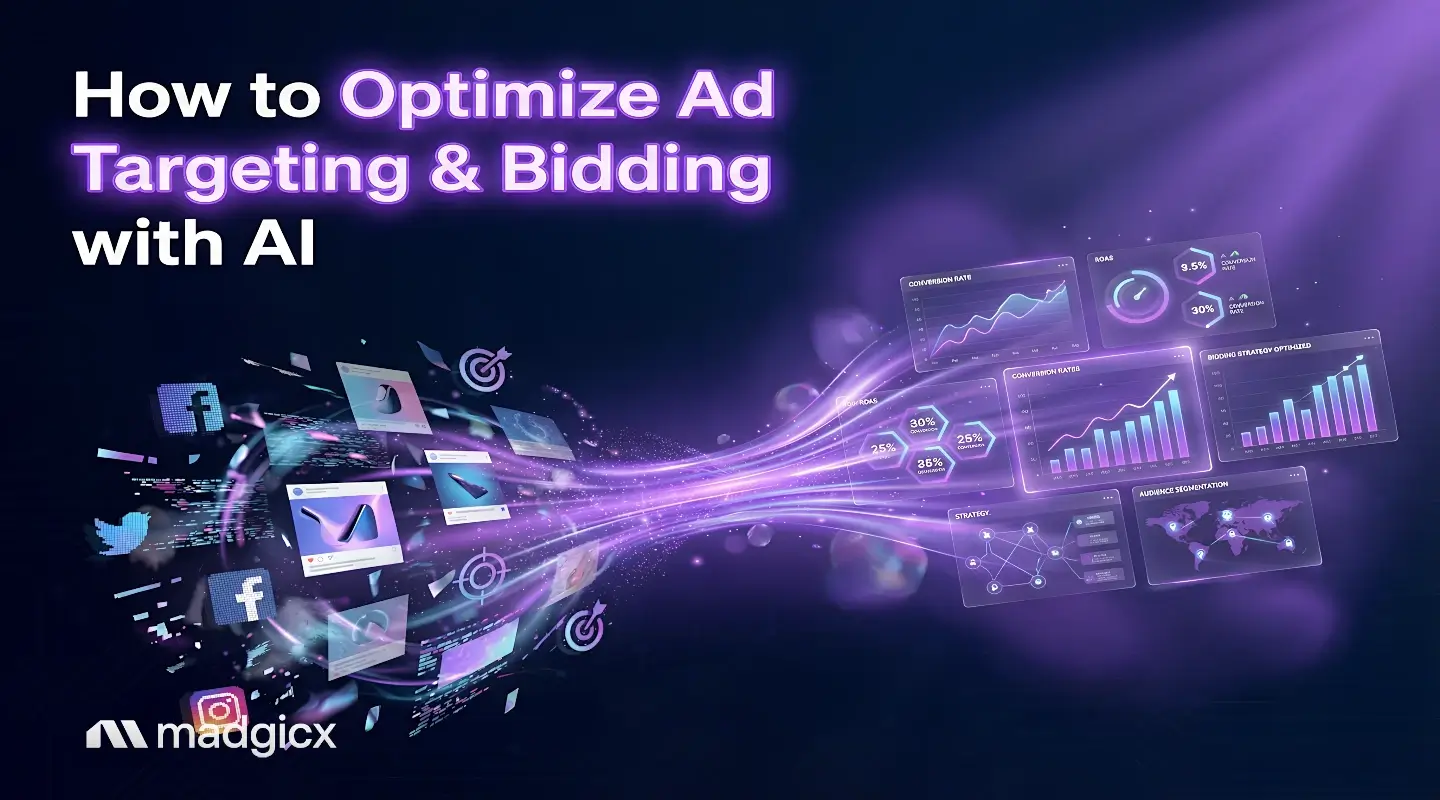
A step-by-step plan for using AI to optimize campaign targeting and bidding on Meta, from conversion data and bid strategies to guardrails and measurement.
To use AI to optimize campaign targeting and bidding, send the AI clean conversion data, give it a clear goal such as a cost per result or ROAS target, let it find audiences and adjust bids and budgets inside limits you set, and review what it changed each week. On Meta, you can start with Advantage+ audience and Meta's bid strategies, then add Madgicx so AI Marketer audits the account and prepares audience, budget and bid actions for you to approve.
Manual optimization can't keep up with auctions, privacy changes and thousands of signals. AI doesn't replace your judgment about goals and margins. It does the analysis and prepares the changes. This guide covers what AI changes in targeting and bidding, the data it needs, a step-by-step rollout plan, how to measure results and the risks to manage.
AI Marketer audits your targeting and budgets daily and recommends changes. You approve each one.
How to use AI to optimize campaign targeting and bidding: key steps
| Step | What you do | Why it matters |
|---|---|---|
| 1. Fix your data | Send purchases with revenue through the Pixel and the Conversions API | AI can only optimize on conversions it sees |
| 2. Set the goal | Pick a bid strategy: highest volume, cost per result goal or ROAS goal | The AI predicts and bids for the goal you choose |
| 3. Open up targeting | Test Advantage+ audience against your own audiences | AI finds people you wouldn't have targeted |
| 4. Set guardrails | Budget caps, CPA and ROAS limits, approval for big moves | Stops errors from scaling |
| 5. Review weekly | Check what changed and why, then repeat | Keeps the AI tied to business results |
What does AI-driven targeting change in campaign setup?
Targeting used to mean choosing an age, gender and interest list. With AI, you describe the goal and the signals, and the system works out who is likely to act. Advantage+ audience is Meta's version: it uses Meta's AI to find the audience for a campaign instead of you defining it, drawing on signals such as past conversions, Meta Pixel data and interactions with previous ads. Meta reports 7.2% lower cost per result for Sales and App promotion campaigns, and recommends A/B testing it for almost all campaign types. It isn't recommended for retargeting.
Your setup work shifts from picking interests to giving the AI better inputs: strong conversion events, customer lists as audience suggestions and a goal that matches your business. Predictive segmentation, which groups people most likely to convert from your first-party data, is a core idea behind predictive audience modeling.
How do you feed conversion data into AI bidding?
Bidding is how much you are willing to pay for each person. On Meta, every ad opportunity runs an auction, and the winner is the ad with the highest total value, a mix of your bid, the estimated action rate and ad quality. AI works on the second part: it predicts how likely each person is to convert, so the same bid goes further.
That prediction depends on conversion data, so:
- Send purchases from your server. Browser tracking misses conversions. The Conversions API sends them from your server. Madgicx Cloud Tracking hosts Meta's Conversions API Gateway and Signals Gateway for you, so Meta sees and attributes more of them.
- Pass the real revenue on purchase events, because value-based bidding needs it.
- Deduplicate events so one sale isn't counted twice.
- Aim for volume. Meta recommends 50 to 100 or more weekly conversions for best performance. The question is conversion volume, not budget size alone.
Which Meta bid strategy should you use?
Meta's bid strategies come in three types: spend-based, goal-based and manual. Each campaign uses a single bid strategy.
| Bid strategy | What it does | Use it when |
|---|---|---|
| Highest volume | Maximizes the conversions you can get from your budget | You want the most results and have no strict cost target |
| Highest value | Spends the budget with a focus on the highest value purchases | Order values vary a lot |
| Cost per result goal | Maximizes conversions near the cost you set | You have a CPA you can't exceed |
| ROAS goal | Aims to keep return on ad spend near an average you set | You track revenue per sale |
| Bid cap | Sets the maximum bid in every auction | You are an advanced advertiser who can predict conversion rates |
Meta notes that adherence to a cost per result goal isn't guaranteed, so treat it as a target the AI works toward, not a promise. For a starting goal, Meta suggests a bid 10 to 20% above your recent average CPA for a cost per result goal, or 10 to 20% below your recent average ROAS for a ROAS goal. Not sure what ROAS you need? The break-even ROAS calculator gives you the floor. For the machine learning behind this, see our guide to machine learning algorithms for bid management.
How do you optimize budget and bids under AI control?
Once data and goals are set, the AI's job is to move money to where it works. Meta's Advantage+ campaign budget distributes one central budget in real time to the ad sets with the best opportunities. Beyond that, a tool like Madgicx watches the whole account:
- AI Marketer audits your Meta account daily and prepares recommendations, such as where to scale and where to cut, that you complete or dismiss.
- Automation runs rules you write 24/7 and includes prebuilt tactics. Meta also has automated rules that pause ads or adjust budgets based on criteria you choose, and Meta advises you to keep monitoring performance while they run.
- Copilot answers questions from your own data, such as why CPA rose, and changes budgets on your approval.
Keep changes small and spaced. Meta says frequent budget changes can send an ad set back into the learning phase, which usually ends after about 50 results in the week after the last significant edit.
A step-by-step plan for rolling out AI targeting and bidding
- Audit your tracking. Confirm purchases and revenue reach Meta through both the Pixel and the Conversions API, with no duplicates.
- Record a baseline. Save two to four weeks of CPA, ROAS and spend before you change anything.
- Pick one campaign. Choose one with enough conversions to learn from.
- Set the goal and limits. Choose a bid strategy and add budget caps and a kill-switch rule, for example pausing an ad set when CPA stays 25% above target for three days.
- Test targeting. Run Advantage+ audience against your own custom and lookalike audiences in an A/B test.
- Leave the learning phase alone. Judge results after the ad set exits learning.
- Review weekly. Check what the AI changed, compare with the baseline, then widen to more campaigns.
How do you measure results beyond efficiency gains?
Lower CPA is not the only win. Track:
- Profit, not only ROAS. Compare ROAS with your break-even point.
- New customers. Check that cheaper results aren't just existing customers buying again.
- Time saved. Hours spent on checks, reports and manual budget changes.
- Consistency. Fewer days of runaway spend or sudden CPA spikes.
Our playbook on tracking KPIs to optimize campaign performance covers which numbers to watch. For results across channels, One-Click Report brings Meta, Google Ads, TikTok, Shopify and Klaviyo data into one view, so bidding decisions don't rest on a single channel's numbers.
What are the limits and risks of AI-driven optimization?
- It optimizes the goal you set. A wrong goal, such as cheap leads that never buy, gets optimized very well.
- It needs data. Low conversion volume gives noisy decisions. Consolidate ad sets or use an earlier funnel event until volume grows.
- It can be a black box. If you can't see why something changed, you can't judge it. Ask for the reason before you accept an action.
- Attribution can mislead. Platforms report conversions in their own favor, so check results against your store data.
- Mistakes scale. A misconfigured rule can drain budget quickly. Use spend caps and alerts.
How do you govern AI in automated campaigns?
Decide who approves what. A workable split: the AI prepares everything, a person approves any change to budgets above a set size, and rules handle small, reversible moves. Keep brand safety under your control by reviewing placement reports and excluding placements that don't fit. Review the log of changes weekly, and keep a person in charge of goals, margins and brand rules. For a wider view of what AI changes in performance, see how AI improves ad performance.
Which tools help with AI targeting and bidding?
| Tool | What it does for targeting and bidding | Price |
|---|---|---|
| Madgicx | Audits Meta accounts daily, prepares audience, budget and bid actions for approval, and sends conversions to Meta from the server | From $45 a month, priced by ad spend; 7-day free trial |
| Meta Ads Manager | Advantage+ audience, bid strategies, Advantage+ campaign budget and automated rules | The baseline to compare against |
| Triple Whale | Store, ad and email data in one dashboard with its own attribution; on higher plans its AI can change budgets and pause ads | A free plan, then paid plans priced by store revenue |
Optimizing Meta targeting and bidding with Madgicx
Madgicx is the agentic AI advertising platform for Meta ads. Cloud Tracking improves the conversion data Meta bids on, AI Marketer finds what is working and prepares recommendations, and you review and approve them in one click. Copilot explains changes in plain language from your own data, and Automation rules enforce your limits around the clock. Madgicx is an Official Meta Business Partner with 200,000+ advertisers and $10B+ in annual ad spend visibility.
Start your 7-day free trial and see what AI Marketer recommends for your targeting and bids
FAQ
How do you use AI to optimize campaign targeting and bidding?
Send clean conversion data, choose a goal-based bid strategy, test AI audience options such as Advantage+ audience, set budget and CPA limits, and review the changes weekly. Madgicx prepares the audience, budget and bid actions for you to approve.
How much budget does AI bidding need?
It depends more on conversion volume than on budget. Meta recommends 50 to 100 or more weekly conversions for best performance, so divide that by your cost per result to estimate the budget. At a $50 CPA, 50 conversions a week is about $2,500 a week.
How does AI targeting work without third-party cookies?
It relies on first-party data, such as customer lists and purchase history, and on signals from your own pixel and server events. The more complete your conversion data, the better the targeting.
Can AI replace a media buyer?
Not fully. AI does the analysis and prepares changes faster, but a person sets goals, margins and brand rules and approves the big moves.
What is the difference between Meta's Advantage+ and a tool like Madgicx?
Advantage+ optimizes delivery and audiences inside Meta. Madgicx sits on top of your Meta account, audits it, shows what drives results and prepares actions, with Google Ads, TikTok, Shopify and Klaviyo data in its reports.