Twelve Facebook ads automation tools scored on rules, AI agents, bulk launching, video ads, alerts and ad platforms, with app install campaigns in mind. Madgicx ranks first.
Which Facebook ads automation tools come out on top?
How do the 12 tools compare side by side?
| Tool | Tool score | Best for | What it does for you | Starting price | Free trial |
|---|---|---|---|---|---|
| Madgicx | 9.6/10 | Meta ads automation with rules, agents and changes you approve | Yes.Automation rules run Meta campaigns 24/7. | From $45/mo | 7-day free trial |
| Markifact | 9.1/10 | Teams automating chores across ad networks and data tools | Partly.Scheduled and triggered workflows; no rule builder. | from $79 a month | Start free with trial credits. |
| Smartly.io | 8.9/10 | Enterprise teams turning product feeds and templates into ads | Yes.Triggers act on ads by performance, weather or time of day. | by quote | No trial. Book a demo to get started. |
| Optmyzr | 8.9/10 | Google Ads teams adding Meta rules, alerts and reports | Yes.Rule Engine runs weekly to hourly by plan; Meta rules too. | from €209 a month, billed annually | 14-day free trial. |
| Bïrch | 8.8/10 | Writing your own rules for Meta, TikTok, Snapchat and Google Ads | Yes.Rules with nested conditions, checked every 15 minutes. | from $49 a month | 14-day free trial. |
| Fab |
8.6/10 | Making, launching and rule-tuning ads in one plan | Yes.Budget and on/off rules on ROAS, CPA, CTR and spend. | from $39 a month | 7-day trial on most plans, not FAB AI. |
| Go |
8.3/10 | Agents that read Meta, Google and TikTok data and wait for your yes | Partly.Agents monitor and flag issues; no rule builder. | from $139 a month | 7-day trial on paid plans. |
| Ad |
8.3/10 | Batch launches to Meta, TikTok, Google and app ad networks | Partly.Rules pause weak ads and scale strong ones; limits by plan. | from £199.99 a month | No free trial. Money-back guarantee. |
| Ad |
7.5/10 | Hand-built Facebook and Instagram campaigns with split tests | Yes.Rules on CPA and ROI move budget and pause ads. | from $49 a month | 14-day free trial, no free plan. |
| Adkit | 7.3/10 | Agent-run ads for freelancers, with every change parked as a draft | No.No automation rules; competitor alerts and a weekly digest. | from $29 a month | 7-day free trial. |
| Albert.ai | 7.3/10 | Large cross-channel budgets steered toward one goal | No rule builder seen; its AI self-optimizes to your goals. | by custom quote | No trial. Request an estimate. |
| Blip | 7.2/10 | Fast launches into Meta and TikTok ad sets you already run | No.No rules; you apply its budget suggestions yourself. | from $49 a month | 7-day free trial. |
Our 12 picks for the best Facebook ads automation tools
Madgicx Best overall
9.6/10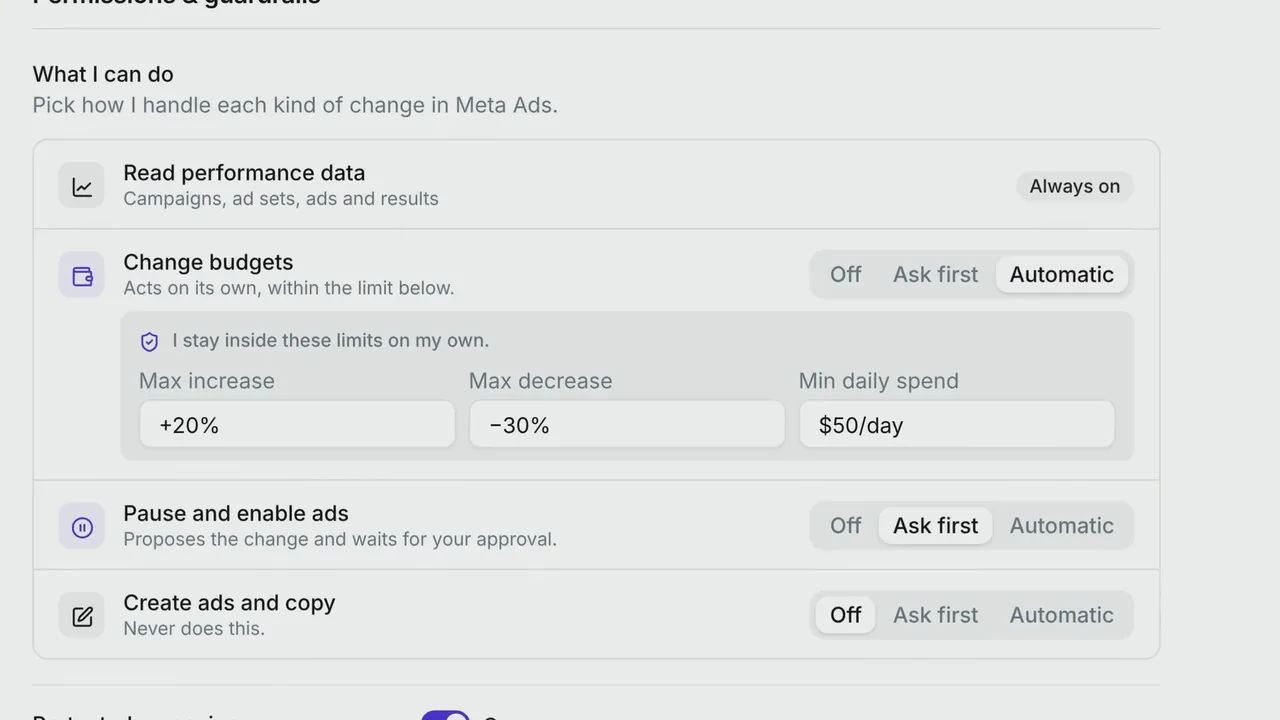
Built as an agentic AI platform for Meta ads, Madgicx divides the work by who has the final say. Rules you write act by themselves the moment their conditions are met. Everything its AI produces, from a budget shift its AI media buyer suggests to a new campaign built in its AI chat, waits as a ready-to-run action or a card until you approve or turn it down, and agents report back by email after each scheduled run, so you stay informed without opening the app.
Its users are performance marketers and agencies whose app or store budget runs mostly on Meta and who want AI to carry the daily workload there. Pricing follows the monthly ad spend a plan covers, with monthly, quarterly or annual billing, and every plan includes two MCP servers: through one, Claude or ChatGPT works in your Meta ad accounts, and the other analyzes Google Ads.
- Best for
- Meta ads automation with rules, agents and changes you approve
- Starting price
- From $45/mo
- Free trial
- 7-day free trial
How it scores
- Yes.Rules and automationAutomation rules run Meta campaigns 24/7 on the conditions you set.
- Yes.AI actions and agentsMadgicx's AI media buyer prepares actions you approve or dismiss, and agents run on a schedule.
- Yes.Bulk launching adsMadgicx builds and launches your campaigns, ad sets and ads, with bulk actions across them.
- Yes.Video adsMadgicx builds Facebook and Instagram video ads from your own videos, ready to publish after your approval.
- Yes.Alerts on your ad accountMadgicx alerts you when an account moves away from the targets you set, and suggests alerts on your Home page.
- Partly.Ad platforms coveredMadgicx optimizes Meta ads. Reporting covers Meta, Google Ads, TikTok, Shopify, Klaviyo and Google Analytics.
Pros
- Pause an ad, change an ad set budget or duplicate one by asking in chat, applied once you approve
- Shows what makes winning creatives win, videos included, and warns when one starts to tire
- Turns a prompt, a product image or any Meta Ad Library ad into new image ads
- Questions about any campaign get answered in the AI chat from your own account data
Cons
- No Google or TikTok app campaign management
Prices checked 23 November 2026
Markifact
9.1/10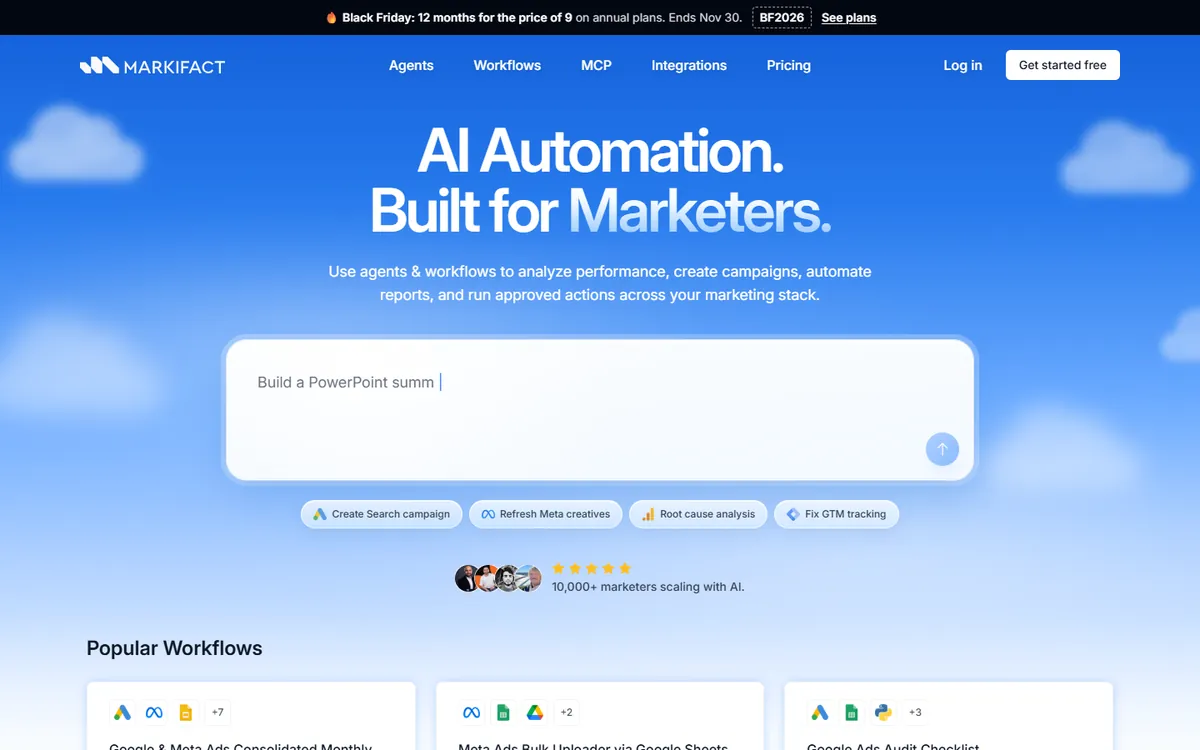
Markifact offers two ways to hand work off. A one-off job goes to its agent as a typed request; a routine becomes a saved workflow, laid out on a visual canvas by you or assembled by its AI copilot. Either way, its pages say changes reach your accounts only after you approve them in the chat or in Slack.
Its audience runs from solo marketers and freelancers to agencies whose work crosses ad networks and data tools such as Shopify, HubSpot, GA4 and Sheets. Ad accounts are unlimited on every listed plan, so seats and credits set the price: Pro is a single seat, Team at $249 a month seats 10 to 50 people and adds API access with priority support, and a custom Managed plan hands the workflow building to Markifact's own team.
- Best for
- Teams automating chores across ad networks and data tools
- Starting price
- from $79 a month
- Free trial
- Its pricing page says to start free with trial credits. We saw no free plan in its plan table.
How it scores
- Partly.Rules and automationWorkflows run manually, on a schedule or from a trigger, with templates for reporting, audits and bulk ad creation. We saw no rule builder for ad performance described.
- Yes.AI actions and agentsYou describe a marketing task in plain language and an agent carries it out, such as building campaigns or adding negative keywords. An MCP server brings its tools into Claude, ChatGPT, Gemini and Cursor.
- Yes.Bulk launching adsIts Meta bulk uploader creates dozens of ads from one Google Sheet, with TikTok and Google versions too.
- Partly.Video adsA workflow step makes videos with OpenAI's Sora 2 from a prompt; we saw no ready video ad template.
- Yes.Alerts on your ad accountWorkflow templates email you when campaign spend passes a pacing limit you set.
- Yes.Ad platforms coveredIt lists 1000+ operations across Google Ads, Meta Ads, TikTok, LinkedIn, Shopify, HubSpot, GA4, Sheets and Slack, with 14 ad platforms in total.
Pros
- Ten image variations per run from a prompt plus a reference picture
- Its creative analysis template proposes new hooks and formats from your Meta results
- Gathers competitor ads from four ad libraries into a Google Sheet
Cons
- Pausing at a cost-per-install line means building a workflow; no rule builder for ad results is listed
- App video ads need a Sora 2 step you add yourself; no ready video ad template is shown
Markifact alternatives, compared · Prices checked 23 November 2026
Smartly.io
8.9/10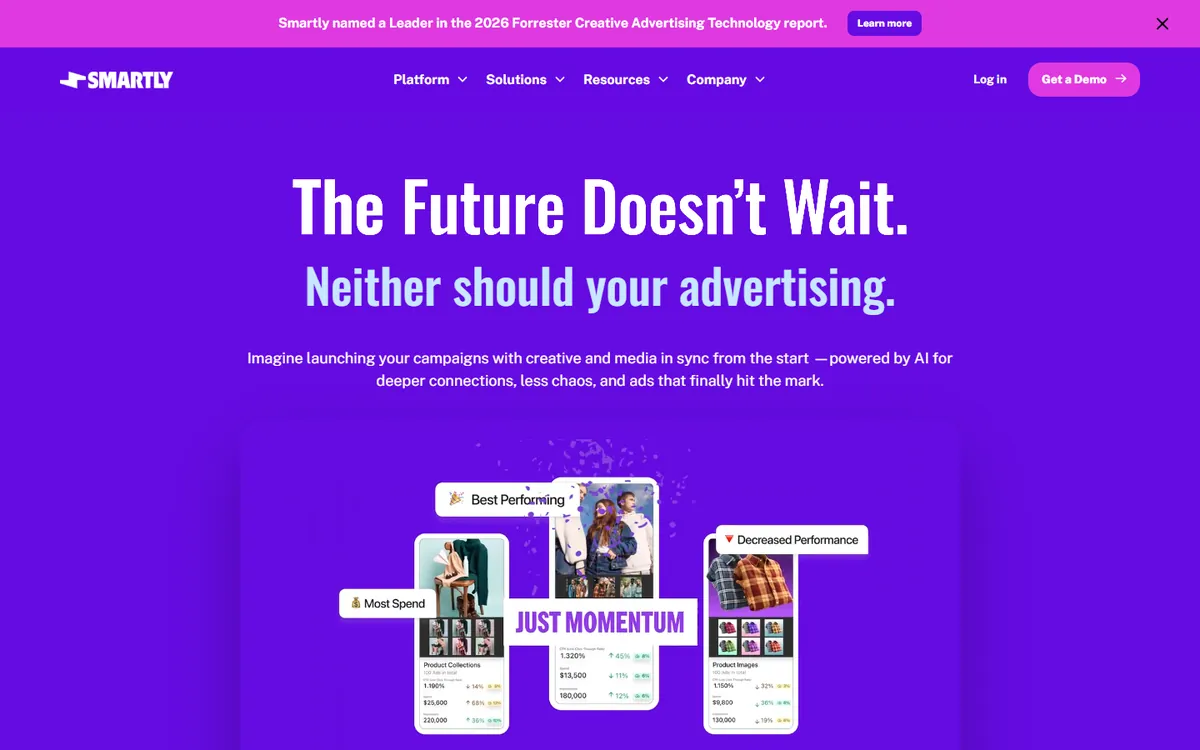
Smartly.io runs on set-ups your team designs in advance. Blueprints tied to a product feed become campaigns, templates reshape each ad for every format, and Automated Ads keeps ads in step with a synced sheet or feed, creating, updating and archiving them, while teammates approve ads in a shared space before launch.
Its buyers are enterprise brands and agencies with big creative teams. There are no published plans to compare: terms are set in a contract after a demo, so scope and price are agreed with its team.
- Best for
- Enterprise teams turning product feeds and templates into ads
- Starting price
- by quote
- Free trial
- We saw no free plan or trial on its pages. Its site asks you to book a demo.
How it scores
- Yes.Rules and automationTriggers switch ads on or off by performance, weather or time of day, and budget moves between selected campaigns by predicted performance.
- No.AI actions and agentsBudget moves between campaigns by predicted performance, run from the blueprints and triggers you set.
- Yes.Bulk launching adsBulk campaign creation for Meta, and hundreds of campaigns launched at once from feeds.
- Yes.Video adsAI video assembly, image-to-video animation and video templates with AI voiceovers.
- Yes.Alerts on your ad accountTriggers can email you when conditions are met, such as ad sets not spending; catalog alerts too.
- Yes.Ad platforms coveredIts product pages name Meta, TikTok, Snapchat, Pinterest and YouTube. It describes itself as cross-channel; check with its team for the full list.
Pros
- AI Studio generates and edits images, and templates resize them for each placement
- Breaks ads into content, CTAs and visuals and shows which ones move your KPIs
- Predicts how a creative will perform before you spend on it
Cons
- Every move follows triggers you configured; an AI that proposes fixes isn't on its pages
- Your AI assistant stays outside: its docs and product pages describe no connector
Madgicx vs Smartly.io · Prices checked 23 November 2026
Optmyzr
8.9/10
Optmyzr is a PPC suite that grew out of Google Ads: you set rules, reports and optimizations once and they run on their schedule, while its AI Sidekick fields questions about your accounts. For Meta, every plan includes its social tools, and Premium adds a Social Campaign Manager for portfolios of accounts.
It suits PPC specialists and agencies with many Google Ads accounts who want Meta in the same place. Prices follow monthly ad spend in euro brackets, with 30% off for annual billing. Essentials stops at 25 ad accounts, Premium has no account limit and the full Sidekick, and Enterprise brings API access plus a dedicated account manager.
- Best for
- Google Ads teams adding Meta rules, alerts and reports
- Starting price
- from €209 a month, billed annually
- Free trial
- A 14-day free trial on Essentials and Premium, according to its pricing page.
How it scores
- Yes.Rules and automationA Rule Engine runs weekly or monthly on Essentials, daily on Premium and hourly on request on Enterprise. Its pricing page also lists a Social Rule Engine.
- Yes.AI actions and agentsAn AI Sidekick assistant, limited on Essentials and full on Premium and Enterprise, plus AI performance summaries and account insights.
- Partly.Bulk launching adsCreates Meta campaigns in bulk across a portfolio's accounts, on the Premium and Enterprise plans.
- No.Video adsWe saw no video ad generation on its pages; its AI writes ad text.
- Yes.Alerts on your ad accountEmail alerts when Meta CPA, CTR, ROAS or spend cross thresholds you set, plus AI spend pacing.
- Yes.Ad platforms coveredGoogle Ads is the core platform. Its pages also list Meta, LinkedIn, Microsoft Ads and Amazon Ads, and say Meta and LinkedIn tools come with every plan.
Pros
- Changes budgets, bids and statuses across many Meta campaigns in a few clicks
- Sorts Meta ads by the creative behind them and compares creative types
- Daily report delivery on Premium, plus Social Reports for Meta
Cons
- Its MCP reads Meta data for Claude or ChatGPT, but the only changes it applies are keyword edits
- Its AI writes ad text; making image or video ads isn't among its listed features
Optmyzr alternatives, compared · Prices checked 23 November 2026
Bïrch
8.8/10
Bïrch, the rule engine formerly called Revealbot, does exactly what you write: once published, a rule fires by itself each time its conditions hold. Rules can also start as AI drafts you review before publishing. Its chat asks before each action unless you change that default, and anything Bïrch AI creates starts paused.
It is made for seasoned media buyers and agencies who want every condition in their own hands, app teams that also buy on TikTok and Snapchat among them. Rules are not on the entry plan; they come with Pro at $99 a month. Both plans are priced on your combined ad spend across connected platforms, an extra fee applies past a plan's limit, and Enterprise drops spend limits and overage fees.
- Best for
- Writing your own rules for Meta, TikTok, Snapchat and Google Ads
- Starting price
- from $49 a month
- Free trial
- A 14-day free trial with all features. We saw no free plan.
How it scores
- Yes.Rules and automationRules with nested conditions that pause or start campaigns, change budgets and bids and send alerts, checked as often as every 15 minutes, plus a library of ready-made strategies.
- Partly.AI actions and agentsBïrch AI reads performance and, with Meta MCP connected, edits ads or builds paused campaigns when you ask.
- Yes.Bulk launching adsStage launches ads in bulk from Google Drive and Sheets across many Meta, TikTok and Snapchat accounts.
- No.Video adsWe saw no video ad generation on its pages; it builds ads from your own media.
- Yes.Alerts on your ad accountCustomizable Slack and email alerts on your campaigns, and rules that send alerts when conditions are met.
- Yes.Ad platforms coveredRules run on Meta, Google Ads, TikTok and Snapchat. The bulk ad builder covers Meta, TikTok and Snapchat.
Pros
- Ready-made reports show which ads are climbing and which are slipping
- Reports across platforms, and scheduled reports for clients
- Its chat looks up rival ads in Meta's Ad Library once Meta's connector is linked
Cons
- New app creatives must come from your team; image and video ad making isn't shown on its pages
- Its reports rank whole ads; analysis of which creative elements win isn't described
Madgicx vs Bïrch · Prices checked 23 November 2026
FabFunnel
8.6/10
FabFunnel covers the whole loop in one place. Genie, its AI, turns your catalogue into ads, the Bulk Launcher spreads them into campaigns across your ad accounts, and once the ads are live, the rules you set handle budget and on/off calls by themselves.
Its users range from media buyers and affiliate marketers to ecommerce brands and agencies. Rules and launching need Explore ($199 a month, one launch ad account, 5 rules) or Growth ($349, five accounts, 10 rules); the FAB AI entry plan is for research and creative only, and yearly billing cuts each price.
- Best for
- Making, launching and rule-tuning ads in one plan
- Starting price
- from $39 a month
- Free trial
- Explore, Growth and Scale include a 7-day trial with 30 credits, charged from day 8. The $39 FAB AI plan has no trial.
How it scores
- Yes.Rules and automationIts rules change budgets and turn campaigns or ad sets on or off based on ROAS, CPA, CTR and spend, checked as often as every 10 minutes.
- No.AI actions and agentsIts Genie generates creatives; we saw no AI media buyer on its pages.
- Yes.Bulk launching adsIts Bulk Launcher builds campaigns, ad sets and ads across ad accounts and multiplies creatives, audiences and copy, for example 3 x 3 x 3 = 27 ads.
- Yes.Video adsGenie makes UGC, Reel and Demo video ads of 8 to 60 seconds, or turns your script into video.
- Yes.Alerts on your ad accountRules post to Slack when a condition fires, such as spend crossing your limit; Telegram too, on Explore and up.
- Partly.Ad platforms coveredIt launches on Meta, TikTok and NewsBreak. Google, Snapchat, OpenAI Ads and BIGO appear in reporting only.
Pros
- One brief becomes static, carousel and story image ads in five sizes
- Video Sage breaks your video ads down into hooks and scenes
- Connects trackers such as Voluum, RedTrack, ClickFlare and Everflow
Cons
- Account reviews stay with you: an AI that proposes budget or bid fixes isn't on its pages
- Campaigns aren't built from a chat; its MCP reads reports and makes creatives
FabFunnel alternatives, compared · Prices checked 23 November 2026
GoMarble
8.3/10
GoMarble's agents study your ad and analytics data together, explain why a result moved and propose the fix. Its site states that nothing changes until you say yes, and its higher plans keep an audit trail and let a team set approval policies for who signs off on what.
In-house growth teams and agencies with several accounts and data sources are its audience, and the plan decides how far the agents may go. Copilot, the entry plan, keeps them read-only and covers 5 accounts and up to $50K a month in spend; Operator, at $399, adds approved writes and campaign launches for 15 accounts and up to $500K; Scale, at $799, reaches $1.5M. Credits, accounts and seats can be added on.
- Best for
- Agents that read Meta, Google and TikTok data and wait for your yes
- Starting price
- from $139 a month
- Free trial
- A 7-day trial on each paid plan. Its FAQ also describes a free option with 100 one-time AI credits, but that option is not in the plan table.
How it scores
- Partly.Rules and automationAgents run continuously and can flag changes such as creative fatigue in Slack. We saw no rule builder described on its pages.
- Yes.AI actions and agentsA team of specialist agents scans campaigns, creatives, audiences and search terms, and prepares account changes for approval. It can also be used from Claude and ChatGPT through a connector.
- Partly.Bulk launching adsLaunches ads, ad sets and campaigns in bulk on the Operator plan and up, after your approval.
- No.Video adsWe saw no video ad generation on its pages. It analyzes video ads frame by frame.
- Yes.Alerts on your ad accountMonitoring agents flag issues such as creative fatigue; Slack alerts start on the Operator plan.
- Yes.Ad platforms coveredMeta, Google, TikTok and Microsoft Ads, plus GA4, Shopify and Klaviyo, with 80+ more connectors listed.
Pros
- Creative Analytics ties hooks, formats and visuals to results and catches fatigue
- Every paid plan sends scheduled reports to your team or clients
- Writes the ad copy when it launches ads from creatives you already have
Cons
- Limits you'd set as rules have no builder on its pages; its agents choose what to flag
- No ad generation on its pages: it studies your videos frame by frame and writes briefs
GoMarble alternatives, compared · Prices checked 23 November 2026
AdManage
8.3/10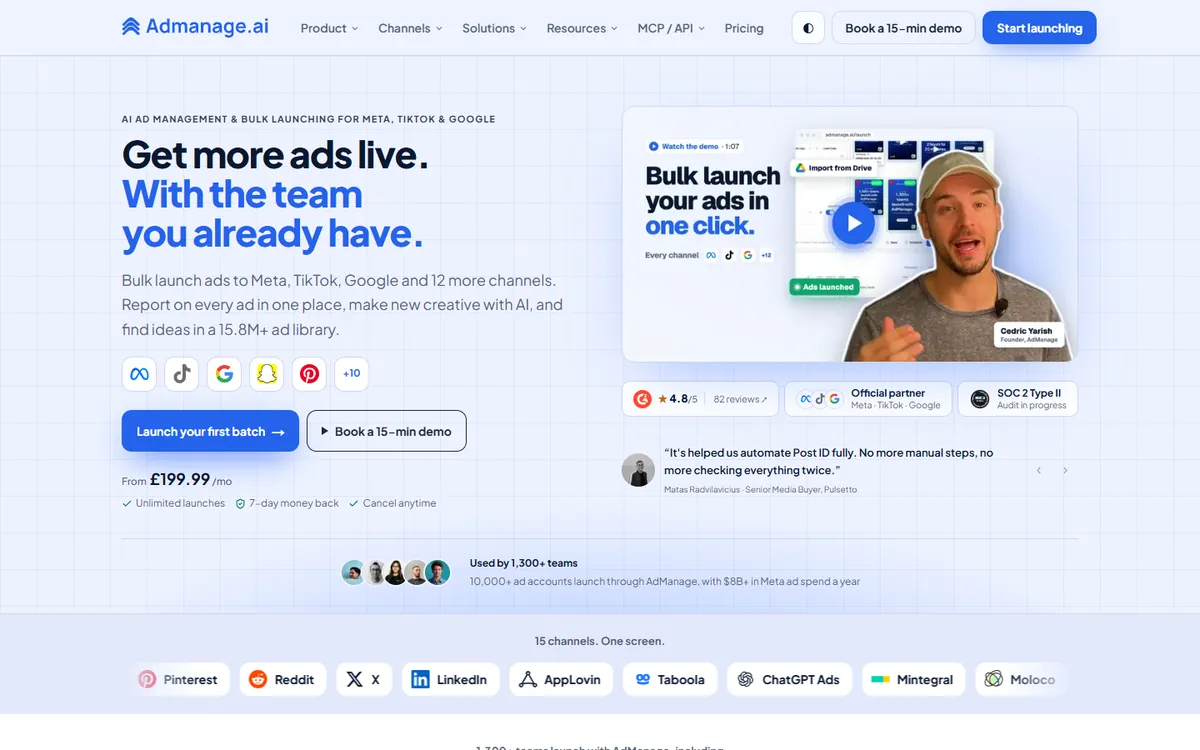
AdManage works batch by batch: you set naming, copy and UTMs once, bring creatives from your storage tools and send the batch to the networks you pick. On Meta it launches into ad sets you already have or copies of them, elsewhere it builds the campaign, and once you switch on write access, its MCP lets Claude, ChatGPT or Cursor fetch reports and draft, launch or edit ads.
For app marketers its network list stands out: besides Meta, TikTok and Google, its pricing page names AppLovin, Mintegral, Moloco, Unity and Apple Ads among its 15 channels. Pricing is in GBP and scales with ad accounts: In-house at £499.99 a month covers five, Agency at £999.99 covers ten, and Enterprise is custom.
- Best for
- Batch launches to Meta, TikTok, Google and app ad networks
- Starting price
- from £199.99 a month
- Free trial
- We saw no free plan or free trial on its pricing page. It offers a 7-day money-back guarantee on Essential and 30 days on the larger plans.
How it scores
- Partly.Rules and automationRules can pause weak ads, scale strong ones and hide comments. Essential includes 1 monitoring or comments rule; performance automations start on In-house with 10 rules; Agency has unlimited.
- No.AI actions and agentsIt is a bulk launch tool; we saw no AI media buyer on its pages.
- Yes.Bulk launching adsIts home page says it bulk launches ads to Meta, TikTok, Google and 12 more channels, pulling creatives from Google Drive, Dropbox, Frame.io, Canva or Google Sheets.
- Yes.Video adsTurns product images or a text prompt into video ads with AI video models, using credits.
- Yes.Alerts on your ad accountSlack alerts when an ad crosses CPA, ROAS, CTR or other thresholds you set.
- Yes.Ad platforms coveredIts pricing page lists 15 platforms, including Meta, TikTok, Google, Snapchat, Pinterest, Reddit, X and LinkedIn.
Pros
- Bulk-edit live ads by the hundred: status, budget, copy and URL in one pass
- Hit-rate and fatigue reports compare creatives across Meta, TikTok and Google
- Clients approve from a preview link before anything goes live
Cons
- Judgment stays with you, since its pages show no AI media buyer
- Performance rules begin on In-house; the entry plan's one rule covers monitoring or comments
AdManage alternatives, compared · Prices checked 23 November 2026
AdEspresso by Hootsuite
7.5/10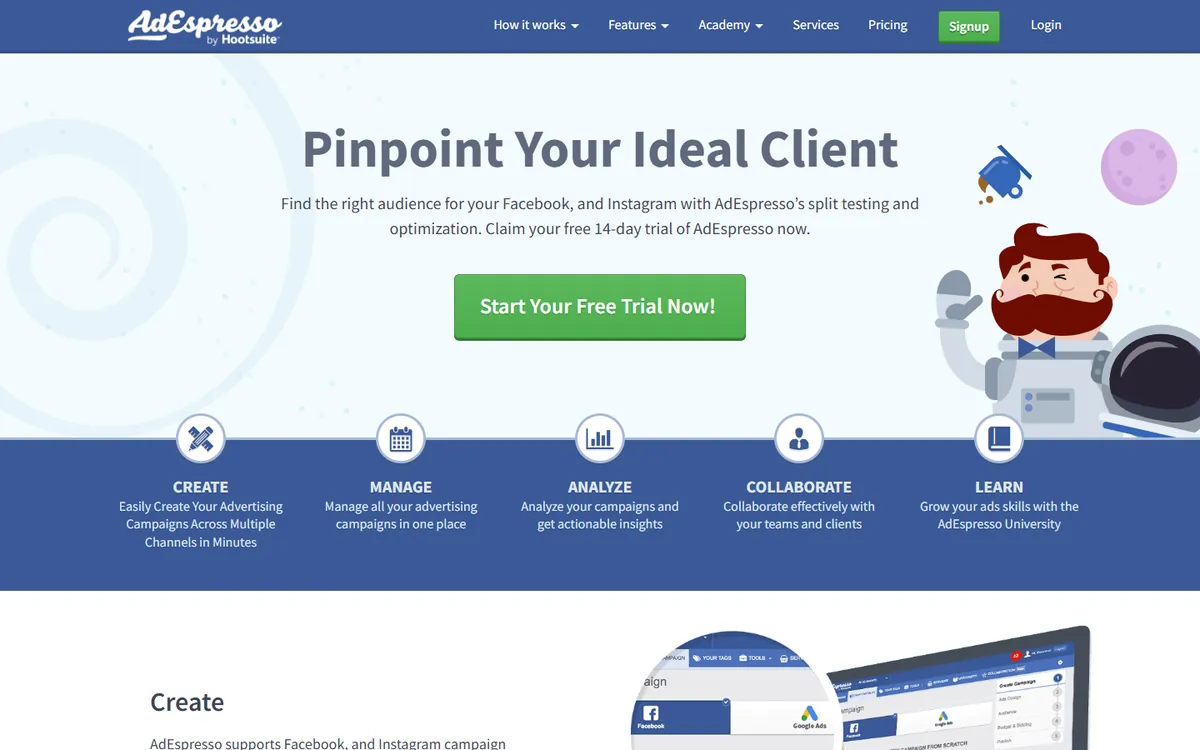
AdEspresso by Hootsuite keeps campaign building in your hands: you put together each Facebook and Instagram campaign, design split tests of headlines, images and audiences, and decide which automations run. Plus and Enterprise add an approval step, so a teammate or client can sign off before a campaign goes out.
Agencies and small teams that prefer building each ad by hand are its core users. Starter covers monthly ad spend up to $1,000. The $99 Plus plan has no spend cap and adds bulk creation plus room for 15 seats, and Enterprise, from $259, lifts the seat limit and comes with API access and a dedicated Facebook marketing consultant.
- Best for
- Hand-built Facebook and Instagram campaigns with split tests
- Starting price
- from $49 a month
- Free trial
- A 14-day free trial on all three plans. We saw no free plan.
How it scores
- Yes.Rules and automationAn optimizer pauses the costliest ads and moves budget to the best ones, and triggers on cost per acquisition, conversions and return on investment change budgets, pause ads or start campaigns.
- No.AI actions and agentsWe saw no AI assistant, chat or AI ad generation on its pricing page, tour pages or home page.
- Yes.Bulk launching adsCreates hundreds of Facebook and Instagram ads at once, and Grid Composer builds ads from a spreadsheet.
- No.Video adsWe saw no video ad generation on its pages.
- No.Alerts on your ad accountWe saw no alerts on ad results on its pages; its dashboard shows tips and suggested next steps.
- Partly.Ad platforms coveredFacebook and Instagram campaigns, which its pricing page lists as the plans' scope.
Pros
- Split-test analysis is included from the entry plan up
- Edit every ad that shares a change in one pass with Bulk update
- Drag-and-drop PDF reports with a drill-down for each ad
Cons
- No AI suggests the next move: its tour and pricing pages show no assistant or chat
- If installs stall, you find out in the dashboard; alerts on results aren't listed
Madgicx vs AdEspresso by Hootsuite · Prices checked 23 November 2026
Adkit
7.3/10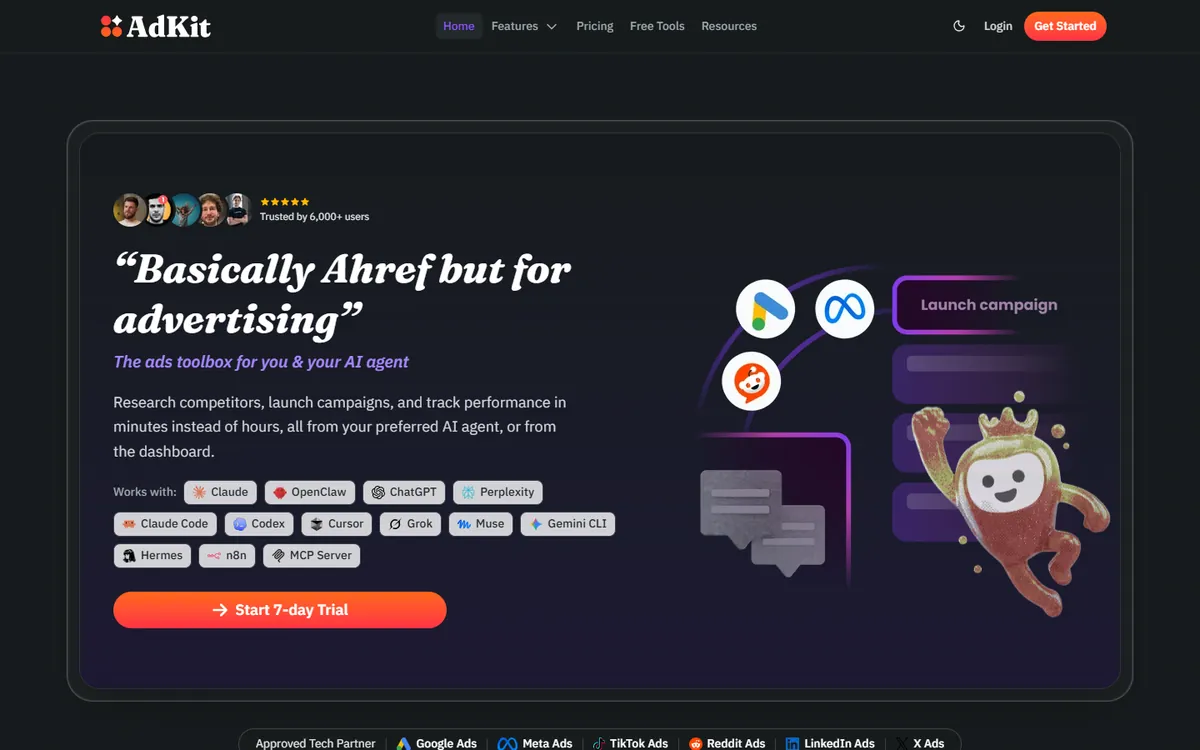
Adkit equips the AI agent you already use. Claude, ChatGPT or Cursor gets into your ad accounts through Adkit's MCP server or its command line, and whatever the agent does there, from new campaigns to paused ads and shifted budgets, sits as a draft in Adkit's dashboard and goes no further until you approve it.
Freelancers and agencies juggling several brands get the most from it. Its cheaper plan, Single Project, caps you at one project and one ad account per ad network; Multiple Projects ($49) has neither cap, and a yearly toggle advertises 30% or more off without showing yearly prices.
- Best for
- Agent-run ads for freelancers, with every change parked as a draft
- Starting price
- from $29 a month
- Free trial
- A 7-day free trial on both plans. We saw no free plan.
How it scores
- No.Rules and automationWe saw no rule-based automation on its pages. It lists activity alerts and a weekly competitor digest.
- Yes.AI actions and agentsIts MCP server and CLI let agents such as Claude, ChatGPT and Cursor run your ads. Every change is saved as a draft and nothing goes live until you approve it.
- Partly.Bulk launching adsIts agent drafts several campaigns or ads from one message; we saw no dedicated bulk launcher.
- No.Video adsWe saw no video ad generation on its pages; it writes briefs for video contractors.
- No.Alerts on your ad accountWe saw no alerts on your own ad results; its Activity Alerts flag new competitor campaigns.
- Yes.Ad platforms coveredIts pricing page lists Meta, Google, TikTok, Reddit, LinkedIn, X and Microsoft Ads.
Pros
- One prompt can rework budgets on every campaign below 1.5 ROAS, held as drafts
- AI static ads, started from a blank brief or a competitor's ad
- A 1M+ ad library with competitor tracking and a swipe file
Cons
- A spike in cost per install triggers nothing by itself; automation rules aren't listed
- Its alerts follow rival launches; a dip in your own installs isn't flagged on its pages
Adkit alternatives, compared · Prices checked 23 November 2026
Albert.ai
7.3/10
Albert.ai takes goals and limits rather than tasks: you set them, and working in the ad accounts you already have, its AI makes the budget, bid, audience and creative rotation changes that move results toward them.
It is aimed at large brands and agencies that buy through sales. There are no plans to pick from: an estimate form asks which yearly ad budget band you are in, the smallest being $100k to $500k and the largest over $10M, and its FAQ says a typical engagement opens with a three-month proof of concept.
- Best for
- Large cross-channel budgets steered toward one goal
- Starting price
- by custom quote
- Free trial
- Its pricing page mentions no free plan or trial, only a form to request an estimate.
How it scores
- Not described.Rules and automationIts home page describes self-optimizing campaign management toward your goals. We saw no rule builder described.
- Yes.AI actions and agentsIts site describes self-optimizing campaign design and management that shifts spend between audience segments as performance changes.
- Partly.Bulk launching adsIts AI builds campaigns, ad sets and ad variations from the assets you supply; we saw no bulk upload tool.
- No.Video adsWe saw no video ad generation; its FAQ says Albert does not develop your creatives.
- No.Alerts on your ad accountWe saw no alerts on its pages; its AI makes changes on its own within the guardrails you set.
- Yes.Ad platforms coveredIts home page shows Bing, Instagram, Facebook, YouTube, TikTok and DV360, and says it covers 90% of the biddable universe.
Pros
- Checks creative elements separately and flags ads that need a refresh
- Weekly, monthly, quarterly and wrap-up campaign reports
- Steers creative rotation toward the ads that perform
Cons
- Its website leaves open whether you review a change before it runs
- App creatives and copy stay in-house: its FAQ says it develops neither
Albert.ai alternatives, compared · Prices checked 23 November 2026
Blip
7.2/10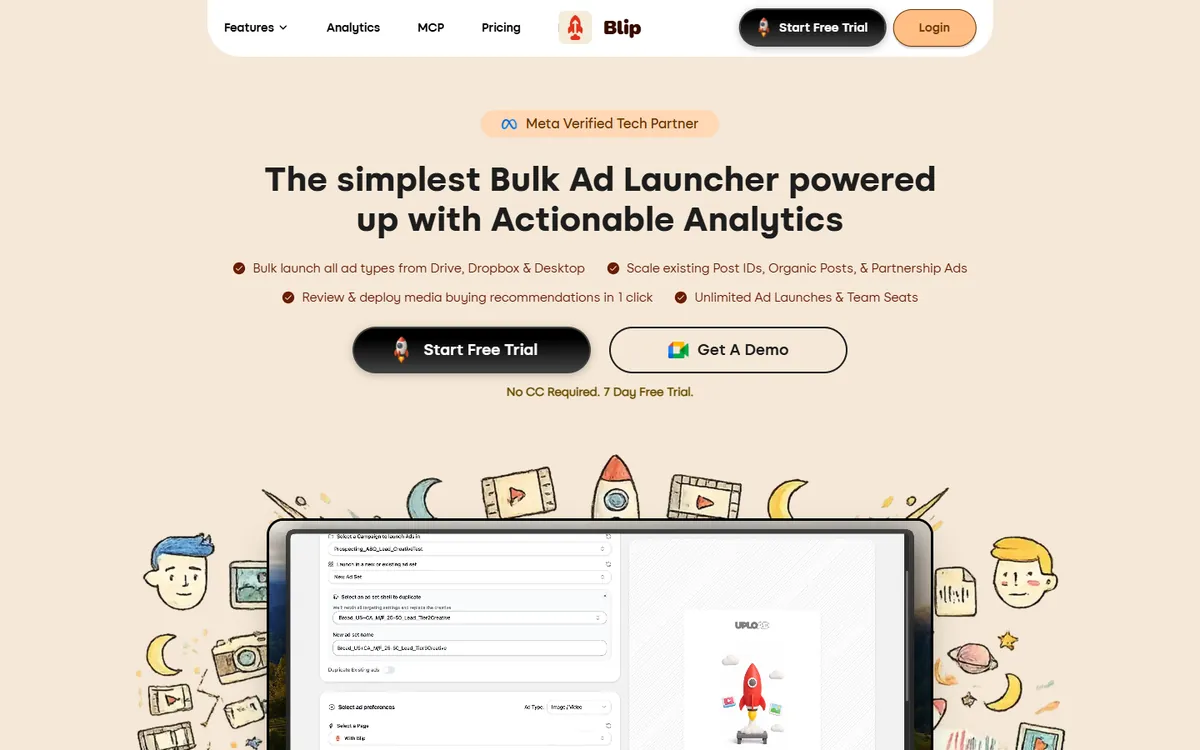
Blip is a launcher with a thin layer of analysis on top. Creatives come in from Drive, Dropbox or your desktop, saved templates fill in copy, CTAs and links, and the batch goes into ad sets that already exist. Afterwards it picks out poor performers among ads that have run 14 days or more, and every budget move it suggests is yours to apply.
Its natural users are media buyers and small agencies running mostly Meta and TikTok who want a short setup. Since every plan allows unlimited launches, ad accounts drive the price: Light at $199 a month covers up to five, and Pro at $370 has no cap.
- Best for
- Fast launches into Meta and TikTok ad sets you already run
- Starting price
- from $49 a month
- Free trial
- Its home page says all plans include a 7-day free trial.
How it scores
- No.Rules and automationWe saw no configurable rules on its pages. It describes budget recommendations and anomaly alerts, and you apply the changes yourself.
- Partly.AI actions and agentsIt suggests budgets to scale, reduce or pause, and you apply them in one click.
- Yes.Bulk launching adsIts home page says you can bulk launch all ad types from Drive, Dropbox and desktop, and scale existing Post IDs, organic posts and partnership ads.
- No.Video adsWe saw no video ad generation on its pages; you upload your own media.
- Yes.Alerts on your ad accountFlags sudden CPA spikes and overspend, with alerts and recommendations in Slack.
- Partly.Ad platforms coveredIts home page says it launches on Meta and TikTok.
Pros
- Sorts assets by aspect ratio for each placement before launch
- Clients sign off through preview links with comments and PDF export
- Claude or ChatGPT can launch ads and pause poor performers through its MCP
Cons
- It flags overspend but won't cut budget itself; configurable rules aren't on its pages
- App videos come from your team; its pages list no video ad creation
Blip alternatives, compared · Prices checked 23 November 2026
Rule engines, agents or launchers: how do these twelve tools work?
Read the cards by how each tool works, not by its feature list. A rule engine, an AI agent and a launcher all automate, but each one hands you a different job: writing conditions, approving proposals or deciding what to launch.
Rule engines: conditions you write, acted on without asking
A rule is an if-then instruction you write once: if cost per install passes your limit for a day, pause the ad set; if ROAS holds above target, add budget. Optmyzr (8.9/10) runs its Rule Engine anywhere from weekly to hourly depending on the plan, with a Social Rule Engine for Meta. Bïrch (8.8/10) evaluates rules with nested conditions at intervals as short as 15 minutes, on Meta, Google Ads, TikTok and Snapchat. FabFunnel (8.6/10) runs budget and on/off rules on ROAS, CPA, CTR and spend every 10 minutes, and AdEspresso by Hootsuite (7.5/10) pauses the costliest ads in an account and shifts budget on cost per acquisition and return on investment. Rules are predictable, but they only catch what you thought to write.
AI agents: the AI reads the account and prepares the change
Here the AI does the reading and proposes or drafts the change, and a person signs off. GoMarble (8.3/10) has specialist agents covering Meta, Google, TikTok and Microsoft Ads, and on its Operator plan and above they write changes once you approve. Adkit (7.3/10) lets your own AI agent work on your accounts and keeps every change as a draft, and Markifact (9.1/10) carries out tasks you describe in plain words across 14 ad platforms. If the idea is new to you, our answer on agentic Meta ads follows one agent task from start to finish.
Launchers: many ads out at once
A launcher saves the hours spent building ads one by one. AdManage (8.3/10) pushes batches to 15 networks, AppLovin, Mintegral, Moloco, Unity and Apple Ads among them, which matters if your app buys installs there too. Blip (7.2/10) sends ads into Meta and TikTok ad sets you already run, with unlimited launches on every plan, and FabFunnel's Bulk Launcher pairs every creative with every audience and copy line, so three of each become 27 ads. Launchers act when you press launch; what happens to the ads afterwards is up to your rules or your own checks.
Enterprise systems you configure once
Smartly.io (8.9/10) generates campaigns from blueprints linked to a product feed and runs triggers on performance, weather or time of day. Albert.ai (7.3/10) steers budgets, bids, audiences and creative rotation toward the goals you set, across search, social and video. Both start with a demo or an estimate request rather than a self-serve sign-up.
Where Madgicx fits
Madgicx combines the first two kinds for Meta. Rules handle the moves you always want made, agents run on a schedule for an ad account and send you an email summary after every run, and the AI media buyer lines up changes for your approval. When the account needs something new, its AI chat builds campaigns, ad sets and ads, each created only after you approve it.
What should the best Facebook ads automation tools do for you?
Facebook ads automation is software doing the repeat work in a Meta ad account while nobody sits in Ads Manager: pausing an ad set when cost per install or cost per purchase climbs, moving budget toward what works, launching new creatives in batches and raising a flag when results drift. In our scoring, Madgicx comes first with 9.6/10: its rules act the moment their conditions are met, its agents email a summary of each scheduled run, and its AI media buyer readies changes for your approval.
We scored twelve tools on six jobs. Rules act on conditions you write. AI actions and agents review the account and prepare or make changes. Bulk launching pushes many ads out at once. Video ads count because an app campaign on Meta can hold up to 50 creatives, and keeping it stocked with fresh video is often the slowest part of the job. Alerts warn you when results drift from your targets, and platform coverage matters to teams that buy installs or sales on more than one network.
If you market an app, the same six jobs apply with a twist. Meta's Advantage+ app campaigns already let its AI set bidding, audiences and placements, so the useful automation sits around the campaign: which campaigns keep their budget, which creatives go in next and what to do when iOS results come back with less detail. The sections below cover Meta's own tools, the limits specific to app campaigns, plans, control and which tool fits which team.
Which automation comes with your Meta ad account?
Before you pay for a tool, know what Meta's own automation already does in the same account, because every tool here works on top of it. For each part: what Meta says it does, the limits Meta states, and the gap left for a tool.
Advantage+ app campaigns
An app promotion campaign in Ads Manager now opens in the Advantage+ setup, with Meta's AI applied across the whole campaign. Meta says Advantage+ app campaigns use its AI to optimize bidding, audiences and placements, and that they can use up to 50 creatives with the mix of ad formats that works for your audience. Meta's developer docs describe the setup as an updated, simplified form of the earlier Advantage+ shopping and app campaigns, which can no longer be created through the API from version 25.0, and manual campaign features remain available. A full walk-through of Advantage+ covers the sales and leads versions too.
Where Meta says it stops: its help page for Advantage+ app campaigns, written for the earlier version, lists operating system, country and language as the only targeting options, applies a 90-day exclusion window automatically and says you can't exclude specific audiences from these campaigns (exclusions go in Advertising settings instead). Tighten budget, audience or placement settings too far and that section drops out of Advantage+, and special ad category campaigns may miss some Advantage+ features.
What a tool adds: Meta's AI works inside each campaign. Which app campaigns deserve more budget, which creatives replace tired ones and when to stop a campaign that isn't earning its installs stay with you, or with rules and an AI that prepares those calls for your approval.
Advantage+ campaign budget
Set one budget at campaign level and Meta keeps reallocating it, in real time, toward the ad sets where it sees the best opportunities; a minimum and maximum per ad set cap the swing. Expect uneven spend across ad sets, use at least two, and keep the budget type, bid strategy and standard delivery the same in each, as Meta requires. It balances spend within one campaign; moving money from one campaign to another is a separate job for you, a rule or an AI media buyer.
Automated rules in Ads Manager
Ads Manager's own rules watch the campaigns, ad sets or ads you pick and, once every condition in a rule is true, switch them on or off, change a daily or lifetime budget, move or scale a manual bid, or simply notify you or a teammate. Rules run at least every 30 minutes unless you set specific days and times, and an account has room for 250 of them, counting the inactive ones.
Meta's stated limits: no condition can appear twice in one rule, and a rule stays on one level, never campaigns and ad sets together. Rules can't act on social issue, election or political ads or pause reservation campaigns, bid changes need manual bids, and the person subscribed to a rule must be an ad account admin with full control of the business portfolio. Meta still advises watching overall performance yourself. Our guide to the parts of an automated rule shows how to judge one before you switch it on.
Opportunity score and auto-applied recommendations
Opportunity score is a number from 0 to 100 that rises as you apply Ads Manager's recommendations, which Meta ranks by expected impact. They span budget and bidding, creative and placements, audience, signals and more, and with auto-apply switched on in Account Overview, the kinds you choose are applied as they appear. Meta is clear that the score is not a measure of actual or future results and can lag behind your changes, so treat it as a list of Meta's suggestions rather than a performance number.
Meta AI business assistant
Inside Ads Manager, Meta's AI business assistant reviews campaigns, sets your cost per result, click-through rate and ROAS against industry benchmarks, and offers recommendations you can edit, drop or apply. Meta labels it a beta that may not be available to every account yet and says its suggestions don't guarantee results. It advises; applying a change is still a step you take.
Meta's ads AI connectors
On 29 April 2026, Meta released its ads AI connectors in open beta. At their core is a Meta-hosted MCP server that any MCP-compatible agent can use, and Meta's setup pages cover Claude Code and ChatGPT. An agent connected this way can build and edit campaigns, ad sets and ads; anything it creates starts paused, and your AI client asks before switching it on. A 16 July 2026 update lets admins decide, per ad account, which actions agents may take, such as budget edits or new campaigns, but Meta lists those agent rules as limited availability and notes that some tools may not have reached your account yet.
What an automation tool adds
All of this is part of your Meta ad account; Meta bills you for the ads you run, at a spend level you pick. What you pay a tool for is the work left over: rules that keep acting on your own conditions, alerts on your own targets, agents that run on a schedule, a steady supply of new image and video ads, and an AI that lines up the next change for your approval. Madgicx adds that layer for Meta, and Madgicx vs Meta Ads Manager lists the differences one by one.
What changes when the campaign promotes an app?
App campaigns run in the same Ads Manager, but three things change how much you can automate: Meta's AI makes more of the in-campaign decisions, the creatives you feed in become the main lever you control, and iOS results come back with less detail. Here is what each one means for rules, agents and the tool you pick. For campaign setup from the ground up, see our guide to Facebook ads for mobile apps.
Meta's AI already sets bids, audiences and placements
In an Advantage+ app campaign, bidding, audiences and placements are Meta's job, and Meta's older help page lists only a few targeting settings, such as operating system, country and language. Automation therefore moves up a level: which campaigns keep running, how much each one gets, and when a campaign has spent enough without installs to stop. Those calls suit rules, which act the moment a limit is crossed, and an AI media buyer that prepares budget and pause actions for your approval.
The creatives you feed in are the lever you control
With room for up to 50 creatives in one campaign and targeting mostly set by Meta, the ads you supply are where your own decisions count most. That favors tools that make ads and show which ones work. Madgicx turns a prompt, a product image or any Meta Ad Library ad into new image ads, makes video ads from your own app footage and flags creatives that are wearing out, while Smartly.io, FabFunnel and AdManage generate video ads as well.
iOS results come back with less detail
For iOS campaigns you choose Aggregated Event Measurement or Apple's SKAdNetwork as the attribution method. Meta has extended Aggregated Event Measurement to campaigns with the app promotion objective, with near real-time reporting, and is introducing that change gradually. An older Meta help page for app campaigns says SKAdNetwork campaigns show delivery information for reach, impressions, clicks and spend, and Meta notes that Aggregated Event Measurement doesn't currently support custom event optimization for app events. What changed with iOS 14 covers the background.
For automation, this means a rule or alert that waits for installs or in-app purchases may have little to act on in a SKAdNetwork campaign. Guard those campaigns with spend, click and impression conditions, and check results against your own app analytics before a rule or an AI moves budget.
App events reach Meta by a different route
Meta's one-click Conversions API setup is web-only, and its Conversions API Gateway is meant for advertisers whose campaigns optimize toward web events. For mobile app events sent through the Conversions API, Meta says direct integration is the only option at this time, and it adds that the Conversions API isn't a way around Apple's App Tracking Transparency rules. If part of your funnel runs on a website, the web setups apply to that part; for in-app events, plan the integration with your developers.
Rules to start with on an app campaign
These starting rules work in Meta's own automated rules or in any rule engine above. Set the numbers from your own targets, and remember that a Meta rule acts only when every condition in it is met.
- Stop spend with no installs: pause an ad set once it has spent two to three times your target cost per install without a single install.
- Cap a rising cost: lower the budget of an ad set whose cost per install stays above target for two or three days running, or pause it if the gap is large.
- Scale in steps: raise the budget of an ad set that holds below target for several days by a fixed share each time, not all at once.
- Warn before acting on iOS: on SKAdNetwork campaigns, use a notification-only rule on spend and clicks, since results may not show in Ads Manager.
- Keep the budget workable: Meta wants a daily budget of no less than 5 times any cost per result goal you set, so don't let a rule cut below that line.
For more ideas, with who each one suits, see these Meta ad automation examples.
How much do Facebook ads automation tools cost?
| Tool | Starting price | How you pay | Free trial | Prices checked |
|---|---|---|---|---|
| Madgicx | From $45/mo | Priced by monthly ad spend, from $45 a month, billed monthly, quarterly or annually. | 7-day free trial | 23 November 2026 |
| Markifact | from $79 a month | A monthly plan: Pro $79 a month for one seat, Team $249 a month, and a custom Managed plan. Credits and seats scale with the option you pick. | Its pricing page says to start free with trial credits. We saw no free plan in its plan table. | 23 November 2026 |
| Smartly.io | by quote | Quote only. Its site asks you to book a demo and lists no plans, prices or free trial. | We saw no free plan or trial on its pages. Its site asks you to book a demo. | 23 November 2026 |
| Optmyzr | from €209 a month, billed annually | Essentials and Premium plans, priced by your monthly ad spend in euros. At the lowest spend bracket (up to €25K), Essentials is €209 a month billed annually or €299 billed monthly, and Premium is €272 or €389. Enterprise is custom. | A 14-day free trial on Essentials and Premium, according to its pricing page. | 23 November 2026 |
| Bïrch | from $49 a month | A monthly plan priced by your ad spend across connected platforms: $49 or $99 a month, with Enterprise by quote. | A 14-day free trial with all features. We saw no free plan. | 23 November 2026 |
| Fab |
from $39 a month | A monthly or yearly plan, with credits for AI creative and limits on ad accounts and rules. Extra credits are sold as one-time top-ups. | Explore, Growth and Scale include a 7-day trial with 30 credits, charged from day 8. The $39 FAB AI plan has no trial. | 23 November 2026 |
| Go |
from $139 a month | Monthly plans sized by ad spend: Copilot $139, Operator $399 and Scale $799 a month, with Enterprise by quote. | A 7-day trial on each paid plan. Its FAQ also describes a free option with 100 one-time AI credits, but that option is not in the plan table. | 23 November 2026 |
| Ad |
from £199.99 a month | A monthly plan priced in GBP, from £199.99 for one ad account. Plans differ by ad accounts, AI credits and automation rules. | We saw no free plan or free trial on its pricing page. It offers a 7-day money-back guarantee on Essential and 30 days on the larger plans. | 23 November 2026 |
| Ad |
from $49 a month | A flat monthly plan: $49 up to $1,000 of ad spend, $99 with unlimited spend, and Enterprise from $259. | A 14-day free trial on all three plans. We saw no free plan. | 23 November 2026 |
| Adkit | from $29 a month | A monthly plan: Single Project $29 a month or Multiple Projects $49 a month, both with a 7-day free trial. A yearly toggle says it saves 30% or more, without yearly prices. | A 7-day free trial on both plans. We saw no free plan. | 23 November 2026 |
| Albert.ai | by custom quote | A custom quote. Its pricing page publishes no plans or prices and asks you to request an estimate. | Its pricing page mentions no free plan or trial, only a form to request an estimate. | 23 November 2026 |
| Blip | from $49 a month | A monthly plan that grows with the number of ad accounts. Ad launches are unlimited on every plan. | Its home page says all plans include a 7-day free trial. | 23 November 2026 |
Which plan unlocks the automation you need?
The table shows where each price starts. For automation, check which plan turns on rules, write access or launching, because several tools keep them above the entry plan.
- Madgicx: plans follow the monthly ad spend they cover, start at $45 a month and can be paid monthly, quarterly or yearly; the trial lasts 7 days and both MCP servers are included.
- Bïrch: rules are not part of Essential, which covers reports, alerts and workspaces; they come with Pro at $99 a month, and spending past a plan's limit adds a fee.
- FabFunnel: FAB AI ($39 a month) covers research and creative with no launching; Explore ($199) adds launching with 1 ad account and 5 rules, Growth ($349) 5 accounts and 10 rules, and Scale ($599) 15 launch accounts.
- AdManage: Essential (£199.99 a month) includes one monitoring or comments rule; performance rules start on In-house (£499.99) with 10, and Agency (£999.99) has no rule limit.
- GoMarble: Copilot ($139 a month) keeps agents read-only; Operator ($399) lets them write approved changes and launch campaigns, and Scale ($799) covers up to $1.5M of monthly spend.
- Optmyzr: Essentials runs the Rule Engine weekly or monthly, Premium daily and Enterprise hourly on request; prices follow ad spend in euros, with 30% off for annual billing.
- AdEspresso by Hootsuite: Starter ($49 a month) stops at $1,000 of monthly ad spend; Plus ($99) removes the limit and adds bulk creation and campaign approval.
- Blip: launches are unlimited on every plan, and the price follows ad accounts: $49 for one, $199 for up to five and $370 for unlimited.
- Adkit and Markifact: Adkit's $49 plan opens unlimited projects and ad accounts; Markifact's Pro ($79) already includes agents, workflows and its MCP server, and Team ($249) covers 10 to 50 seats.
- Smartly.io and Albert.ai: sold by quote; the smallest budget band on Albert.ai's estimate form is $100k to $500k a year.
Meta's own rules, Advantage+ and recommendations sit inside every ad account with no plan to choose; your cost there is the ad spend itself.
Which features does each tool cover?
| Tool | Score | Rules and automation | AI actions and agents | Bulk launching ads | Video ads | Alerts on your ad account | Ad platforms covered |
|---|---|---|---|---|---|---|---|
| Madgicx | 9.6/10 | Yes. | Yes. | Yes. | Yes. | Yes. | Partly. |
| Markifact | 9.1/10 | Partly. | Yes. | Yes. | Partly. | Yes. | Yes. |
| Smartly.io | 8.9/10 | Yes. | No. | Yes. | Yes. | Yes. | Yes. |
| Optmyzr | 8.9/10 | Yes. | Yes. | Partly. | No. | Yes. | Yes. |
| Bïrch | 8.8/10 | Yes. | Partly. | Yes. | No. | Yes. | Yes. |
| Fab |
8.6/10 | Yes. | No. | Yes. | Yes. | Yes. | Partly. |
| Go |
8.3/10 | Partly. | Yes. | Partly. | No. | Yes. | Yes. |
| Ad |
8.3/10 | Partly. | No. | Yes. | Yes. | Yes. | Yes. |
| Ad |
7.5/10 | Yes. | No. | Yes. | No. | No. | Partly. |
| Adkit | 7.3/10 | No. | Yes. | Partly. | No. | No. | Yes. |
| Albert.ai | 7.3/10 | Not described. | Yes. | Partly. | No. | No. | Yes. |
| Blip | 7.2/10 | No. | Partly. | Yes. | No. | Yes. | Partly. |
How much control do you keep once automation is on?
All twelve tools can alter a live account, so the useful question is which changes wait for you. The answers sort into three groups, and most tools belong to more than one.
Changes that wait for your approval
Each action Madgicx's AI media buyer prepares sits waiting until you approve or dismiss it, and its AI chat creates nothing until you approve the card it shows. Adkit holds every agent change as a draft, GoMarble writes only after approval and only from its Operator plan, Markifact takes approval in chat or Slack, and Blip's budget suggestions wait for your click.
Changes that run on their own once you set them up
Rules act whenever their conditions are met, in Madgicx and in Bïrch, FabFunnel, AdEspresso, Optmyzr and AdManage alike, and Smartly.io's triggers do the same. Albert.ai changes budgets, bids and audiences in pursuit of your goals, with no word on its website about reviewing them first. Write these with care: a rule doesn't know about an app release, a store sale or a tracking outage unless you build that into its conditions.
Changes made only when you ask
Bïrch's chat asks before each action by default and creates campaigns paused, AdManage's MCP stays read-only until you allow writes, Optmyzr's MCP applies only keyword changes, and launchers such as Blip and AdManage send ads out when you press launch. Madgicx agents need no request: they run on a schedule for the ad account, and each run ends with an emailed summary.
Limits Meta enforces whichever tool you use
Put Meta's own spending limits in place before any tool gets access. Meta pauses every ad once the account spending limit, a lifetime cap for the whole ad account, is reached; a campaign spending limit caps a single campaign (with Advantage+ campaign budget, the campaign's lifetime budget plays that role). A daily budget is not a hard ceiling, since Meta may spend up to 75% above it on a given day, while scheduled budget increases top out at 8 times the daily budget. If an AI agent connects through Meta's own server, the per-account agent rules, still in limited availability, decide what it may change.
How to automate a Meta ad account with Madgicx
Open a 7-day free trial and connect the Meta ad account you want automated, using a login with permission to manage it, so the AI can read results and carry out the changes you sign off. When the trial ends, your plan is set by monthly ad spend.
Set a target for each campaign, such as a cost per result, a cost per purchase or a ROAS. Madgicx alerts you when the account drifts away from those targets, and they give you a yardstick for every action you are asked to approve.
Begin with two or three: pause an ad set that spends past your limit without results, cut budget when cost per result stays above target, and raise it in steps when it stays below. A rule acts without asking, so apply each one to a single campaign first and widen the scope once it behaves.
Each recommendation arrives with a ready-to-run action. Approve the ones that fit what you know and the AI can't, such as an app release, a pricing change or a promotion next week, and turn down the others.
Schedule an agent for the ad account. Each run ends with a summary in your email; read them together in one weekly slot and check results against the targets from step 2.
When a creative tires, generate image ads from a prompt or from a competitor's ad in the Meta Ad Library, and turn your own app videos into Facebook and Instagram video ads in the AI chat. Nothing is created until you approve it.
What do automation tools still leave to you?
Automation takes over watching, pausing, shifting budget and launching. Six decisions stay yours, and each one sets the ceiling on what any tool can do for you.
The event that counts, and what a user is worth
Every tool optimizes toward the result you choose, whether that is an install, a trial start or a purchase. Which event signals a valuable user, and what you can pay for it, comes from your own retention and revenue data. The ad budget calculator sizes the budget for a goal, or shows how far a fixed budget goes, on Meta, Google Ads and other networks.
Installs you can verify
Rules and AI act on the results Meta reports. Before you let anything scale an app campaign, compare Meta's installs and in-app events with your own app analytics, and treat a gap between them as a measurement problem to fix first. No automation tool can repair events that never reach Meta.
The story your ads tell
What your app does, why someone should install it today and the screen recordings that show it still come from your team. Tools take it from there: Madgicx turns your recordings into Facebook and Instagram video ads, Smartly.io, FabFunnel and AdManage can generate video from images, scripts or prompts, and Albert.ai, by its own FAQ, works only with the creative you supply.
What may run under your name
Generated ads still need a person to read them. Meta's text tool alone can produce up to 5 versions of a headline, and no AI knows which claims your market or app store allows. Meta's generative AI features come with their own ad terms, and some verticals, special ad categories and countries don't have every feature yet, so keep new creative on approval.
Restricted categories and issue ads
If your app falls under a special ad category, or your ads touch social issues, elections or politics, expect fewer automatic options: Meta's own rules don't run on political and issue ads or pause reservation campaigns, and special ad category campaigns may miss some Advantage+ features. Before you sign, check with each vendor which of its features work for those campaigns.
The networks beyond Meta
Madgicx manages your Meta campaigns, and its reports bring Google Ads and TikTok data into the same place, so results from all three sit side by side. Changing Google or TikTok app campaigns still happens in their own ad managers, or in a tool that acts there, such as AdManage, Markifact or GoMarble.
Which questions should you ask before you buy?
- Which changes run on their own, which wait for your approval, and where you approve them.
- Which metrics its rules can use as conditions, and whether those metrics show up in your iOS campaigns.
- How often rules check the account: every 10 or 15 minutes, every 30 minutes like Meta's own, hourly or daily.
- Whether it makes new image and video ads, or only launches the ones you upload.
- Which ad networks it can act on, and which it only reports on.
- Which plan includes rules, write access or launching, since several tools keep them above the entry plan.
- How you hear about a problem: email, Slack, a summary after each run, or only the dashboard.
How did we score each tool?
We scored each tool on automation rules, AI actions and agents, bulk launching, video ads, alerts and the ad platforms it covers. Rules weigh most because a rule keeps working when nobody is watching the account, AI agents and bulk launching follow because they take the analysis and the building off your hands, and platform coverage counts because many app marketers buy on more than one network.
Every tool on this list starts at 5 out of 10. The other 5 points are split across the criteria by the shares in the table below: a tool that fully covers every criterion scores 10, and a criterion it only partly covers earns half its share.
| Capability | Share of the 5 points |
|---|---|
| Rules and automation | 25% |
| AI actions and agents | 21% |
| Bulk launching ads | 17% |
| Video ads | 13% |
| Alerts on your ad account | 8% |
| Ad platforms covered | 16% |
The Madgicx team wrote this page and scored every tool, Madgicx included, with the same rubric.
Which automation tool fits your situation?
Start from where your installs and sales come from. When most of the spend goes to Meta, Madgicx, first in our ranking with 9.6/10, is the pick; each situation below names the tool to add or compare for a specific need. For a list built around optimization for apps, see the best Facebook ad optimization platforms for mobile apps.
Your app's growth runs mainly on Meta
Pick Madgicx. Rules guard each campaign around the clock, agents run on a schedule and email a summary, the AI media buyer lines up budget and creative actions for your approval, and new image and video ads come from the same platform. Try it on one ad account during the 7-day free trial, then set a month of results against the month before it.
You buy installs on Meta, Google, TikTok and app networks
Run the Meta side in Madgicx, where reports line up Google Ads and TikTok data with Meta and the Google MCP lets Claude or ChatGPT dig into your Google Ads accounts. To launch the same creatives to AppLovin, Mintegral, Moloco, Unity or Apple Ads, AdManage covers 15 networks, and Markifact and GoMarble act on Google and TikTok as well as Meta. AdManage vs FabFunnel compares two launchers that come with rules.
You ship new creatives every week
Madgicx generates image ads from a prompt or a competitor's Ad Library ad, turns your own footage into video ads and shows which creatives are wearing out, so you know what to replace. If launch volume is the bottleneck, FabFunnel joins AI creative, a bulk launcher and rules in one plan, and Blip launches into Meta and TikTok ad sets you already run.
You want to write every rule yourself
Madgicx lets you write the rules and still has its AI media buyer look for openings no rule anticipated. For buyers who want nothing but rules, Bïrch runs rules with nested conditions on four ad platforms and checks them up to every 15 minutes, and AdEspresso pairs rules with split tests for teams that build campaigns by hand; AdEspresso vs Bïrch compares the two.
You want an AI agent, but every change approved
Madgicx's AI media buyer prepares each change for your approval, and its AI chat shows a card before it creates anything. If you would rather work from your own assistant, Adkit holds every change as a draft, and GoMarble's agents combine Meta, Google, TikTok and analytics data; Adkit vs GoMarble weighs the two approaches.
Google is your main channel, or you buy by contract
Teams whose spend sits mostly in Google Ads get Google rules plus a Meta rule engine and Meta alerts from Optmyzr. Large advertisers used to signing contracts have two other routes: Smartly.io for campaigns generated from feeds and templates, and Albert.ai for budgets pushed toward one goal across search, social and video. For the Meta part of either budget, Madgicx needs no sales call, since its 7-day free trial starts from a self-serve sign-up.
What changed for 2027
This edition scores twelve tools on six criteria. Smartly.io stays from the earlier list, and ten tools join it, from rule engines such as Bïrch to AI agents such as GoMarble and launchers such as AdManage, while six earlier picks make way for tools that automate Meta campaigns directly. Every price and plan was checked again on the tools' own sites in October and November 2026, and new sections cover Meta's built-in automation, what changes for app campaigns, plan limits and the control you keep.
So which one should you choose?
Madgicx is our top pick for automating Facebook ads, ranked first with 9.6/10: the rules you set work around the clock, its agents email you a summary after each scheduled run, its AI media buyer readies changes for your approval, and new image and video ads come from the same platform, all for Meta with a 7-day free trial. If you launch the same creatives to app networks such as AppLovin, Unity and Apple Ads, AdManage pushes batches to 15 channels. If you want to write every rule yourself across Meta, Google Ads, TikTok and Snapchat, Bïrch is the rule engine to compare.
Frequently asked questions
What is the best Facebook ads automation tool?
Madgicx is the best Facebook ads automation tool overall, ranked first here with 9.6/10. Its rules run your Meta campaigns on the conditions you write, its agents work on a schedule and report each run by email, and its AI media buyer prepares changes you approve or dismiss. Second-placed Markifact fits teams that would rather run one agent over 14 ad platforms.
Can you automate Meta app install campaigns?
Yes, in layers. Advantage+ app campaigns already use Meta's AI to optimize bidding, audiences and placements, and they can run up to 50 creatives. Rules, alerts and an AI media buyer add the decisions around the campaign: stopping spend that brings no installs, moving budget between campaigns and replacing tired creatives. In Madgicx, every action its AI prepares runs after you approve it.
How does iOS measurement affect Facebook ads automation?
For iOS app campaigns you measure with Aggregated Event Measurement or Apple's SKAdNetwork. An older Meta help page says SKAdNetwork campaigns show delivery information for reach, impressions, clicks and spend, so a rule that waits for installs may have little to act on there. Use spend and click conditions or notification-only rules on those campaigns, and check results in your own app analytics before budget moves.
Will an automation tool change my Facebook ads without asking?
Rules do, once you publish them; acting on their own is what they are for. AI tools differ: Madgicx runs each action its AI prepares only after you approve it, Adkit saves changes as drafts, GoMarble writes only after approval, and Albert.ai's website doesn't say whether you review changes first. Meta's own connector creates new items paused until your AI client confirms.
How much do Facebook ads automation tools cost?
Madgicx plans are set by monthly ad spend and begin at $45 a month, after a 7-day free trial. Among the others, Adkit begins at $29 a month, FabFunnel at $39 for creative only and $199 once launching and rules are included, Bïrch at $49 (rules from $99), Blip and AdEspresso at $49, Markifact at $79, GoMarble at $139, AdManage at £199.99 and Optmyzr from €209 billed annually. Smartly.io and Albert.ai price each deal individually, and Meta's own automation comes with your ad account.